Cellular IoT

Search documents
Omdia Forecasts Cellular IoT Connections to Reach 5.9 Billion by 2035
Businesswire· 2025-12-08 12:00
Core Insights - The cellular IoT market is projected to grow significantly, with connections expected to reach 5.9 billion by 2035, driven by the adoption of 5G technologies [1][4] Group 1: 5G RedCap Technology - 5G RedCap is identified as a transformative development in the cellular IoT landscape, with adoption expected to gain momentum starting in 2025 [2][3] - The technology serves as an optimal mid-tier connectivity solution for 5G devices that do not require advanced specifications like uRLLC or eMBB, providing futureproofing as 4G networks phase out beyond 2030 [2][3] Group 2: Automotive Segment Growth - The automotive segment is anticipated to grow from 500 million connections to approximately 1.2 billion by 2035, increasing its market share from 13% to 21% [4][5] - This growth is primarily driven by rising consumer demand for intelligent vehicles equipped with 5G connectivity, particularly in Asia & Oceania [4][5] Group 3: Market Trends and Analysis - Omdia's Cellular IoT Market Tracker 2021-2035 provides comprehensive analysis on trends in the cellular IoT market, including regional insights, air interface applications, module shipments, revenues, and connectivity revenues [6]



Shanghai Eigencomm Technologies Co., Ltd.(H0174) - Application Proof (1st submission)
2025-11-29 16:00
The Stock Exchange of Hong Kong Limited and the Securities and Futures Commission take no responsibility for the contents of this Application Proof, make no representation as to its accuracy or completeness and expressly disclaim any liability whatsoever for any loss howsoever arising from or in reliance upon the whole or any part of the contents of this Application Proof. Application Proof of Shanghai Eigencomm Technologies Co., Ltd. 上海移芯通信科技股份有限公司 (the "Company") (A joint stock company incorporated in the ...
前5家中国蜂窝物联网模组企业出货量全球占比近70%,需关注一系列新的挑战
3 6 Ke· 2025-06-16 11:44
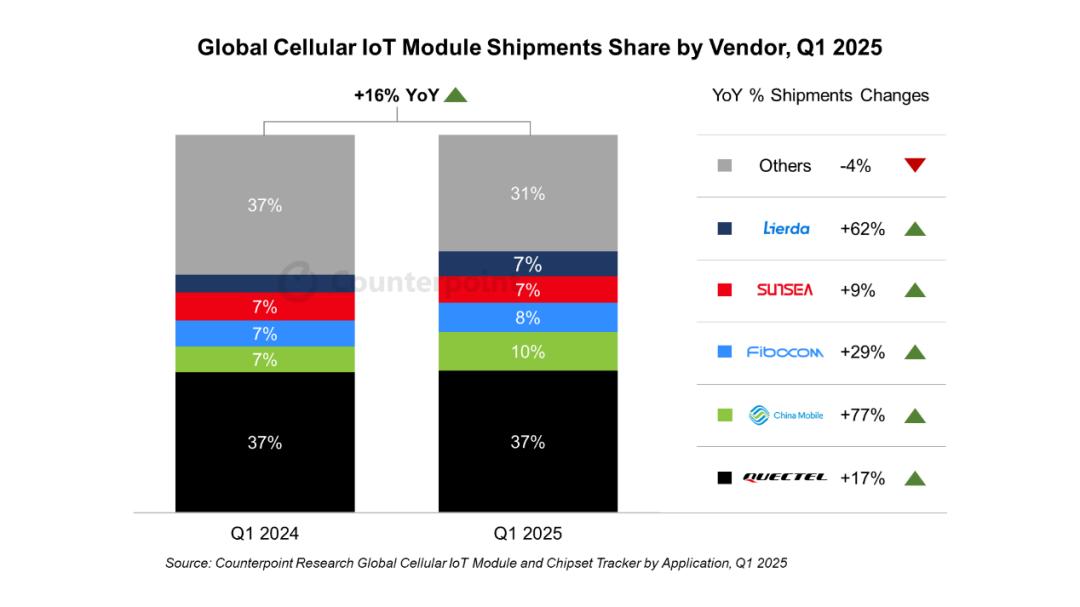
Group 1 - The core viewpoint of the article highlights the significant growth in the global cellular IoT module market, with a year-on-year shipment increase of 16% driven by strong demand from India, China, and other regions [1][10] - The top five companies in the cellular IoT module market are all Chinese firms, accounting for 69% of global shipments, indicating a high market concentration [2][10] - The leading company, Quectel, holds a substantial 37% of the global shipment share, with a year-on-year growth of 17%, slightly above the global average [5][10] Group 2 - China Mobile experienced a remarkable 77% growth in shipments, moving from a lower position to second place, surpassing Guanghetong [5][10] - Guanghetong ranked third with a shipment growth rate of 29%, while the fourth-ranked company, Rihai, had a slower growth of only 9% [5][10] - The fifth company, Lierda, showed a significant 62% growth, indicating potential for further advancement in rankings if the trend continues [5][10] Group 3 - The article notes that the market structure has remained stable, with Chinese companies dominating both shipment volume and revenue, but challenges persist for these firms in international markets [11][10] - Geopolitical factors pose significant challenges for Chinese companies seeking to expand overseas, with concerns over network security leading to increased scrutiny and regulatory hurdles [12][14] - The rapid evolution of technology presents product planning challenges for cellular IoT module companies, as they must navigate competitive pressures and potential opportunity costs [15][10] Group 4 - The need for localization in overseas markets is emphasized, as Chinese firms must adapt to local demands and regulatory environments to maintain their competitive edge [16][17] - The article suggests that while Chinese companies have captured a significant market share, sustaining high growth rates in a low-growth environment will be increasingly difficult [16][10] - Establishing a localized ecosystem and understanding market needs are crucial for Chinese firms to thrive in international markets [17][10]