
Corporate Average Fuel Economy (CAFE)

Search documents
Weekend Round-Up: Ford's Support For CAFE Rollback, BYD's Milestone, GM CEO's Credit For Musk And More
Benzinga· 2025-12-07 13:00
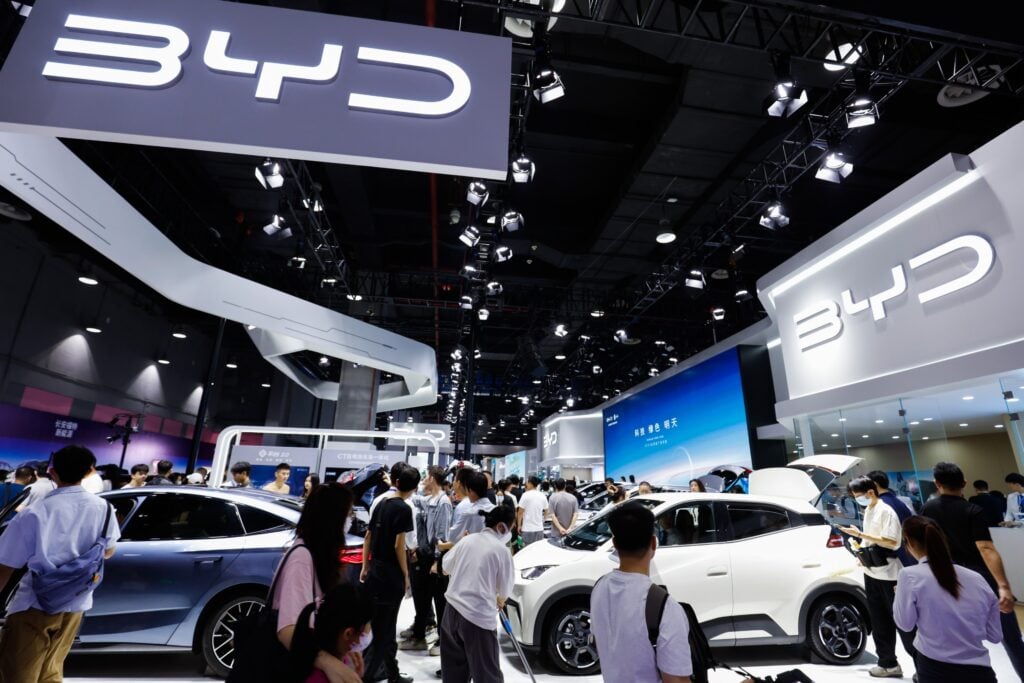
Group 1: Ford - Ford's CEO Jim Farley supports President Trump's rollback of CAFE norms, stating it will enable more investment in affordable vehicles and strengthen the American-made vehicle market [2] - In November, Ford's electric vehicle sales plummeted by 60.8% year-on-year, attributed to a fire at a key supplier and the rollback of the Federal EV Credit, although the Mustang Mach-E saw a 6.7% growth in year-to-date sales [5] Group 2: BYD - BYD has achieved another significant milestone with its electric vehicles reaching one million unit sales, intensifying competition with Tesla and solidifying its dominance in the Chinese EV market while expanding operations in Asia and Europe [4] Group 3: Uber and Waymo - Uber faces challenges from Waymo, which has expanded its market share to 10% in San Francisco, posing a significant threat to Uber's operations [6] Group 4: General Motors - GM's CEO Mary Barra credited Elon Musk and Tesla for the growth of the EV market in the U.S., acknowledging Musk's influence during a conversation with former President Joe Biden [7]

Stellantis warns this issue could destroy the European auto industry
Yahoo Finance· 2025-11-26 17:33
Core Insights - U.S. automakers are adapting to tariff burdens while benefiting from regulatory changes under the Trump administration, which have eased restrictions on emissions and fuel economy standards [1][2][3] - The elimination of penalties related to Corporate Average Fuel Economy (CAFE) rules has provided significant financial relief to automakers, particularly General Motors and Stellantis, who previously faced substantial fines [3][4][7] Regulatory Changes - The One Big Beautiful Bill Act has dismantled many Biden-era climate policies, benefiting original equipment manufacturers (OEMs) [1] - The Biden administration's emissions standards were deemed to exceed authority, leading to a reevaluation of expected electric vehicle adoption [2] Financial Implications - General Motors faced a $145.8 million penalty and forfeited $300 million in emission credits due to compliance issues, with total costs related to emission compliance reaching approximately $450 million through 2023 [5][7] - Stellantis incurred $191 million in civil penalties for failing to meet fuel economy requirements for 2019 and 2020, in addition to nearly $400 million in fines from 2016 to 2019 [7] Market Performance - U.S. market share for automakers stands at 17%, with electric vehicle sales reaching 67,000 units and an EV market share of 16.5% [8] - Dealer inventory has decreased by 16% year over year, while EV inventory has dropped by 30% since June [8] Industry Advocacy - Stellantis has supported proposals to eliminate CAFE penalties and is actively petitioning for lower emissions standards in the European Union, warning of potential industry decline if changes are not made [9][10]

Tesla, Rivian, and Lucid Will Have Their Fortunes Changed Forever Today, Sept. 30, Courtesy of President Donald Trump
The Motley Fool· 2025-09-30 07:06
Group 1: Impact of Trump's Legislation on the EV Industry - President Trump's "Big, Beautiful Bill" significantly alters the electric vehicle (EV) landscape, particularly affecting leading manufacturers like Tesla, Rivian, and Lucid [1][2] - The bill terminates the $7,500 tax credit for new EV purchases and the $4,000 credit for used EVs, which were previously available until 2032 [3][4] - This tax credit was crucial for making EVs more price-competitive against internal combustion engine (ICE) vehicles, especially given the current limitations in EV charging infrastructure [6][7] Group 2: Regulatory Changes and Financial Implications - The legislation also eliminates corporate average fuel economy (CAFE) fines, removing financial incentives for automakers to meet fuel efficiency standards [8][9] - The removal of CAFE penalties is expected to adversely affect the profitability of Tesla, Rivian, and Lucid, as it diminishes the market for automotive regulatory credits that these companies rely on [10][12] - Tesla has been generating a significant portion of its pre-tax income from selling regulatory credits, and the new law could expose the unsustainable nature of this revenue stream [11][12] Group 3: Long-term Viability of EV Manufacturers - The changes brought by Trump's bill may lead to a more challenging environment for pure-play EV manufacturers to compete with traditional ICE vehicles [14] - Rivian and Lucid, despite having substantial cash reserves and financial backing, face uncertainty regarding their long-term success as they continue to incur losses while scaling operations [13]


