Credit repair

Search documents
‘My Ex Ruined My Credit. What Do I Do?’ — a Money Expert Weighs In
Yahoo Finance· 2026-01-22 13:17
Core Insights - The article discusses the financial struggles of a consumer, Dana, who has a poor credit score due to a long-standing unpaid credit card debt from an ex-boyfriend, highlighting the importance of understanding credit history and taking proactive steps to rebuild credit [1][2]. Group 1: Understanding Credit - Many consumers mistakenly believe that having no credit is equivalent to having good credit, which is not the case [4]. - Credit is a reporting system rather than a measure of morality, and avoiding debt does not contribute positively to one's credit profile [5]. Group 2: Steps to Rebuild Credit - The first step for individuals in similar situations is to confirm what appears on their credit report to address any existing damage and rebuild credit intentionally [5]. - Proper sequencing in addressing credit issues is crucial, as fixing the wrong problem first can hinder progress [6]. - It is important to verify the status of any debt before making payments, as older debts may be past the statute of limitations for collection, and paying them could inadvertently harm the credit score [6][7].
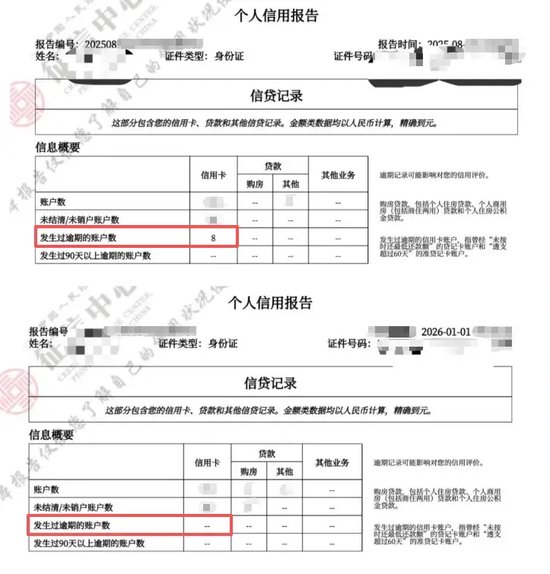
你的征信被修复了吗?央行新政落地后,贷款人晒逾期清零图
Xin Lang Cai Jing· 2026-01-05 00:56
Core Viewpoint - The People's Bank of China has implemented a one-time credit repair policy that allows eligible individuals to have overdue loan records automatically removed or reduced from their credit reports, enhancing their creditworthiness without requiring any application process [1][4][10]. Group 1: Policy Details - The one-time credit repair policy was announced on December 22, 2022, and became effective on January 1, 2026, allowing eligible overdue information to be excluded from personal credit reports [1][4]. - The policy applies to overdue information generated between January 1, 2020, and December 31, 2025, with a maximum single overdue amount of 10,000 yuan [4][8]. - Individuals must fully repay their overdue debts by March 31, 2026, to qualify for the credit repair [4][8]. Group 2: Implementation Mechanism - The credit report adjustments will occur in two scenarios: if debts are settled by November 30, 2025, the overdue information will be removed starting January 1, 2026; if settled between December 1, 2025, and March 31, 2026, adjustments will be made by the end of the month following repayment [8]. - The credit repair process is automatic, requiring no application or documentation from individuals, significantly reducing operational costs for borrowers [8][10]. Group 3: Impact on Banking Sector - The policy is expected to improve banks' asset quality by encouraging overdue customers to repay their debts promptly, potentially leading to a slight increase in retail loan issuance [10][11]. - For customers with historical overdue records who have settled their debts, the removal of these records will facilitate future loan approvals, as credit history is a critical factor in risk assessment [11]. - The policy aims to alleviate the rising overdue and non-performing loan rates in the retail sector, thereby enhancing overall asset quality for banks [11].