
Currency hedging

Search documents
How the Euro at $1.16 Changes Everything About These 3 Europe ETFs
Yahoo Finance· 2026-03-26 13:10
IEUR is BlackRock's entry in the core Europe category, and its cost structure is hard to beat. The expense ratio sits at 0.1%, and annual portfolio turnover is just 4%, keeping the fund tax-efficient and cheap to hold over time. Assets under management total $7.7 billion, making it one of the most liquid European equity ETFs available to US investors.Have You read The New Report Shaking Up Retirement Plans ? Americans are answering three questions and many are realizing they can retire earlier than expected ...
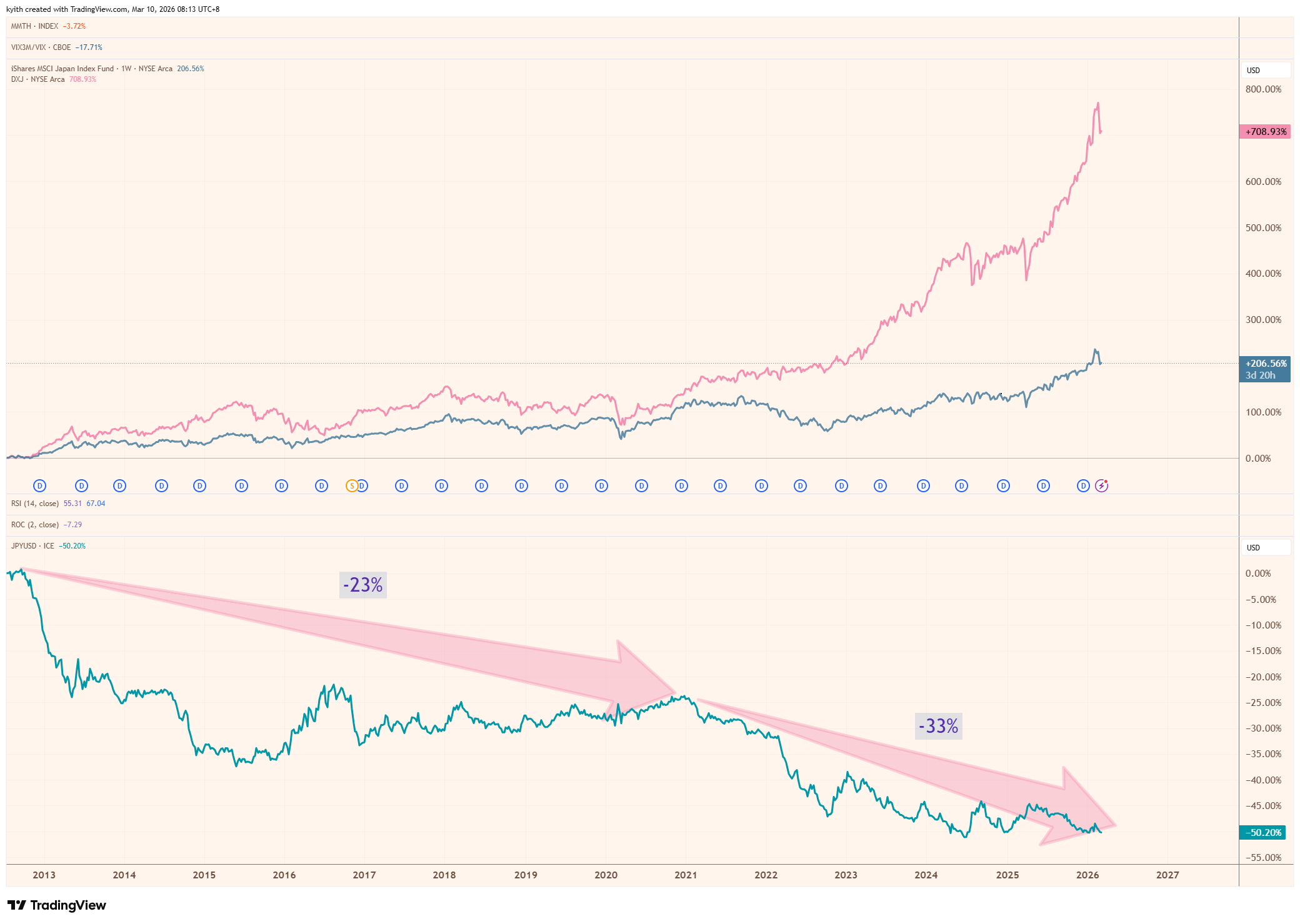
How the Hedged Class of a Japan Fund Result in a 500% Outperformance Over a Non-Hedge One.
Investment Moats· 2026-03-11 00:46
Group 1 - The article discusses concerns about the potential decline of the USD and its implications for investments, particularly in the context of de-dollarization and currency hedging strategies [3][30]. - It highlights the performance comparison between unhedged and hedged equity funds, specifically focusing on the iShares MSCI Japan ETF (EWJ) and the WisdomTree Japan Hedged Equity ETF (DXJ) [8][12]. - The article emphasizes the importance of understanding the difference between being denominated in a currency versus being hedged against currency fluctuations, which can significantly impact investment performance [15][18]. Group 2 - The performance of DXJ has been notably superior to EWJ, with DXJ achieving a 453% return compared to EWJ's 107% since DXJ's inception in 2006, illustrating the benefits of currency hedging in a depreciating currency environment [20]. - The article notes that the Japanese Yen has experienced significant volatility, with a 56% appreciation against the USD from 2006 to 2012, followed by a decline, which affects the performance of both hedged and unhedged funds [24][25]. - It suggests that investors should consider the underlying methodology of funds, as DXJ is designed to favor companies that benefit from a weaker yen, while EWJ is more general in its approach [28].

Smart Japan Investors Are Choosing DXJ Over EWJ and the Returns Prove Why
Yahoo Finance· 2026-03-10 11:55
Core Insights - Japanese equities have shown strong returns over the past year, but USD-based investors without currency hedging have realized lower returns than expected [2][5] - The WisdomTree Japan Hedged Equity Fund (DXJ) aims to provide U.S. investors with exposure to Japanese dividend-paying equities while mitigating currency risk [3][4] Fund Overview - DXJ offers exposure to 433 Japanese stocks, including major companies like Mitsubishi UFJ Financial Group and Toyota Motor, with an expense ratio of 0.48% [3][8] - The fund's structure allows returns from Japanese stocks priced in yen to be converted to dollars at a fixed rate, avoiding the negative impact of yen fluctuations [3][4] Performance Analysis - Over the past year, DXJ achieved a return of 45.92%, significantly outperforming the unhedged iShares MSCI Japan ETF (EWJ), which returned 27.41% [5][8] - The performance gap is primarily attributed to the weakening yen, which adversely affects unhedged investors [5][6] Long-term Impact - Over a five-year period, DXJ's cumulative return of 206.1% far exceeds EWJ's 40.47%, highlighting the detrimental effect of a persistently weak yen on unhedged investments [6][8] Policy Influence - The economic agenda of Prime Minister Sanae Takaichi, termed "Sanaenomics," focuses on sectors like AI, semiconductors, energy, and defense, which align with DXJ's holdings [7] - As of early December 2025, DXJ was up 25.30% year-to-date, largely due to favorable policy developments [7][8]
Retirees Love This $115 Billion ETF That Pays Monthly Income
247Wallst· 2026-03-02 20:14
Core Insights - The Vanguard Total International Bond ETF (BNDX) has gained popularity among retirees due to its monthly income distribution and low expense ratio of 0.07% [1] - BNDX provides exposure to non-U.S. investment-grade bonds, returning 22.2% over ten years in price terms, with a current dividend yield of 3.2% [1] Summary by Categories Fund Overview - BNDX tracks the Bloomberg Global Aggregate ex-USD Float Adjusted RIC Capped Index (USD Hedged), holding thousands of government and corporate bonds from developed markets and a small emerging market component [1] - The fund systematically applies currency hedging to mitigate volatility, allowing U.S. investors to focus on bond performance without currency risk [1] Performance Metrics - Over five years, BNDX has gained 3.17% in price terms, which does not account for monthly distributions, indicating its role as an income and diversification vehicle rather than a growth engine [1] - Year-to-date through February 27, 2026, BNDX is up 2.06%, supported by a pullback in the 10-year Treasury yield to 4.02% [1] Investment Characteristics - The fund's low expense ratio of 0.07% makes it an affordable option for accessing global bond exposure, with the potential for compounding income over time [1] - BNDX's income is stable but not high, primarily consisting of investment-grade government debt, which reflects the nature of investment-grade bond investing [1]

iShares Currency Hedged MSCI EAFE Small-Cap ETF (HSCZ US) - Investment Proposition
ETF Strategy· 2026-01-19 10:04
Core Viewpoint - iShares Currency Hedged MSCI EAFE Small-Cap ETF (HSCZ) offers targeted exposure to developed small-cap equities outside the U.S. while mitigating currency fluctuation impacts against the U.S. dollar [1] Group 1: Investment Proposition - The fund aims to replicate a diversified small-cap universe and employs a forward-hedging strategy to ensure equity fundamentals dominate returns rather than foreign exchange translation [1] - The investment opportunity focuses on domestically oriented businesses that are more sensitive to local demand, policy changes, and regional supply chains, leading to greater dispersion compared to large-cap equities [1] - Hedging can reduce volatility from currency fluctuations but may introduce implementation costs and basis risk related to interest-rate differentials [1] Group 2: Use Cases and Suitable Investors - HSCZ can serve as a size tilt within international allocations, act as a satellite for factor completion when portfolios are underweight in small caps, and provide a tactical overlay when concerns about a stronger dollar arise [1] - Suitable investors include those seeking clearer attribution to local equity drivers and outcome-oriented strategies that prioritize returns in home currency [1] Group 3: Market Conditions and Risks - Supportive market conditions for HSCZ often include periods of dollar strength or phases when domestic catalysts drive small-cap earnings, while it may be less advantageous during foreign currency appreciation [1] - Key fund-specific risks involve hedge implementation and roll costs, which can increase tracking differences, along with the higher volatility and liquidity risks typically associated with small-cap equities [1]

iShares Silver Trust (SLV US) - Investment Proposition
ETF Strategy· 2026-01-18 12:22
Core Viewpoint - iShares Silver Trust (SLV) offers direct exposure to silver prices, allowing investors to express views on precious metals without company-specific risks [1] Group 1: Investment Strategy - The strategy aims to mirror spot silver movements, with returns driven by metal supply-demand, currency trends, and investor risk appetite [1] - SLV serves as a tactical overlay for inflation or currency hedging, a diversification tool due to low long-run correlation with many financial assets, or a targeted satellite for precious metals mandates [1] Group 2: Characteristics and Risks - As a single-commodity holding, SLV is concentrated and non-income producing, leading to potentially volatile performance sensitive to real rates and dollar fluctuations [1] - Silver's dual role as a monetary metal and industrial input introduces cyclical characteristics that may diverge from gold, adding beta related to manufacturing and electronics alongside inflation and policy expectations [1] - A key risk is the concentration in a single commodity, where sharp price movements and sentiment shifts can significantly impact outcomes compared to broader multi-asset exposures [1]
DXJ Lets You Bet On America’s Ally, Get Paid 3%, and It Beat The S&P 500 Last Year
Yahoo Finance· 2026-01-05 12:10
Core Viewpoint - The WisdomTree Japan Hedged Equity Fund (DXJ) effectively mitigates currency risk for U.S. investors, allowing them to benefit from Japanese equity returns without the adverse effects of yen fluctuations, achieving a 34% return in 2024 compared to 16% for the S&P 500 [1][3]. Group 1: Fund Performance - DXJ returned 34% in 2024, outperforming the S&P 500's 16% return [3]. - The fund's currency hedging contributed over 7 percentage points of outperformance compared to unhedged Japanese equities in 2024 [4]. - The unhedged alternative, iShares MSCI Japan ETF (EWJ), returned 27% during the same period, highlighting the impact of currency movements on returns [4]. Group 2: Fund Composition and Strategy - DXJ holds 430 Japanese companies that pay dividends and derive at least 20% of their revenue from outside Japan, including major exporters like Toyota, Mitsubishi UFJ Financial, and Sumitomo Mitsui Financial [2]. - The fund employs forward currency contracts to neutralize yen-dollar fluctuations, enabling investors to capture Japanese equity returns without currency headwinds [2]. Group 3: Income and Expenses - DXJ offers a yield of 3.1%, providing modest income alongside potential capital appreciation, although dividend distributions can be volatile due to underlying equity dividends and hedging gains or losses [5]. - The fund charges a 0.48% expense ratio, which is reasonable for an actively hedged strategy but higher than that of broad market index funds [6]. - With $4.8 billion in assets, DXJ provides sufficient liquidity and trades at approximately 16 times earnings, which is attractive compared to U.S. large caps [6]. Group 4: Risks and Trade-offs - Currency hedging can be a double-edged sword; when the yen strengthens, unhedged investors benefit from favorable currency translation, while DXJ holders miss out, leading to potential underperformance of DXJ compared to EWJ [7]. - Investors are essentially betting that the yen will remain weak or that Japanese equities will rise sufficiently to offset any currency-related losses [7].
X @Bloomberg
Bloomberg· 2025-09-14 22:22
Currency Hedging Strategy - Taiwan's life insurers are poised to increase currency hedging from near record lows [1] - The goal is to protect overseas assets from fluctuations in the local dollar (New Taiwan dollar) [1]