Data Quality

Search documents
中国观察:去年的经验总结-China Matters_ Lessons Learned from the Last Year
2026-02-10 03:24
Summary of Key Points from the Conference Call Industry Overview - The report focuses on the **Chinese economy** and its macroeconomic data and policies over the past year, drawing lessons and implications for investors in 2026 [6][2]. Core Insights and Arguments 1. **Data Quality Issues**: - There are significant concerns regarding the quality of Chinese macroeconomic data, with patterns indicating increased quality issues in 2025. For example, the NBS Manufacturing PMI showed a consistent rise at quarter-end, suggesting potential manipulation to boost GDP figures [7][8]. - Fixed asset investment (FAI) data showed double-digit declines year-over-year, which may reflect statistical corrections rather than actual downturns in investment [8]. 2. **Divergence in Economic Indicators**: - The Chinese economy is experiencing pronounced divergence, with export value increasing by 6.6% year-over-year while property FAI dropped by 37% in December 2025. The IT sector expanded by 11%, contrasting with a 1% contraction in construction [5][13][15]. 3. **High-Tech Sector Growth**: - The government's push for technology and innovation is yielding results, with significant production increases in sectors like electric vehicles and semiconductors. The drag from the property market on the economy is expected to peak, with projections indicating a reduction in its negative impact on GDP growth from 2 percentage points in 2025 to 1.5 percentage points in 2026 [20][21]. 4. **Conservative Fiscal Policy**: - Policymakers have been conservative in implementing fiscal stimulus due to concerns over the rising government debt-to-GDP ratio, which has implications for domestic demand and overall economic growth. China's nominal GDP grew by only 4% in 2025, while the fiscal deficit was estimated at 11% of GDP [28][29]. 5. **Impact of US Tariffs on Exports**: - Despite higher US tariffs, Chinese export volume increased by over 8% in 2025. However, the data indicates that US tariffs did have a moderating effect on export growth during periods of heightened trade tensions [35][36]. Additional Important Insights - **Investor Considerations**: - Investors should carefully analyze data to understand the bifurcated nature of the Chinese economy, where both bullish and bearish narratives can be supported by data [39]. - There are signs that segments of the economy that have been depressed may be bottoming out, suggesting potential investment opportunities [40]. - The threshold for meaningful policy easing in the property market is rising, indicating that the government may focus on managing the downturn rather than reversing it [45][46]. - **Export Growth Projections**: - The baseline expectation for Chinese export volume growth in 2026 is around 5%, with potential upside risks given the resilience shown in 2025 despite tariffs [48]. This summary encapsulates the key points discussed in the conference call, providing a comprehensive overview of the current state and future outlook of the Chinese economy.
2026 年数据与人工智能的 7 项预测
3 6 Ke· 2026-01-22 05:52
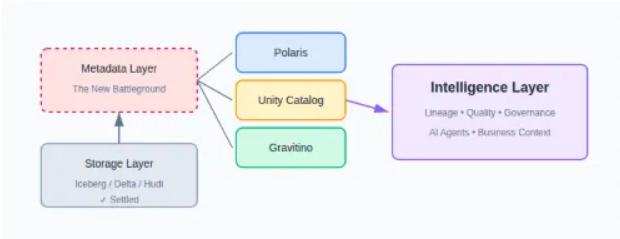
Core Insights - The infrastructure supporting artificial intelligence is undergoing a significant transformation, driven by the convergence of open formats, AI capabilities, and the unsustainable costs of integrating numerous tools [1][2]. Group 1: Importance of Fundamentals - Basic skills remain crucial as architecture changes can disrupt pipelines, and data quality issues continue to plague organizations, costing an average of $12.9 million annually due to poor data quality [2][11]. - The key challenge by 2026 will not be the existence of these issues but the speed and method of their detection and resolution [2]. Group 2: Metadata Layer as a Battleground - The storage layer competition has concluded with Iceberg, Delta Lake, and Hudi emerging as winners, while Parquet has become the common language for data storage [3][6]. - The focus is shifting upstream to the metadata layer, which is becoming the operational backbone of data management, encompassing data lineage, quality rules, access policies, and business context [6][20]. Group 3: Simplification of Data Stacks - Organizations are experiencing tool fatigue, managing an average of 15 to 30 different tools across various data functions, which is unsustainable [7][9]. - By 2026, the integration process will accelerate, with platforms like Snowflake and Databricks consolidating functionalities to streamline data operations [10]. Group 4: Data Quality as a Business Function - Data quality metrics will shift from engineering-focused indicators to business outcomes, with organizations increasingly linking data pipeline failures to revenue impacts [11][12]. - By 2026, 80% of organizations are expected to deploy AI/ML-driven data quality solutions, emphasizing the need for accountability through data contracts between producers and consumers [12]. Group 5: AI Agents Replacing Dashboards - The traditional model of data observability through dashboards is becoming obsolete, with AI agents expected to take over operational responsibilities by 2026 [13][15]. - These AI agents will be capable of understanding business context, automatically tracing issues, and applying fixes, fundamentally changing the approach to data observability [15]. Group 6: AI Reshaping Data Infrastructure - The initial design of data stacks was for dashboard services, not AI workloads, but AI is now a primary user of data [16]. - By 2026, two types of companies will emerge: AI-native architectures designed for AI workloads and traditional stacks with AI capabilities added later [16]. Group 7: The Rise of Semantic Layers - Semantic layers, previously seen as optional, are becoming essential for AI applications, providing necessary context for data interpretation and ensuring data quality [17]. - These layers serve as a bridge between technical data and business meaning, crucial for AI agents to function effectively [17]. Group 8: Common Theme - A common theme across the predictions is the shift from passive to proactive data infrastructure, where systems will not only store and visualize data but also understand, reason, and act based on interactions [18][19].


X @Bloomberg
Bloomberg· 2025-12-19 12:27
Britain’s ONS is preparing for a potential change in the law that would force households to respond to key economic surveys, as it tries to rebuild its credibility after a collapse in data quality https://t.co/WOqzPJPrtc ...
不融资、不烧钱、不扩团队,华裔 CEO 创办的AI独角兽打入谷歌、Anthropic核心供应链!如今营收近百亿
Sou Hu Cai Jing· 2025-12-10 07:15
Core Insights - Meta has invested $14.3 billion to acquire nearly half of Scale AI, a competitor that has achieved over $1 billion in annual revenue without external funding, despite having only a fraction of the workforce compared to its rivals [1][5]. - Surge AI, a low-profile competitor with a workforce of only 60-70 employees, has also surpassed $1 billion in revenue within four years without any financing, highlighting a contrasting approach in the AI industry [5][14]. - Edwin Chen, the founder and CEO of Surge AI, emphasizes the critical importance of data quality in AI training, which he believes is often underestimated even by large tech companies [6][12]. Company Overview - Surge AI was founded in 2020 by Edwin Chen, who has a background in mathematics and linguistics from MIT and experience in major tech companies like Google and Meta [6][7]. - The company focuses on high-quality, human-annotated data and AI training infrastructure, aiming to address the shortcomings in data quality that Chen observed during his previous roles [6][7][8]. - Surge AI has developed a rigorous selection system for its annotators, including a network called "Surge Force," which consists of highly qualified professionals, including professors from top universities [8][9]. Business Model and Strategy - Surge AI's business model is built on providing superior data quality, which has attracted top-tier clients such as OpenAI, Anthropic, Google, Microsoft, and Meta, with Meta alone projected to spend over $150 million on Surge AI's services in 2024 [9][10]. - The company achieved profitability in its first year, demonstrating the effectiveness of its unique approach to data quality and operational efficiency [10]. - Edwin Chen believes that the future will see more companies achieving high revenue with fewer employees, driven by advancements in AI efficiency [14][15]. Industry Trends - The AI industry is witnessing a shift where companies are realizing that large organizations are not necessary for success, and AI is enabling smaller, more efficient teams to thrive [15][16]. - There is a growing recognition that the quality of data, rather than just the quantity, is crucial for training effective AI models [19][20]. - The emergence of reinforcement learning environments is expected to play a significant role in the future of AI training, allowing models to learn in more complex, real-world scenarios [26][30]. Research and Development - Surge AI has invested in its own research team to advance the field of AI and improve data quality standards, which is relatively rare for companies in this sector [36][38]. - The research team focuses on developing better benchmarks and evaluation methods to ensure that AI models are trained effectively and ethically [37][38]. - Edwin Chen's vision for Surge AI is to operate more like a research lab than a typical startup, prioritizing long-term impact over short-term financial metrics [50][52].

X @Ansem
Ansem 🧸💸· 2025-12-09 18:49
RT Adam (@Adam_Tehc)there's a bunch of inflated dashboards, which I myself have relied on, that are wrong.terminator did a great service for data quality.this comes off as a Polymarket issue, which is not the case.I asked @primo_data about a related issue a month ago and was sent the correct logic back, same as suggested by terminator.adam ...
X @BNB Chain
BNB Chain· 2025-12-08 15:00
Robotics on BNB Chain is gaining momentum with builders like @EurexaLabs showing what’s possible on this frontier 🤖Note: This post is for informational purposes only and not financial advice. DYOR.https://t.co/cTdES8jlrZEurexaLabs (@EurexaLabs):We're pushing the boundaries of Robot Logistics!Our latest task is designed to generate a high-quality dataset for humanoid robots handling items.We've structured the challenge into 3 distinct levels to significantly enhance data quality.We invite more users to explo ...
Data Intelligence Platform for Nation Scale AI Factories (Presented by DDN)
DDN· 2025-11-25 20:54
As you probably know, AI is already redefining the world economy from financial services to healthcare to automotive, energy, manufacturing, public sector. We are really starting to see great new AI applications come and this is all in partnerships with Nvidia, our great partner who has been pushing us on the envelope of innovation. So what we are talking about here is yes we've been here for many years 27 years in fact but the last 10 years has been amazing in 2015 almost 10 years ago we were supercharging ...

The Internet of Tasks | Dilan Özdemir-Kaluk | TEDxRWTHAachen
TEDx Talks· 2025-11-17 16:15
Collaboration Challenges & Vision - Enterprises face challenges due to data silos and fragmented communication, hindering efficient information flow [5][6] - The vision is to ensure fluent, task-specific information flow within cross-functional teams, enabling efficient teamwork [7] - Employees spend approximately two hours per day searching for information, impacting task execution [7] Digital Transformation & the Internet of Tasks - The focus should be on human-centered digital collaboration to transform organizations for efficient and qualitative work [4][5] - The concept of the "internet of tasks" is introduced, emphasizing connecting humans in the context of companies [1] - Building a "digital twin" of the organization is crucial to understand expertise and knowledge within the company [9][10] Data Foundation & AI - Establishing one data foundation is essential to avoid repetitive work and foster organizational growth [5][13] - Data quality is paramount for effective AI implementation; AI needs a good database to be useful [17] - Continuously mapping daily tasks is necessary to build collaborative intelligence and provide nutrition for AI [19] Enterprise Task Management System - Building an enterprise task management system is proposed to document, prioritize, and track tasks, activities, results, and learnings [13] - The enterprise is the sum of its tasks; solving tasks efficiently in terms of quality, budget, and time is a key challenge [14] - The goal is to create a map of activities, knowledge, and expertise within the company through an enterprise task management system [16]

Why Getting Data Right Could Be The Key To Effective AI Projects — With Charles Sansbury
Alex Kantrowitz· 2025-11-05 17:30
What does AI need to do to deliver real economic value. Let's talk about it with Charles Sansbury, the CEO of Cloudera, who is here with us in studio for a video brought to you by Cloudera. Charles, great to see you.How are you. >> Great to see you and thanks for having me. >> Thanks for being here.We've been talking on the show so much about the economic value of artificial intelligence. Um whether or not there there will be an ROI on this technology. >> I'm so happy to be speaking with you today because y ...

Stephen Miran Declines to Comment on Trump’s Firing of BLS Commissioner | WSJ News
WSJ News· 2025-09-04 17:38
Data Quality Concerns - The Bureau of Labor Statistics (BLS) data quality and reliability has deteriorated over the decades [1] - Declining response rates and a refusal to correct for them are the root causes of the data quality deterioration [2] - BLS leadership did nothing to arrest the deterioration in data quality [3] Political Influence Allegations - There are concerns about potential political interference affecting BLS data [1] - The question of whether the president should fire BLS leadership for disliking the results is raised [4] - The loss of professional staff is unlikely to improve the situation [5] Confidence in Leadership - The nominee's answers do not inspire confidence regarding the protection of BLS independence [5]