Digital Agriculture

Search documents
Farm Software Management Solution Market Size to Grow USD 5.37 Billion by 2035 | Research by SNS Insider
Globenewswire· 2026-03-09 03:30
Market Overview - The Farm Software Management Solution Market was valued at USD 2.41 billion in 2025 and is projected to reach USD 5.37 billion by 2035, with a CAGR of 8.37% from 2026 to 2035 [1][5]. Government and Regulatory Influence - Government mandates such as USDA digital agriculture requirements and EU Farm-to-Fork strategy compliance are significant drivers for market expansion, enhancing farm data accessibility and agricultural transparency [1]. Market Segmentation By Component - The software segment accounted for approximately 67.45% of revenue in 2025, driven by demand for integrated farm management platforms, while the services segment is expected to grow at a CAGR of nearly 9.12% from 2026 to 2035 [6]. By Deployment Mode - The cloud-based segment contributed 61.38% of revenue in 2025, favored for its scalability and cost-effectiveness, while on-premises solutions remain important for large agribusinesses due to localized data needs [7]. By Farm Size - Large farms held about 48.73% of the market share, with medium farms expected to grow at a CAGR of around 9.04% during the forecast period as they seek comprehensive management platforms [8]. By Application - Crop management applications represented approximately 32.56% of revenue in 2025, with livestock management anticipated to grow at a CAGR of about 8.89% from 2026 to 2035 [10]. By End-User - Farmers comprised 52.61% of the market share, while agribusinesses are projected to grow at a CAGR of around 9.23% during the forecast period [11]. Regional Insights - The Asia Pacific region is the fastest-growing segment with a CAGR of 10.14%, driven by increasing awareness of digital agricultural services and government initiatives [12]. - North America held over 38.42% of the market share in 2025, supported by a robust agri-tech environment and stringent data record-keeping requirements [13]. Key Players - Leading market players include Trimble Inc., Deere & Company, CNH Industrial, AGCO Corporation, and Climate Corporation among others [4]. Recent Developments - Trimble Inc. expanded its software platform with AI capabilities in March 2025, while Deere & Company launched an enhanced cloud-based platform in January 2025, both aimed at improving farm productivity and digital management adoption [16].


I know what you grew last summer | Steve Shirtliffe | TEDxUniversityofSaskatchewan
TEDx Talks· 2026-02-10 17:54
I'm from a farm in southern Manitoba. Here's a photo of it back in 1982. I was just out of high school and this picture was taken.This picture was taken by a spy satellite that nobody even knew existed at that time. It was a cold war era keyhole spy satellite that belonged to the US government. And they spent most of their time taking pictures of the USSR and China.But even back then, for whatever reason, that day, they were taking images of southern Manitoba. An executive order by Clinton in 1995 declassif ...

Yimutian Announces Strategic Cooperation for Large-Scale Digital Agriculture Project in Guangdong Province
Globenewswire· 2026-02-06 00:20
Core Viewpoint - Yimutian Group has entered into a strategic cooperation agreement to develop a large-scale integrated agricultural project in Huazhou City, Guangdong Province, focusing on digital agriculture and sustainable practices [1][5]. Group 1: Project Overview - The Jianjiang Farmland Integrated Development Initiative will cover over 21,000 mu (approximately 1,400 hectares) and aims to enhance Yimutian's technology-enabled agricultural development model [2]. - The initiative emphasizes improving land utilization efficiency, advancing digital farm management, and creating a scalable agricultural production ecosystem [3]. Group 2: Collaboration and Contributions - Under the agreement, Yimutian will provide its digital platform capabilities and AI technologies, while local partners will assist with land coordination and project execution [4]. - The project will implement inclusive participation mechanisms for local farmers, including land leasing and employment opportunities, to align productivity improvements with sustainable income generation [4]. Group 3: Strategic Goals and Previous Initiatives - The project reflects Yimutian's strategy to extend digital agriculture into large-scale production systems, combining digital infrastructure and AI technology for efficient agricultural models [5]. - This initiative marks Yimutian's second integrated land development project, following a similar project in Maonan District, which together represent a combined area of approximately 35,000 mu [5]. Group 4: Technological Implementation - The project will focus on land consolidation and infrastructure optimization to enhance soil quality and irrigation systems, creating contiguous high-standard farmland [8]. - Yimutian plans to deploy digital technologies for end-to-end oversight from cultivation to distribution, including AI-driven planting optimization and supply-chain management systems [8]. Group 5: Industry Impact - These large-scale, technology-enabled agricultural initiatives are expected to modernize China's agricultural industry, improving productivity, food quality, and market efficiency [7].

John Deere(DE) - 2025 Q4 - Earnings Call Transcript
2025-11-26 16:02
Financial Data and Key Metrics Changes - For fiscal year 2025, net sales and revenues decreased by 12% to $45.7 billion, while net sales for equipment operations fell by 13% to $38.9 billion [8] - Net income attributable to Deere & Company was $5 billion, or $18.50 per diluted share [8] - In the fourth quarter, net sales and revenues increased by 11% to $12.4 billion, with net sales for equipment operations rising by 14% to $10.6 billion [8] - Net income attributable to Deere & Company for the fourth quarter decreased to $1.1 billion, or $3.93 per diluted share [8] Business Segment Data and Key Metrics Changes - Production and Precision Ag segment saw net sales of $4.74 billion, up 10% year-over-year, with an operating profit of $604 million and a 12.7% operating margin [9] - Small Ag and Turf segment reported net sales of $2.57 billion, up 7% year-over-year, but operating profit declined to $25 million due to higher costs [10] - Construction and Forestry segment's net sales increased by 27% year-over-year to $3.382 billion, with an operating profit of $348 million and a 10.3% operating margin [13] Market Data and Key Metrics Changes - Industry sales of large equipment in the U.S. and Canada are expected to decline by 15%-20% in fiscal year 2026, while small agriculture and turf demand is estimated to be flat to up 5% [10][11] - In Europe, the industry is projected to be flat to up 5%, with robust dairy sector margins and improving arable cash flows [11] - South America is expected to see flat industry sales, with Brazilian customer demand tempered by high interest rates and strong global crop yields [11] Company Strategy and Development Direction - The company aims to manage inventory carefully and avoid oversupply while focusing on used inventory reduction [37] - Deere is committed to advancing its Smart Industrial journey, emphasizing technology and innovation to enhance customer value [20][23] - The company anticipates growth in small ag and turf, as well as construction and forestry, while entering fiscal year 2026 with lean production in North American large ag [67] Management's Comments on Operating Environment and Future Outlook - Management expressed optimism about stabilization in certain segments and geographies, despite challenges in large ag [7][8] - The company highlighted strong crop use and consumption, new trade agreements, and supportive government payments as potential growth drivers [11] - Management acknowledged the resilience of the organization in navigating a challenging market environment while maintaining strong performance levels [20][26] Other Important Information - The company expects full-year net income for fiscal year 2026 to be in the range of $4 billion to $4.75 billion, with an effective tax rate between 25%-27% [17] - Cash flow from equipment operations is projected to be between $4 billion and $5 billion [17] - The company plans to resume normal capital allocation activities in 2026 after pausing buybacks in the fourth quarter of fiscal 2025 [66] Q&A Session Summary Question: How is the company thinking about offsetting the $1.2 billion tariff headwind in 2026? - The company expects to capture back some of the incremental exposure this year and some from 2025, with a plan to continue executing activities to mitigate the impact [73][74] Question: Can you provide insights on the production plans and product mix implications for seasonality? - The company anticipates net sales in production precision ag to be close to the first quarter of 2025, but margins will be significantly lower due to a lean production plan [51]
Preserve ancient agricultural wisdom, sow a digitally sustainable future | 李众 Li Zhong | TEDxBeijing
TEDx Talks· 2025-10-15 15:38
Agriculture & Technology Intersection - The agriculture industry faces the dual challenge of feeding a growing global population projected to reach 10 billion by 2050, requiring a 56% increase in agricultural output, while also addressing the environmental impact, with the global food and agriculture systems contributing up to 31% of greenhouse gas emissions [4][5][6] - The industry is at a crossroads, needing to combine advancing digital technologies with traditional farming wisdom to address global food system challenges [2][3][4][11] - Digital technologies can empower traditional wisdom by digitalizing farmers' knowledge, decoding ecological mysteries through data analysis, and connecting traditions to markets via digital platforms [11][12][15][16][19] Sustainability & Heritage - Approximately one-third of all food produced globally is wasted annually, highlighting a deep contradiction in the food system and posing a severe challenge to achieving the UN 2030 sustainable development goals [6][7] - Agriculture heritage systems, such as the rice-fish co-culture system in Chinchen Jang province used for 1,200 years, offer sustainable ecological models and biodiversity, but are disappearing as younger generations move to cities [8][10] - The UN Food and Agriculture Organization (FAO) has designated 99 Globally Important Agricultural Heritage Systems (GIAHS) worldwide, with 25 located in China, but these systems are losing successors as young people migrate to urban areas [10] Digital Agriculture Solutions - Digital technology can transform implicit experiences into explicit data models by using sensors, weather stations, drone spectral cameras, and AI algorithms to learn from farmers and create a digital library of ancient agricultural wisdom [14][15] - Data analysis can quantify the benefits of traditional systems, such as the rice-fish co-culture, by measuring fertilizer reduction, soil organic matter content increase, and biodiversity support, enabling optimization and replication of successful ecological farming models [17][18][19] - Blockchain technology can create immutable digital IDs for agricultural products, allowing consumers to trace the origin and cultivation methods, fostering value recognition and supporting sustainable production methods [20] Youth & Future - Youth are key to agricultural transformation, acting as pioneers of change by using AI, big data, and blockchain to optimize farm management, reduce food waste, and enhance supply chain transparency [25] - The World Food Forum (WFF), initiated by the FAO in 2021, empowers youth innovation by fostering a global network of partners and promoting youth action on green agri-heritage [26][27] - The industry is standing on the threshold of a digital agriculture revolution, where choices made will determine the ability to feed 10 billion people while allowing other species to thrive, requiring a combination of cutting-edge technologies and ancient wisdom [29]

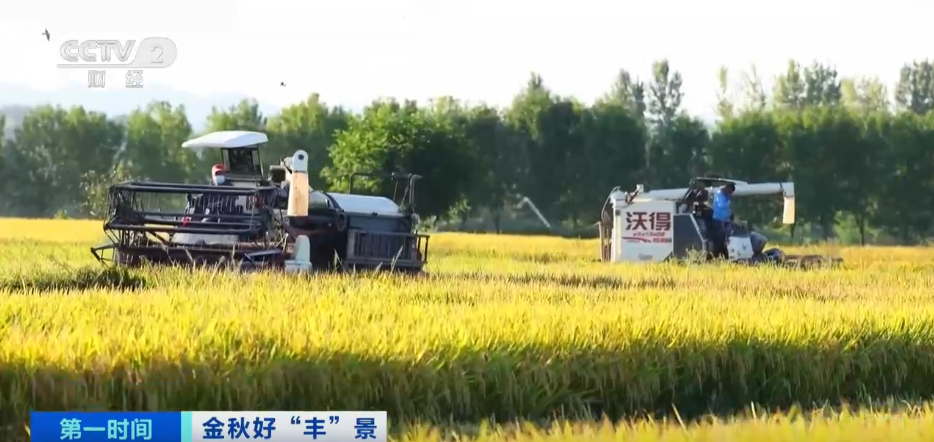
流“金”沃野奏响丰收曲 科技赋能让希望的田野更添“智慧”
Yang Shi Wang· 2025-10-05 06:57
Core Viewpoint - The article highlights the ongoing harvest season in Hubei and other regions, emphasizing the high mechanization rates and efforts to ensure efficient grain collection and drying processes. Group 1: Rice Harvesting in Hubei - Hubei is experiencing a rice harvesting season with a mechanization rate exceeding 98% [1] - In Xiangyang's Nanzhang County, 384,000 acres of rice are at the critical harvesting stage, with local agricultural departments mobilizing over 2,000 harvesters and 190 drying machines to minimize losses [3] - The province expects a total purchase of 20 billion jin of medium and late rice this year [5] Group 2: Corn Harvesting in Henan - In Nanyang's Sheqi County, 800,000 acres of corn are being harvested, taking advantage of a brief period of good weather [7] - The agricultural department is coordinating technical support and drying facilities to ensure a seamless operation from harvesting to drying [9] - The efficient mechanization in Sheqi County enhances the overall harvest efficiency and ensures grain is stored properly [11] Group 3: Sunflower Cultivation in Ningxia - In Ningxia's Yongning County, over 6,000 acres of sunflowers are in full bloom, contributing to local income through a crop rotation system [13] - The rotation model of planting wheat in spring and sunflowers in autumn increases land productivity and adds approximately 500 yuan per acre [13] Group 4: Pomegranate Harvesting in Shaanxi - In Xi'an's Lintong District, pomegranates are entering the harvest season, with farmers preparing to send the fruits to markets [15] - The region has established a digital pomegranate smart demonstration garden, utilizing technology for real-time monitoring of various agricultural factors [19] - The digital platform allows for better management of harvest timing, enabling early and late varieties to be harvested at optimal times, thus avoiding price competition [19]