Double Carbon

Search documents
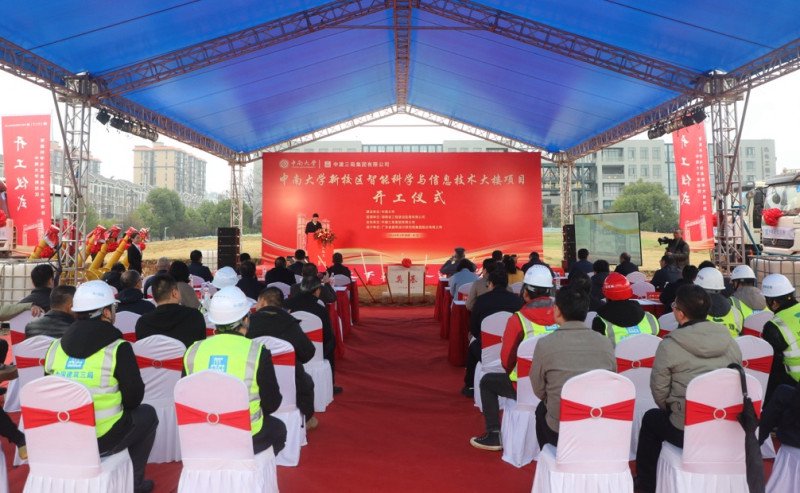
中南大学新校区智能科学与信息技术大楼项目开工
Chang Sha Wan Bao· 2026-02-27 10:36
Core Viewpoint - The construction of the new Intelligent Science and Information Technology Building at Central South University marks a significant advancement in improving the educational conditions for information disciplines, fostering deep collaboration in teaching and research, and enhancing the university's core competitiveness in cultivating high-end talent in intelligent information technology [1][2]. Group 1: Project Overview - The new building is located at the Xiaoxiang campus of Central South University, covering a total area of 54,945 square meters, consisting of 7 floors above ground and 1 underground level, primarily for research and experimental facilities [3][9]. - The project received approval from the Ministry of Education in December 2024 and is scheduled for completion in June 2027 [3][9]. Group 2: Strategic Importance - The building is described as a "new position" for resource aggregation in information disciplines and a "frontline station" for innovation empowered by "Artificial Intelligence+" [5][11]. - The project aims to achieve the "dual carbon" goals and meet the green building three-star standard, positioning it as a new model for green development [5][11]. Group 3: Construction and Collaboration - The construction is a significant achievement for Central South University and a testament to the collaboration between China State Construction Engineering Corporation (CSCEC) and the university [7][13]. - CSCEC plans to prioritize resource coordination and optimize key processes to ensure high-quality project delivery, aiming to create a benchmark project in the education sector [7][13].

城市24小时 | 强势登顶,安徽拿下“双料”第一
Mei Ri Jing Ji Xin Wen· 2026-01-22 15:53
Group 1: Automotive Industry in Anhui - Anhui province is projected to produce 3.6865 million vehicles in 2025, including 1.7941 million new energy vehicles, both ranking first in the country [1] - Anhui is the first province in China to export over 1 million vehicles annually, with an expected export volume of 1.228 million vehicles in 2025, marking a 28.7% increase [1] - The automotive industry in Anhui has become the first single industry in the province to exceed 100 billion yuan in annual export value [1] Group 2: Industry Structure and Development - Anhui has established a complete automotive industry chain, with over 3,000 component manufacturers covering various sectors such as power batteries, electric motors, and intelligent networking [2] - Hefei and Wuhu are emerging as key cities in the automotive sector, with Hefei's new energy vehicle production expected to reach 1.376 million units in 2024, ranking second nationally [2] - Wuhu, driven by Chery Group, accounted for 46.2% of Anhui's total vehicle production in 2024 and nearly 80% of its export volume [2] Group 3: Strategic Initiatives - The "14th Five-Year Plan" for Anhui emphasizes the development of strategic emerging industries, particularly in intelligent connected new energy vehicles [3] - Anhui is implementing the "Hui Dong Global" initiative to promote international cooperation and open innovation in the automotive industry [3]

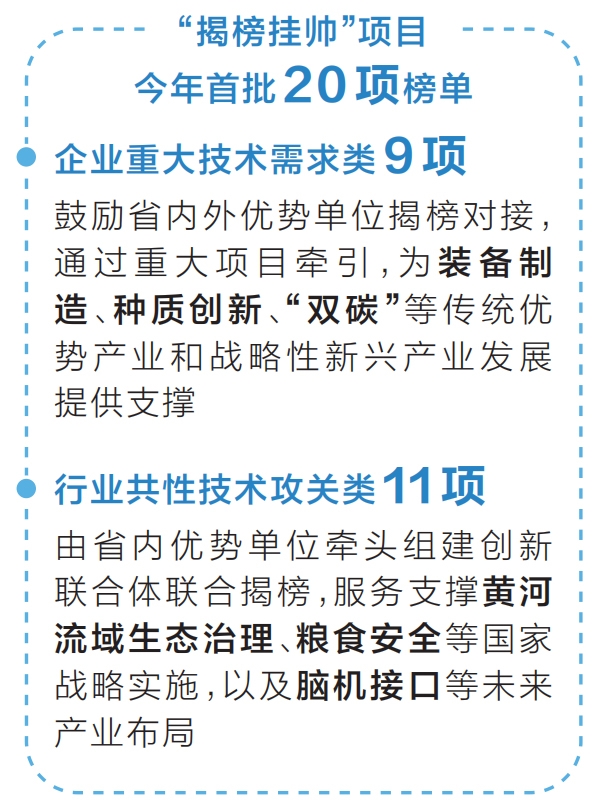
河南省今年首批“揭榜挂帅”项目榜单发布
He Nan Ri Bao· 2026-01-13 23:36
Group 1 - The core viewpoint of the news is the announcement of the first batch of 20 key technology projects under the "reveal the list and take the lead" initiative in Henan Province, aimed at addressing major industrial technology needs and promoting innovation [1][2] - The initiative has already released two batches of 23 projects, with 13 projects successfully approved and a total financial support of 200 million yuan from the provincial government [1][2] - The new batch of 20 projects includes 9 major technology demand projects and 11 common technology tackling projects, expected to drive a total investment of 800 million yuan and over 300 million yuan in R&D investment, with projected annual sales revenue of nearly 740 million yuan and tax revenue of 110 million yuan [2] Group 2 - The projects focus on key areas such as artificial intelligence, high-end equipment, ecological protection of the Yellow River basin, and genetic resource innovation, aligning with national strategies for high-quality development [1][2] - The provincial government encourages qualified units nationwide to participate in the initiative, providing support for application consultation and project implementation to enhance the industrial scale and promote transformation and upgrading [2]
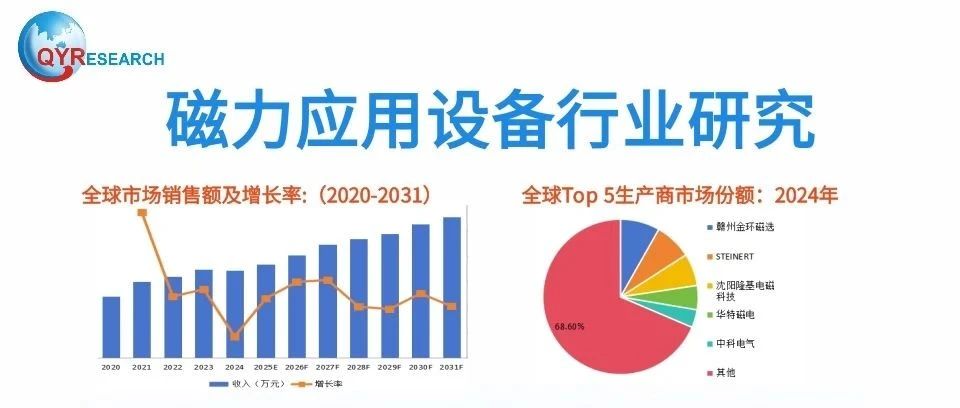
2025年全球磁力应用设备行业总体规模、主要企业国内外市场占有率及排名
QYResearch· 2025-07-14 08:53
Core Viewpoint - The magnetic application equipment industry is experiencing significant growth driven by advancements in technology, increasing domestic production capabilities, and rising demand for high-quality, customized products. The market is projected to reach $10.325 billion in 2024 and $16.609 billion by 2031, with a compound annual growth rate (CAGR) of 7.09% from 2025 to 2031 [4][5]. Industry Overview - The magnetic application equipment industry has seen improvements in technology due to enhanced domestic R&D capabilities, leading to optimized magnetic circuit designs and the integration of smart control systems [4]. - Key breakthroughs in high-precision magnetic separation and efficient electromagnetic control have brought the industry closer to international standards [5]. Market Size and Growth - The global market for magnetic application equipment is expected to grow from $10.325 billion in 2024 to $16.609 billion by 2031, with a CAGR of 7.09% from 2025 to 2031 [5]. - In China, the market size is projected to reach $3.666 billion by 2024 and $6.382 billion by 2031, with an estimated CAGR of 8.36% from 2025 to 2031 [9]. Competitive Landscape - The market is becoming increasingly concentrated, with the top ten manufacturers holding nearly 42% of the market share. Major players include Ganzhou Jinhui Magnetic Selection, Shenyang Longji Electromagnetic Technology, and STEINERT [12]. - The primary consumer regions for magnetic application equipment include North America, China, Europe, and Australia, with emerging markets in India and Southeast Asia showing significant potential [13]. Industry Characteristics - The industry serves a wide range of applications across metallurgy, mining, environmental protection, manufacturing, and energy sectors [15]. - There is a high degree of customization required for magnetic equipment, driven by varying demands across different industries [16]. - The industry is increasingly focused on green and environmentally friendly technologies, aligning with global sustainability goals [17]. - The trend towards smart technology integration is evident, with equipment incorporating IoT, sensors, and remote monitoring capabilities [18]. Positive Factors for Development - Government policies are supportive of high-end equipment manufacturing and environmental industries, which is expected to expand equipment demand [19]. - Opportunities for domestic brands to replace imported high-end magnetic equipment are growing as local technology improves [19]. - Advances in new materials, particularly rare earth permanent magnets, are facilitating the development of smaller and more efficient equipment [19]. Challenges Facing the Industry - The industry faces challenges related to reliance on imported core materials, particularly high-performance rare earth materials, which are subject to price fluctuations and geopolitical risks [20]. - Intense competition in the mid to low-end market has led to significant price wars, impacting overall profit margins [20]. - Increasing customer demands for customization and longer project sales cycles add operational pressure on companies [22]. - Stricter environmental regulations in the processing of rare earth materials and magnetic materials are raising compliance costs [23].