Economic Forecasting

Search documents
美国经济:2025 年经济数据意外表现、我们的预测表现与市场反应-US Economics Analyst_ Economic Data Surprises, Our Forecast Performance, and Market Reactions in 2025
2026-01-19 02:32
Summary of Economic Data Surprises and Market Reactions in 2025 Industry Overview - The report focuses on the US economy, analyzing economic data surprises, forecasting performance, and market reactions related to growth and inflation in 2025 [1][2]. Key Points Economic Growth - The US GDP is projected to have increased just under 2.5% Q4/Q4 in 2025, aligning with the initial forecast of 2.4% and surpassing the consensus forecast of 1.9% [3][4]. - Initial growth forecasts were lowered by 1.9 percentage points due to anticipated large tariffs, but were later adjusted upward after the most disruptive tariffs were scaled back [4][5]. Inflation - The core PCE price index increased by approximately 2.8% Q4/Q4 in 2025, which is higher than the forecast of 2.4% and reflects a modest progress in disinflation [12][16]. - The overshoot in inflation is attributed to larger-than-expected tariffs, contributing an estimated 60 basis points to the year-on-year rate [12][16]. Forecast Performance - The hit rate for economic indicator forecasts averaged 71% in 2025, slightly above the 64% average since 2017, with notable accuracy in GDP (100% correct) and core CPI (90% correct) [16][22]. - The performance lagged for the ISM manufacturing index, achieving only a 44% hit rate, indicating overly optimistic forecasts for manufacturing surveys [22][29]. Market Reactions - Market sensitivity to inflation data surprises was notably high, with stock market reactions at 1.5 times the normal level and bond market reactions at 2.6 times the historical average [29][33]. - The relative importance of the unemployment rate in market reactions has increased, with an estimated 80% weight on unemployment surprises compared to 20% on nonfarm payrolls, reflecting uncertainty in labor market conditions [36][39]. Economic Indicators - The report includes various economic indicators such as consumer expenditures, business fixed investment, and housing market statistics, projecting a mixed outlook for these areas in 2025 and beyond [43][44]. - Notable projections include a decline in residential fixed investment by 2.1% and an increase in business fixed investment by 4.1% in 2025 [43]. Additional Insights - The report highlights the impact of frontloading imports ahead of tariff increases, which distorted GDP measurements due to the differing treatment of imports and inventory investments [8][9]. - The economic outlook for 2026 suggests potential moderation in market reactions due to expected healthy growth and lower inflation, but uncertainties in the labor market may keep reactions elevated [39]. Conclusion - The analysis provides a comprehensive overview of the US economic landscape in 2025, emphasizing the interplay between tariffs, inflation, and market reactions, while also highlighting the forecasting accuracy and challenges faced by analysts in predicting economic trends.

These Economists Nailed Their 2025 Forecast: Here's What They Say About 2026
Investopedia· 2026-01-02 17:00
Economic Outlook - The U.S. economy is expected to experience solid growth in 2026, with lower unemployment and slightly reduced inflation compared to 2025 [2][9] - Vanguard's forecast for 2026 includes a drop in the unemployment rate to 4.2% from 4.6% in November 2025, driven by increased investments in AI and other projects [7] Employment and Job Market - The job market is anticipated to rebound in 2026 after a sluggish performance in 2025, as businesses increase investments and economic growth drives demand for workers [7][9] Economic Growth - GDP growth is projected at 2.25% for 2026, supported by strong investment numbers and fiscal policy changes, particularly tax cuts from the "One Big, Beautiful Bill" [7][10] Inflation Trends - Inflation is expected to remain elevated due to the continued impact of tariffs, with consumer prices rising by 2.6% in 2026, slightly down from 2.8% in September 2025 [10][11]


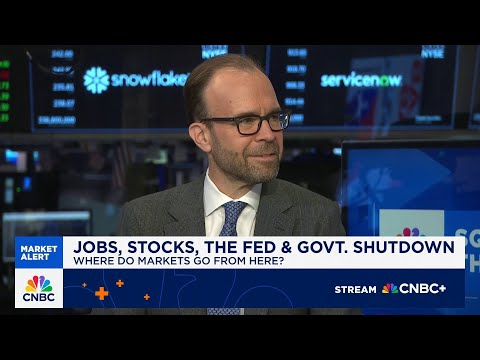
Goldman Sachs' Jan Hatzius: Lack of BLS data is a 'significant handicap' in forecasting
CNBC Television· 2025-10-03 15:28
Chicago Fed President Goulsby on squawkbox this morning defending the validity of BLS data and the shortcomings of relying just on private sector sources. Joining us here at Post9 this morning to talk more about it, Goldman Sachs chief economist John Hotsi is who normally joins us on jobs Friday. A little bit different today.It's a jobs Friday except they're not jobs. Yes. Do you do you feel like you're flying blind or no.He seems to think that um BLS is still the gold standard. Oh, for sure. It's a signifi ...