Growth ETF

Search documents
PWB: A Growth ETF With Light Mega-Cap Exposure
Seeking Alpha· 2026-02-02 10:01
Core Insights - The article does not provide specific insights or analysis regarding any companies or industries, focusing instead on disclaimers and disclosures [1][2] Group 1 - There is no stock, option, or similar derivative position in any of the companies mentioned [1] - The article expresses personal opinions and is not receiving compensation beyond Seeking Alpha [1] - No business relationship exists with any company whose stock is mentioned [1] Group 2 - Past performance is not indicative of future results, and no investment recommendations are provided [2] - The views expressed may not reflect those of Seeking Alpha as a whole [2] - Analysts include both professional and individual investors who may not be licensed or certified [2]

VOOG vs. IWO: Is S&P 500 Stability or Small-Cap Growth Potential the Better Buy Right Now?
Yahoo Finance· 2026-01-25 21:21
Core Insights - The Vanguard S&P 500 Growth ETF (VOOG) and the iShares Russell 2000 Growth ETF (IWO) target U.S. growth stocks but differ significantly in their focus, with VOOG emphasizing large-cap established companies and IWO focusing on smaller, fast-growing firms [2] Cost & Size Comparison - VOOG has a lower expense ratio of 0.07% compared to IWO's 0.24% - As of January 25, 2026, VOOG's one-year return is 16.16%, while IWO's is 15.31% - VOOG has a dividend yield of 0.49% and IWO has a yield of 0.56% - VOOG has a five-year beta of 1.08, indicating lower volatility compared to IWO's beta of 1.45 - VOOG's assets under management (AUM) stand at $22 billion, while IWO's AUM is $13 billion [3][4] Performance & Risk Comparison - Over the past five years, VOOG experienced a maximum drawdown of -32.74%, while IWO faced a more severe drawdown of -42.02% - An investment of $1,000 in VOOG would have grown to $1,880, whereas the same investment in IWO would have grown to $1,097 [5][8] Portfolio Composition - IWO tracks 1,098 small-cap growth stocks, with significant allocations in healthcare (26%), technology (23%), and industrials (20%) - The largest positions in IWO include Bloom Energy, Credo Technology Group, and Kratos Defense & Security Solutions, each under 2% of total assets - VOOG is concentrated in large-cap U.S. growth stocks, with technology making up nearly 50% of its assets, followed by communication services and financial services - Top holdings in VOOG include Nvidia, Microsoft, and Apple, which collectively account for over 30% of its assets [6][7] Investor Implications - Growth ETFs cater to various investor preferences, with VOOG focusing on larger, more stable companies that may better withstand market volatility compared to smaller firms in IWO [10]
VONG vs. SCHG: Which of These Popular Growth ETFs Is the Better Choice for Investors?
The Motley Fool· 2026-01-13 01:17
Core Insights - The Vanguard Russell 1000 Growth ETF (VONG) and the Schwab U.S. Large-Cap Growth ETF (SCHG) provide broad exposure to growth-focused U.S. large-cap stocks, but differ in cost, portfolio construction, sector exposure, and historical risk [1][2]. Cost & Size Comparison - VONG has an expense ratio of 0.07% and AUM of $45 billion, while SCHG has a lower expense ratio of 0.04% and AUM of $53 billion [3]. - The 1-year return for VONG is 19.84% compared to SCHG's 18.77%, and VONG offers a higher dividend yield of 0.45% versus SCHG's 0.36% [3]. Performance & Risk Comparison - Over the past five years, VONG experienced a max drawdown of -32.72%, while SCHG had a max drawdown of -34.59% [4]. - A $1,000 investment in VONG would have grown to $1,980, while the same investment in SCHG would have grown to $2,049 over five years [4]. Portfolio Composition - SCHG consists of 198 holdings, with 45% in technology, 16% in communication services, and 13% in consumer cyclical, featuring top positions in Nvidia, Apple, and Microsoft [5]. - VONG has a more diversified portfolio with 391 stocks, where technology makes up 53% of total assets, and its top holdings are similar to SCHG but with higher individual weights [6]. Sector Exposure & Concentration - Both funds have similar top three holdings, but these stocks constitute about 35% of VONG's portfolio compared to 29% for SCHG, indicating a greater concentration in VONG [7]. - The concentration on a small number of stocks can present both risks and opportunities depending on their performance [7]. Future Outlook - If the technology sector, particularly Nvidia, Apple, and Microsoft, continues to perform well, VONG may have a slight advantage in returns; however, underperformance could impact VONG more severely than SCHG [8]. - Investors will pay $4 annually for every $10,000 invested in SCHG and $7 for VONG, but VONG's higher dividend yield may offset some of the cost [8].



Jack Bowman’s CGDV ETF Breakdown: A “Dividend Value” Fund That Defies Its Label
Seeking Alpha· 2025-12-17 15:30
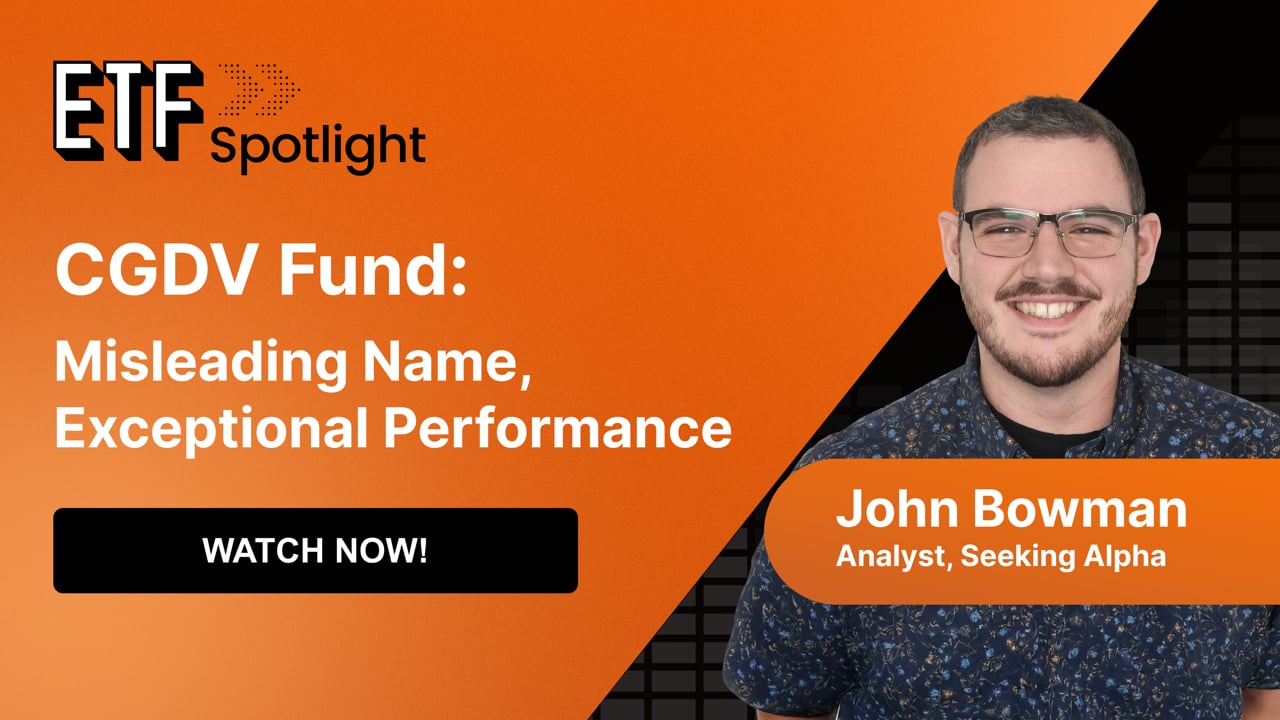
Core Viewpoint - The Capital Group Dividend Value ETF (CGDV) is described as misleadingly labeled, as it aims to produce a dividend yield higher than the S&P 500 while incorporating growth stocks, which differentiates it from traditional value ETFs [4][6][14]. ETF Overview - CGDV's mandate is to generate a dividend yield exceeding the S&P 500's current yield of approximately 1.3%, with CGDV achieving a yield of around 1.8% [5][11]. - The ETF has performed well since its inception, keeping pace with NASDAQ returns and outperforming traditional value ETFs [5][6]. Investment Strategy - CGDV includes a mix of growth and value stocks, with significant holdings in companies like NVIDIA, which contributes to its performance dynamics [6][10]. - The ETF allocates about 20% to mid-cap stocks and approximately 8-10% to foreign stocks, primarily from developed markets [7][10]. Holdings and Diversification - The top holdings of CGDV include major U.S. companies such as Eli Lilly, Microsoft, and NVIDIA, indicating a focus on large-cap stocks [8][10]. - The ETF is positioned as a way to diversify a core holding, offering slightly more foreign and mid-cap exposure compared to traditional indices [13]. Target Investor Profile - CGDV is suited for investors seeking total returns rather than solely focusing on dividends, appealing to those who are comfortable with some level of risk and potential share liquidation for cash needs [12][13]. - Traditional value investors may find CGDV less appealing due to its growth-oriented approach, which diverges from classic value investing principles [14][19]. Market Outlook - The ETF is not hedged against market downturns, but it has shown resilience during market shocks, indicating a potential for stability [17]. - The overall market outlook remains bullish, with expectations of continued growth driven by lower borrowing costs and expanding profit margins for growth companies [20][21].


This Unstoppable Vanguard ETF Could Make You a Millionaire With Just $5 Per Day
Yahoo Finance· 2025-10-13 17:00
Core Insights - Becoming a stock market millionaire is more achievable than it seems, requiring the right investment and patience rather than large sums of money or extensive knowledge [1] Investment Strategy - Investing in a growth ETF, such as the Vanguard S&P 500 Growth ETF, is a simple way to build wealth, offering instant diversification with minimal effort [2] - The Vanguard S&P 500 Growth ETF is designed to earn above-average returns over time, focusing on 214 stocks with the highest growth potential from the S&P 500 [5][6] Performance and Risk - The Vanguard S&P 500 Growth ETF has achieved an average annual return of 17.49% over the last 10 years, although past performance does not guarantee future results [10] - This ETF provides a balance of risk and reward, limiting exposure to smaller, riskier stocks while still targeting long-term wealth generation [7][9] Long-term Wealth Building - Building a million-dollar portfolio typically takes decades, but starting early can reduce the amount needed to invest daily or monthly for significant gains [8]
XLG: The Smarter Growth ETF For A Mega-Cap Dominated Decade (NYSEARCA:XLG)
Seeking Alpha· 2025-10-07 15:40
Group 1 - The Invesco QQQ Trust ETF (QQQ) is highlighted as a popular growth ETF with an Assets Under Management (AUM) of approximately $387 billion, indicating its status as a core investment choice for many investors [1] - The article emphasizes the importance of quantitative research, financial modeling, and risk management in identifying high-growth investment opportunities [1] - The authors have a strong background in equity valuation, market trends, and portfolio optimization, with experience in model validation and regulatory finance [1] Group 2 - The research approach combines rigorous risk management with a long-term perspective on value creation, focusing on macroeconomic trends and corporate earnings [1] - The collaboration between the authors aims to deliver high-quality, data-driven insights for investors seeking to outperform the market [1]

Quality Growth ETF QGRO Crosses $2 Billion AUM Amid New Interest
Etftrends· 2025-09-15 17:17
Core Insights - The American Century U.S. Quality Growth ETF (QGRO) has recently crossed the $2 billion AUM mark, indicating strong investor interest and confidence in quality growth strategies amid market uncertainty [2][5] - QGRO employs a strategy that balances stable growth and high-growth stocks, focusing on companies with strong financial fundamentals, which has contributed to its impressive performance [3][4] - The fund has achieved a year-to-date return of 13.76% and a one-year return of 29.6%, outperforming its category and segment averages [4] Fund Details - QGRO charges a fee of 29 basis points and has seen over $650 million in net inflows year-to-date, along with nearly $200 million in AUM growth from asset price appreciation [2][3] - The ETF tracks the American Century U.S. Quality Growth Index, screening stocks based on cash flow, sales, profitability, and return on assets [3] Market Context - Investors are increasingly seeking exposure to growth stocks in 2025, with a focus on high-quality attributes that can withstand market volatility [5] - The milestone achieved by QGRO positions it as an intriguing option for investors looking for steady, quality growth in uncertain economic conditions [5]