Headline Risk

Search documents
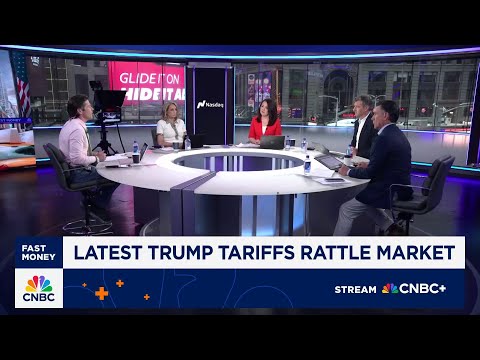
'Fast Money' traders talk the impact of latest tariff news on the markets
CNBC Television· 2025-07-07 21:50
Market Risk & Trade Tensions - The market faces headline risk due to uncertainty in trade negotiations, despite an implicit extension, with potential for the administration to take a firm stance on trade with key partners like Japan and South Korea [1][2] - The market, previously exhibiting low volatility (VIX sub 16), is vulnerable due to its position near all-time highs and lightly positioned investors who are still overweight in equities [2] - Wall Street economists are expected to analyze the impact of imputed tariffs, which do not include sectoral tariffs on industries like steel, suggesting a broader potential impact [3][4] - The market's current reaction to tariff announcements is muted compared to previous instances, possibly due to a belief that the tariff issue is not serious and will be resolved later [4][5] Policy & Economic Impact - The market previously sold off due to trepidation and policy chaos, but recovered when authorities "blinked," possibly due to concerns about the bond market and rising interest rates, with the 10-year Treasury yield around 4-44% [6] - Strategists will need to assess the implications of across-the-board tariffs, potentially around 15%, while the Federal Reserve seems concerned about economic growth and has lowered its expectations [7] - Tariffs, if implemented, will impact the supply chain, exporters, consumers, or companies, ultimately slowing growth, even if the market anticipates a resolution or delay [8] - The administration might pursue tariffs more aggressively given the stock market's all-time highs and stable interest rates [8][9]

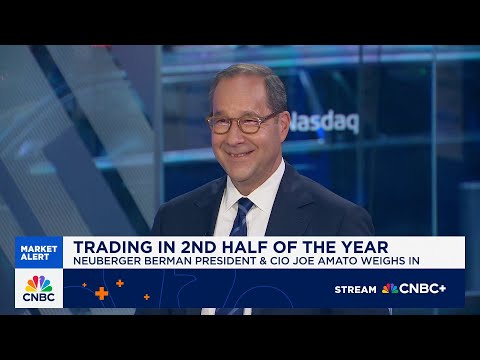
Seeing better value in small cap and non-U.S. equities in 2nd half of the year, says Joe Amato
CNBC Television· 2025-07-02 11:56
Market Outlook & Investment Strategy - The firm suggests rotating into value and small-cap stocks, as they have underperformed in the first half of the year [5] - The firm is at target for large-cap stocks but overweight in small-cap and non-US equities, believing there is better value in these areas for the second half of the year [6] - The firm has been bullish on Japan for a number of years due to strong improvements in corporate governance and better returns for shareholders [7] Currency & Economic Factors - The dollar index was down 11% in the first half of the year, marking its worst performance since 1973 [7] - The firm anticipates potential dollar weakness, especially if the Federal Reserve reduces rates by 100 basis points over the next year [8][9] - A softening dollar is seen as a reason to be overweight in developed markets outside the US [10] - Fiscal stimulus in Europe, particularly in Germany, is expected to be beneficial [6] Sector Analysis - There was a rotation out of higher multiple sectors like tech and AI into lower multiple sectors like consumer discretionary [2] - Financials are favored due to the prospect of less stringent regulation and potential capital returns [15][16] - The firm believes that progrowth policies and less regulation will benefit small and mid-cap companies more significantly [13] Risk Factors - Headline risk related to tariffs, particularly with Japan and China, remains a concern [16][17][18]