
High - speed Railway Construction

Search documents
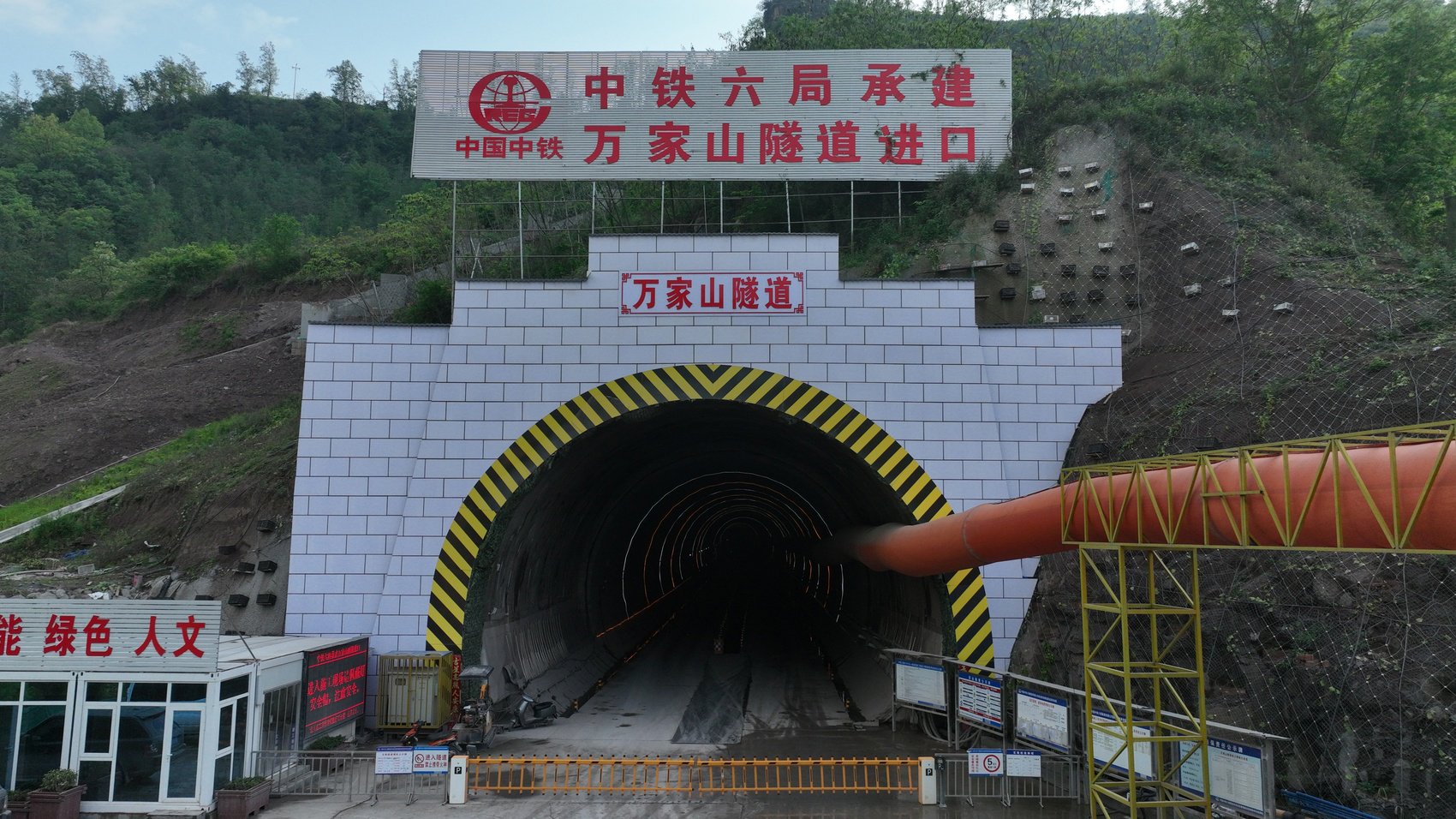
西渝高铁康渝段首座超6公里隧道贯通
Xin Lang Cai Jing· 2026-01-01 12:38
Core Viewpoint - The successful completion of the Wanjia Mountain Tunnel marks significant progress in the construction of the Xiyu High-Speed Railway, specifically the Kangyu section, which is crucial for enhancing transportation connectivity in the central and western regions of China [1][5]. Group 1: Tunnel Construction Details - The Wanjia Mountain Tunnel is 6,465 meters long and is a single-tube double-track tunnel, designed by China Railway Erju and constructed by China Railway Sixth Group [3]. - The construction faced complex geological conditions, including soft rock deformation and harmful gases, which posed high safety risks and construction challenges [3]. - Advanced construction techniques were employed, including laser calibration for arch installation, intelligent concrete pouring systems, and step-by-step excavation methods to ensure safety and timely completion [3][5]. Group 2: Impact on Transportation and Development - With the successful completion of the Wanjia Mountain Tunnel, a total of 43 tunnels have been completed in the Kangyu section of the Xiyu High-Speed Railway, with other major infrastructure works progressing smoothly [5]. - The Xiyu High-Speed Railway will connect with other major high-speed rail lines, significantly reducing travel time between Xi'an and Chongqing, thereby improving the railway network structure in the central and western regions [5]. - The railway's completion is expected to facilitate rural revitalization, promote urban-rural integration, and support coordinated regional development, contributing to a new pattern of western development [5].

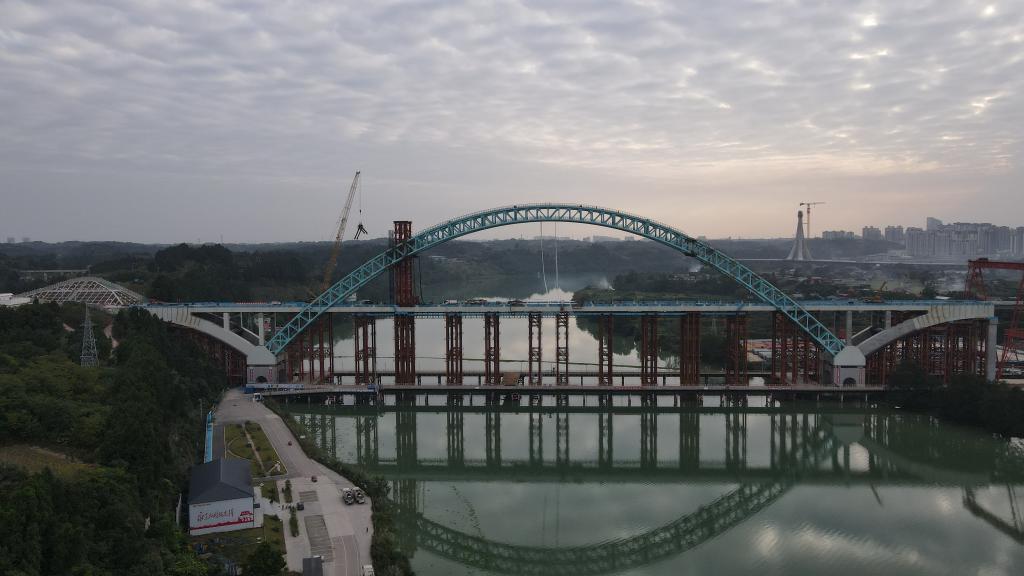
成渝中线高铁沱江特大桥顺利合龙
Xin Hua Wang· 2025-11-10 11:45
Core Points - The main beam of the Tuojiang Grand Bridge, a key project of the Chengyu Middle Line High-Speed Railway, successfully completed its closure on November 10 in Jianyang, Sichuan [1][3] - The bridge spans 1252 meters and features innovative design solutions to address construction challenges, including a no-thrust arch bridge structure [3] Group 1: Construction Challenges and Innovations - The main arch, weighing 2200 tons and measuring 174 meters, was lifted 21.7 meters with a height difference of no more than 20 millimeters at four lifting points, likened to "airborne embroidery" [3] - A virtual assembly technology was utilized for repeated simulations to ensure precise lifting speed and posture, allowing eight welders to work simultaneously at a height of 103 meters above the river [3] - The main beam closure required a 5000-ton horizontal tensioning method, with high precision demands, supported by a construction monitoring information system to dynamically adjust parameters and control errors to the millimeter level [3] Group 2: Project Overview and Significance - The Chengyu Middle Line High-Speed Railway has a total length of 292 kilometers and is designed for a speed of 350 kilometers per hour [3] - This project is a crucial part of China's "Eight Vertical and Eight Horizontal" high-speed rail network, enhancing connectivity between the Yangtze River Economic Belt and the Chengdu-Chongqing urban agglomeration [3]
铁路国庆中秋假期运输今日启动,10月1日起不再提供“纸质票”
Xin Jing Bao· 2025-09-29 06:25
Core Points - The National Railway Group has initiated transportation for the National Day and Mid-Autumn Festival holiday period from September 29 to October 10, expecting to send 219 million passengers, with the peak day on October 1 and an average of 13,000 trains planned daily [1][2] Group 1: Holiday Transportation Overview - The holiday period combines an 8-day break, leading to a significant increase in travel demand, particularly for tourism, family visits, and student travel, resulting in concentrated passenger flow during peak times [2] - As of September 28, over 90 million tickets have been sold for the holiday period, with the railway department implementing a peak operation schedule [2] Group 2: New High-Speed Rail Lines - Several new high-speed rail lines have opened before the holiday, including the Shenyang to Jiamusi high-speed rail and the Xiangjing high-speed rail, enhancing regional transportation capacity [2][3] - The Shenyang to Jiamusi line spans 430 kilometers with a design speed of 350 km/h, while the Xiangjing line is 116 kilometers long, also designed for 350 km/h [3] Group 3: Enhanced Services During Peak Travel - During peak travel times, night high-speed trains will be added, and sleeper trains will be arranged for specific routes to accommodate increased passenger demand [4] - The railway department will monitor passenger flow closely and adjust train services accordingly, ensuring a balance between long-distance and short-distance travel needs [4] Group 4: Digital Ticketing and Services - Starting October 1, the railway will fully implement electronic invoices, discontinuing the provision of printed reimbursement vouchers, while still offering paper travel information for those who need it [7][8] - The transition to electronic invoicing aims to improve convenience for passengers, especially for elderly and non-digital users, with additional offline application channels being established [8]
襄荆高铁试运行,全线开通运营进入倒计时
Zhong Guo Xin Wen Wang· 2025-08-25 01:12
Core Viewpoint - The Xiangjing High-Speed Railway has officially begun trial operations, marking a significant step towards its full opening, which is expected soon [1] Group 1: Project Overview - The Xiangjing High-Speed Railway is located in northwestern Hubei province, starting from Xiangyang and ending in Jingmen, with a total length of approximately 116.23 kilometers [1] - The railway is designed for a maximum speed of 350 kilometers per hour and includes 69 new bridges and 16 tunnels, with bridges and tunnels accounting for 84.7% of the total length [1] - There are three passenger stations along the line: Xiangyang East Station and Jingmen West Station (existing stations), and Yicheng Station (newly built) [1] Group 2: Strategic Importance - The Xiangjing High-Speed Railway connects with the Zhengzhou-Chongqing High-Speed Railway to the north and the Shanghai-Chongqing-Chengdu High-Speed Railway to the south, forming an important part of China's "Eight Vertical and Eight Horizontal" high-speed rail network, specifically the "Hunan-Guangdong Corridor" [1] - Once operational, travel time between Xiangyang and Jingmen will be reduced to approximately 30 minutes, enhancing connectivity and supporting the high-quality development of the Yangtze River Economic Belt [1] - The railway is expected to play a crucial role in accelerating Hubei's strategic development as a key point in the central region's rise [1]