
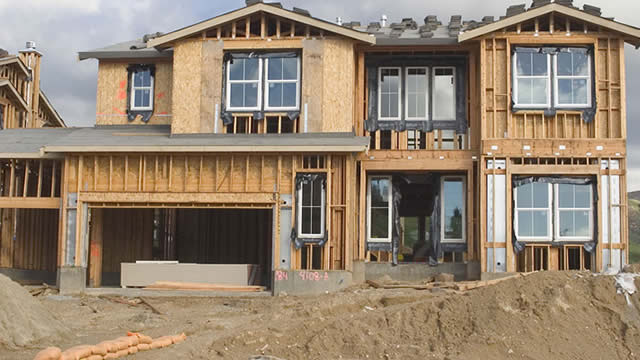
Housing supply shortage

Search documents
Inflation Hope vs. Rate Reality: Is Housing Market at Crossroads?
ZACKS· 2026-03-31 14:46
Core Insights - The U.S. housing market is showing signs of normalization with a decrease in the 30-year fixed-rate mortgage to 5.98% as of February 26, 2026, after being above 6% for over a year [1] - However, geopolitical tensions and tariffs have led to a rise in mortgage rates to 6.38% by March 26, 2026, impacting homebuyer affordability and potentially slowing demand [2] - Federal Reserve Chair Jerome Powell expressed optimism about inflation responding less to oil price hikes and tariffs, indicating the Fed's interest rate benchmark is in a good position for observing future developments [3] Housing Market Dynamics - Despite elevated mortgage rates and inflation concerns, the homebuilding industry has a positive mid- to long-term outlook due to strong structural fundamentals [5] - A persistent housing supply shortage is stabilizing home prices, while homebuilders are offering incentives like mortgage rate buydowns to maintain sales momentum [6] - Homebuilders are in a stronger financial position compared to previous cycles, with better inventory management and healthier balance sheets, allowing them to navigate short-term volatility [6] Inflation and Economic Outlook - Jerome Powell's statements suggest inflation could stabilize near 2% without tariffs, indicating a critical inflection point for the housing market amid easing inflation expectations and high mortgage rates [7] - The trajectory of inflation will be crucial in determining whether the housing market recovers or remains stagnant [8] Earnings Estimates for Homebuilders - Beazer Homes USA (BZH) has seen a decline in earnings estimates for fiscal 2026 by 57.1%, but a significant growth of 283.8% is expected for fiscal 2027 [11] - Century Communities (CCS) has experienced a 22.5% decline in earnings estimates for 2026, while estimates for 2027 remain stable with a projected growth of 63.2% [12] - D.R. Horton (DHI) has a 9.5% decline in earnings estimates for fiscal 2026, but a growth of 16.1% is anticipated for fiscal 2027 [14]


Homebuying Is More Affordable. Why Rising Oil Prices Could Spoil the Party.
Barrons· 2026-03-14 00:59
Core Insights - First-time home buyers are re-entering the market according to data from the National Association of Realtors [1] - The housing supply remains tight, which could impact market dynamics [1] - Inflation driven by war could lead to increased mortgage rates, affecting affordability for buyers [1] Market Dynamics - The return of first-time home buyers indicates a potential recovery in the housing market [1] - Tight supply conditions suggest that competition for available homes may increase [1] - Rising mortgage rates due to inflation could deter some buyers, impacting overall market activity [1]

Bank of America CEO Says 'Lock-In Effect' Isn't the Real Housing Crisis —Half of Households Don't Even Have a Mortgage, So What's Really Stalling Sales?
Yahoo Finance· 2026-01-10 12:46
Core Insights - Bank of America CEO Brian Moynihan argues that the primary issue in the housing market is not homeowners with low mortgage rates but rather the inability of potential buyers to afford homes [1][2] - Moynihan highlights that approximately half of the 130 million households in America do not have a mortgage, indicating that the "lock-in" effect is not relevant for many renters and mortgage-free homeowners [2] - He emphasizes a universal housing shortage, stating that the solution lies in increasing housing supply and streamlining the permitting process [3] Group 1 - The housing market is facing challenges due to affordability issues for potential buyers rather than existing homeowners with low mortgage rates [1][2] - There are about 130 million households in America, with half being mortgage-free, which shifts the focus from locked-in homeowners to renters who are struggling with rental affordability [2] - Moynihan believes that simply lowering mortgage rates will not significantly impact the housing market, as many homeowners with low rates are unlikely to sell [3] Group 2 - The housing market is characterized by a universal shortage, necessitating increased housing supply and improved permitting processes to address the issue [3] - The current economic environment should not rely on low interest rates for growth, as this could indicate underlying economic weaknesses [3] - With strong demand for rental housing and lagging supply, there are opportunities for investors to generate income from rental properties rather than being adversely affected by the housing market constraints [3]
