Iceberg Index

Search documents
员工吐槽“给 AI 擦屁股”更辛苦?揭秘企业 AI 提效的“悖论”与真拐点
3 6 Ke· 2025-12-17 02:45
Core Insights - AI is becoming a core engine for innovation and growth in enterprises, prompting discussions on how to leverage AI for new business opportunities and efficient user acquisition, retention, and conversion [1][2]. Group 1: Model Utilization - The current top AI models, such as GPT-4 and Gemini 3, are likened to "PhD-level" intelligence, but the engineering environment and prompts provided are still at a "elementary school" level, leading to a mismatch in capabilities [3]. - Selecting the right foundational model based on specific scenarios is crucial, as GUI operations differ significantly from text or voice tasks, with the "Qianwen 3" model showing promising results in GUI reasoning [3][4]. - The design of AI Agent architecture must account for uncertainty and allow for controlled interactions with systems, incorporating mechanisms like a "referee" role to guide operations [4]. Group 2: Context Engineering - Context engineering, or prompt engineering, is essential for maximizing AI capabilities, as it allows for the injection of necessary information and expert knowledge into the model [4][5]. - The importance of context is highlighted by the need for a complete understanding of tasks, as models cannot be expected to provide final answers without sufficient context [5][6]. Group 3: Data Governance - Data governance is a critical precondition for AI model engineering, requiring the transformation of enterprise knowledge into a format that models can understand [9][10]. - Effective data governance involves both knowledge data, which includes expert experience and structured analysis, and production data, which encompasses API call records and system logs [11]. - The governance process must ensure that data is accurate, timely, and secure, particularly in multi-agent environments to prevent data leakage [11][14]. Group 4: Efficiency and Employee Experience - The perception of efficiency gains from AI varies, with some employees feeling overwhelmed by the need to write prompts and verify AI outputs, especially when accuracy is low [15][16]. - Achieving high accuracy rates (e.g., from 40% to 90-95%) significantly boosts employee confidence in AI tools, leading to noticeable efficiency improvements [15][16]. Group 5: AI in Business Context - AI technology is capable of automating approximately 11.7% of labor tasks in the U.S. economy, with a significant portion of these tasks found outside the tech industry, such as in finance and logistics [18][19]. - The key to successful AI integration is not the technology itself but the ability of individuals to effectively utilize AI tools [19]. Group 6: Hiring and Skills Development - The hiring criteria for technical roles are evolving, with an emphasis on candidates' ability to understand and leverage AI technologies, including skills in probability thinking and effect evaluation [20][21]. - Project managers and testing engineers now require a blend of business understanding and technical knowledge to effectively manage AI projects and ensure quality assurance [21][22]. Group 7: Future Considerations - Companies are advised to carefully select AI application scenarios based on business value, data readiness, and acceptable error margins, avoiding both overly ambitious and trivial projects [24][25]. - Continuous iteration and small-scale pilot testing are recommended to identify effective AI applications, with a focus on integrating AI capabilities into existing business processes [26].
AI can already replace 11.7% of the U.S. workforce, MIT study finds
CNBC Television· 2025-11-26 16:00
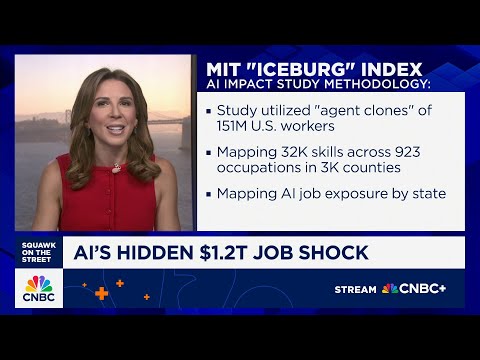
AI Impact on Labor Market - MIT研究表明,AI可能影响美国12%的劳动力市场,涉及约12万亿美元的工资 [3] - 报告揭示了AI驱动的工资颠覆中,隐藏的风险层是目前可见的五倍,影响跨行业和地域 [2] - “冰山指数”通过模拟1.51亿美国劳动者的数字孪生,识别出最易受AI影响的职业 [1] Industry and Geographic Exposure - 医疗保健、金融和专业服务领域的职业面临较高的AI替代风险 [3] - AI的影响不仅限于沿海城市,各州都存在AI替代的风险 [2] Policy and Training Implications - 该指数为决策者提供了详细的地图,可以了解AI颠覆的形成地点,并进行假设情景分析,以便在投入资金和立法之前进行评估 [3] - 田纳西州、犹他州和北卡罗来纳州等州正在使用“冰山指数”来测试新的培训计划和技能优先的招聘规则 [4] - “冰山团队”构建了一个交互式模拟环境,允许各州试验不同的政策杠杆,例如转移劳动力资金和调整培训计划 [5] Tools and Resources - 该报告提供了一个早期预警地图,以便决策者可以在冲击来临之前转移资金和进行培训 [5] - 田纳西州已经建立了自己的人工智能和工作仪表板,用于跟踪全州的职业风险和工资影响,以指导其政策和支出决策 [6]