Reskilling

Search documents
What Needs To Happen During The AI Job Transition?
ARK Invest· 2026-03-20 13:06
AI doesn't change the success rate of entrepreneurship. Or it shouldn't. I mean, maybe it increases it a bit.>> Yeah, maybe it makes it better, but it doesn't change the fact that yes, these people can go out, start a business. >> Does that, you know, give them a $500,000 salary, a $200,000 salary that they were previously getting at one of these tech companies. Like I I I feel like I agree that there's if if we're all agreeing that every company is bloated and that AI could force layoffs across the board l ...


'We don't have to accept an AI job apocalypse': Pearson CEO
Youtube· 2026-02-27 11:42
Core Insights - The company expresses strong confidence in its future, attributing this to the advantages provided by AI and its unique business model [1][4] - The company reported a 4% growth in net revenues, a 6% increase in operating profit, and an 8% rise in free cash flows for the previous year, with a conversion rate of 125% [2] - The company anticipates mid-single-digit growth for the current year and is optimistic about 2026 [3] Business Model and Profit Streams - 80% of the company's profit comes from assessments and virtual schools, with an additional 10% from print, indicating that 90% of profits are derived from complex, human-led services in regulated markets [6] - The remaining 10% of operating profit is generated from digital courseware, which is deeply integrated into educational systems [9][10] - The company emphasizes the operational excellence required for its services, which includes biometric security, supply chain management, and psychometric validation [7][8] AI and Reskilling Demand - The company has secured nine significant contracts with leading technology firms to assist in reskilling efforts, highlighting the growing demand for such services [5] - The company acknowledges the transformative impact of AI on job markets but believes that it can also create new opportunities for reskilling and training [24][25] Trust and Operational Excellence - Trust is a critical component of the company's business model, with the CEO noting that only a few companies can match its capabilities, which fosters customer confidence [13][14] - The company is focused on maintaining high operational standards and addressing past issues, such as fines related to breaches of standards [12][15] Market Position and Economic Factors - Approximately 70% of the company's revenues are generated in the US, where it employs around 6,000 people and invests about £1.5 billion annually [17][18] - The company has not been significantly affected by recent tariff changes, as most of its operations are digital [18] Job Market Concerns - The discussion highlights concerns about job displacement due to AI, particularly in professions like law, where efficiency gains could reduce the need for traditional roles [19][26] - The company acknowledges the uncertainty surrounding future job markets but emphasizes the potential for new roles to emerge as industries evolve [32][33]


U.S. Tech Hiring Moderates as Employers Prioritize Quality Over Quantity
Prnewswire· 2026-01-15 14:32
Core Insights - The U.S. tech hiring landscape is showing signs of moderation as 2026 begins, with a reported Net Employment Outlook (NEO) of 33% for the first quarter [1] Group 1: Hiring Trends - Nearly half of tech employers in the U.S. still plan to hire despite the moderation in hiring activity [1] - The Net Employment Outlook (NEO) of 33% indicates a positive but cautious hiring environment among tech employers [1] Group 2: Skills Gaps and Reskilling - Persistent skills gaps in the tech industry are prompting employers to invest in reskilling initiatives [1] - Companies are adopting flexible workforce strategies to address the challenges posed by these skills gaps [1]


AI can already replace 11.7% of the U.S. workforce, MIT study finds
CNBC Television· 2025-11-26 16:00
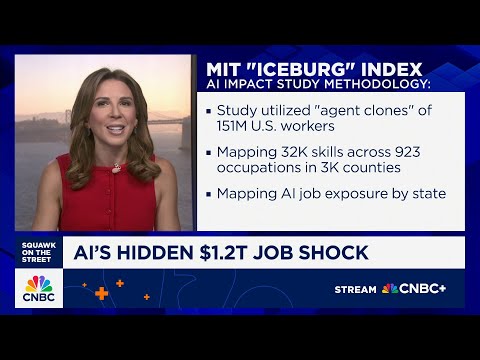
AI Impact on Labor Market - MIT研究表明,AI可能影响美国12%的劳动力市场,涉及约12万亿美元的工资 [3] - 报告揭示了AI驱动的工资颠覆中,隐藏的风险层是目前可见的五倍,影响跨行业和地域 [2] - “冰山指数”通过模拟1.51亿美国劳动者的数字孪生,识别出最易受AI影响的职业 [1] Industry and Geographic Exposure - 医疗保健、金融和专业服务领域的职业面临较高的AI替代风险 [3] - AI的影响不仅限于沿海城市,各州都存在AI替代的风险 [2] Policy and Training Implications - 该指数为决策者提供了详细的地图,可以了解AI颠覆的形成地点,并进行假设情景分析,以便在投入资金和立法之前进行评估 [3] - 田纳西州、犹他州和北卡罗来纳州等州正在使用“冰山指数”来测试新的培训计划和技能优先的招聘规则 [4] - “冰山团队”构建了一个交互式模拟环境,允许各州试验不同的政策杠杆,例如转移劳动力资金和调整培训计划 [5] Tools and Resources - 该报告提供了一个早期预警地图,以便决策者可以在冲击来临之前转移资金和进行培训 [5] - 田纳西州已经建立了自己的人工智能和工作仪表板,用于跟踪全州的职业风险和工资影响,以指导其政策和支出决策 [6]
In healthcare AI isn't replacing people, its restoring capacity, says Outcomes AI CEO
CNBC Television· 2025-10-16 21:32
AI Impact on Job Market - Nestle will simplify its organization and automate processes, cutting 16,000 jobs [1] - Corporate leaders suggest AI will eliminate jobs, with some companies already reducing workforce due to AI efficiency gains [2] - The impact of AI on jobs depends on the nature of the work and the pace of adoption, with banking and customer service being more susceptible to automation [4] - AI adoption may require workforce reskilling, similar to the offshoring or outsourcing challenge [8] Healthcare Industry & AI - Healthcare faces a shortage of nurses and physicians, projected to be almost 1 million nurses by 2031 [5] - In healthcare, AI is seen as restoring capacity rather than replacing people, by automating administrative and repetitive tasks [6][7][8] - Outcomes AI uses AI to improve patient care time for nurses by handling rudimentary questions [3] - AI can handle 60% of nurses' work, such as answering calls, care coordination, and data entry into EHRs [8] - AI is being trained to exhibit empathy and bedside manners in patient interactions [10]
Nearly 4 in 10 companies will replace workers with AI by 2026, survey shows
Yahoo Finance· 2025-09-22 10:40
Group 1 - Companies are increasingly investing in and adopting AI tools, with nearly 30% already having replaced jobs with AI, and 37% expecting to do so by the end of 2026 [1] - AI adoption is projected to reshape the job market significantly over the next 18 to 24 months, leading to the displacement of routine roles and the emergence of new job categories focused on AI oversight and collaboration [2] - Economic uncertainty, trade policy, and AI are cited as primary reasons for hiring pullbacks and layoffs, with 39% of surveyed leaders having conducted layoffs in 2025 and 58% believing layoffs are likely in 2026 [2] Group 2 - High-salary employees and those lacking AI-related skills are at the highest risk for layoffs, with recently hired and entry-level workers also facing increased vulnerability [3] - Companies are moving towards leaner, tech-ready workforces, prioritizing cost efficiency and agility over traditional career pathways, prompting a need for professionals to reskill in AI and emerging technologies [4] - Soft skills such as adaptability and emotional intelligence are becoming increasingly important, alongside technical skills, for differentiating top talent in the future [4] Group 3 - Recent trends indicate that HR leaders have engaged in "serial layoffs," reflecting a shift towards reactive workforce management rather than long-term planning, which has negatively impacted morale and led to a loss of critical skills [5]
Employers say they are staying the course instead of hiring right now
Yahoo Finance· 2025-09-15 10:26
Group 1 - Employers are becoming cautious in their hiring outlook, focusing more on retention rather than new hiring, with an emphasis on selective hiring to maintain organizational resilience [3][4] - Nearly half of employers surveyed identified attracting qualified applicants and retention as their biggest challenges, with AI talent remaining in demand despite hiring slowdowns in other areas [3] - Two-thirds of HR managers have implemented hiring freezes, and nearly half plan to pause recruitment for at least the next 12 months, leading to a focus on reskilling and internal mobility [4] Group 2 - The global hiring market is becoming more measured due to economic uncertainty, with 45% of employers intending to maintain current workforce levels in Q4 2025, the highest since early 2022 [6] - Less than 40% of employers plan to add staff in Q4, while 15% expect to reduce their workforce, indicating a cautious approach to hiring [6] - Employers that do intend to hire are focusing on specific capabilities, particularly in technological advancement [6]