Industry-Education Integration

Search documents
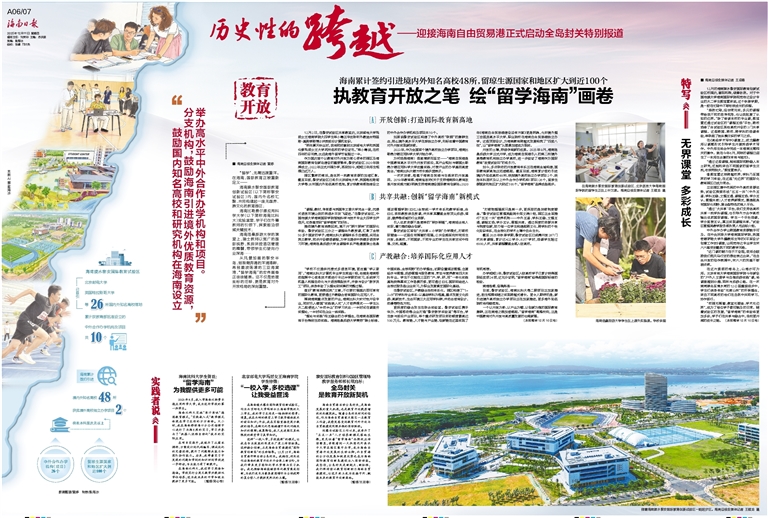
执教育开放之笔 绘“留学海南”画卷
Hai Nan Ri Bao· 2025-12-11 00:57
Core Insights - Hainan has signed agreements to introduce 48 renowned domestic and international universities, expanding the source countries and regions for students to nearly 100, marking a significant step in redefining international education in Hainan [11][14]. Group A: Open Innovation - Building an International Education Hub - The Lian'an International Education Innovation Pilot Zone was established in 2020 and has attracted 26 domestic and international universities, with 10 approved Sino-foreign cooperative education institutions and projects [12][14]. - The establishment of the Hainan Bielefeld University of Applied Sciences in 2023 represents a breakthrough in China's educational openness, aligning with Hainan's free trade port strategy [13]. - By 2025, the Hainan Lausanne University will also commence operations, further enhancing Hainan's appeal as a "policy testing ground" for international education [13]. Group B: Shared Integration - Innovating the "Study in Hainan" Model - The Lian'an Pilot Zone offers a unique educational experience with one-third of courses taught by foreign teachers, attracting students from over 50 countries [15]. - The "Big Sharing + Small College" model promotes inter-institutional collaboration, allowing students from different backgrounds to engage and learn together [16]. - By the fall of 2025, the pilot zone will have opened 287 shared courses, covering all participating universities [16]. Group C: Industry-Education Integration - Cultivating International Talent - The Hainan Bielefeld University emphasizes practical learning, with students engaging in internships that bridge theory and practice [17]. - The curriculum is tailored to Hainan's key industries, incorporating a "practice-embedded" training model that combines classroom learning with real-world experience [18]. - The pilot zone has established a "1+3+N" academic system focusing on cultural tourism, high-tech, and ecological environment disciplines, fostering collaboration with companies like Huawei [18]. Future Prospects - The Lian'an Pilot Zone and Hainan Bielefeld University are set to expand their enrollment significantly, with more overseas universities expected to establish independent programs in Hainan [20]. - An international education cluster is rapidly emerging in Hainan, driven by openness, industry alignment, and innovation [20].

上海天华人工智能科创园开园启用:构筑产教融合创新生态
Xin Hua Cai Jing· 2025-12-09 07:46
Core Insights - The establishment of the Shanghai Tianhua Artificial Intelligence Innovation Park aims to integrate education, research, and production, focusing on talent cultivation and innovation [1][2] Group 1: Innovation Ecosystem - The innovation park will feature six core functional platforms to support an integrated ecosystem of education and industry [1] - Key platforms include the Tianhua Artificial Intelligence Research Institute, Tianhua Robotics Industry College, X-SCHOOL Innovation Center, Low-altitude Economy Innovation Base, Tianhua AI + Health Management Center, and the National Overseas Students Entrepreneurship Park 2.0 [1][2] Group 2: Educational Focus - The East Campus of Tianhua College is set to prioritize new engineering disciplines such as artificial intelligence, robotics, drones, and smart medical devices [2] - The college has developed over 100 interdisciplinary general courses and mandatory courses that integrate innovation and entrepreneurship [1] Group 3: Industry Collaboration - The collaboration model involves government policy guidance, school resource support, and shared development within the industrial park [2] - Sixteen companies, including Titanium Tiger Robotics and Jingyi Times Technology, have signed agreements to establish a presence in the innovation park [2]
产教融合推动土木工程教育转型
Xin Hua Ri Bao· 2025-12-04 21:58
Core Insights - The modern industrial system is identified as the material and technical foundation for Chinese-style modernization, with the civil engineering industry playing a crucial role in supporting national infrastructure development [1] - The transition of the civil engineering sector from traditional construction methods to a modern industrial system characterized by greening and intelligence is emphasized as a critical opportunity during the 14th Five-Year Plan period [1] - The integration of education and industry is highlighted as a key strategy to cultivate innovative and compound talents capable of leading future industry development [2] Group 1: Strategic Value of Industry-Education Integration - Industry-education integration is a vital link connecting national strategic needs, with high-quality civil engineering talent being essential for the implementation of new infrastructure and urban renewal initiatives [2] - Deepening school-enterprise collaboration can incorporate cutting-edge technologies and practices into the educational process, enhancing students' practical capabilities to serve national strategies [2] - The integration serves as an internal driving force for upgrading professional content, addressing issues such as outdated curricula and insufficient interdisciplinary integration [2] Group 2: Challenges in Industry-Education Integration - There is a lack of consensus on the concept of industry-education integration, with some educators viewing it as superficial cooperation rather than a systemic and collaborative approach [3] - The curriculum is often disconnected from industry practices, with low practical course content and limited integration of advanced technologies [3] - The mechanisms for school-enterprise collaboration are not deeply established, leading to short-term partnerships and a lack of sustained institutional support [3] Group 3: Multi-Party Collaboration for Development - A multi-party collaborative mechanism involving government, schools, enterprises, and industry should be established to enhance top-level design and institutional support for civil engineering education [4] - The curriculum should be restructured to integrate industry needs, incorporating real project cases and emerging topics such as smart construction and green building [4] - Strengthening the dual-teacher system and creating a practical platform that combines virtual and real-world experiences is essential for effective education [5] Group 4: Implementation Strategies - The establishment of a dual-logic driven teaching system that combines academic and industry logic is proposed to enhance the educational framework [4] - Faculty development should include a dual mentorship system, requiring educators to engage in industry practices and providing training for industry mentors [5] - Creating immersive virtual laboratories linked to real engineering sites can facilitate a new teaching model that emphasizes practical experience [5]
高校助力人工智能和机器人产业发展大会举行
Nan Fang Du Shi Bao· 2025-06-14 10:28
Group 1 - The conference aimed to leverage the technological innovation and talent cultivation advantages of universities in Guangdong to support the development of the artificial intelligence and robotics industries [2] - The report presented by the Chief Economist of the Provincial Department of Industry and Information Technology highlighted the current state, issues, and support policies for the AI and robotics industry, emphasizing the need for deeper integration of education and industry to overcome development bottlenecks [2] - The XbotPark innovation model introduced by Professor Li Zexiang features an "end-to-end, high-quality, high-efficiency" approach, integrating a multidisciplinary project-driven talent training system and a full-chain innovation and entrepreneurship ecosystem [2] Group 2 - The Director of the Provincial Artificial Intelligence Talent Training Committee outlined five innovative work plans, while representatives from Guangdong University of Technology and Sun Yat-sen University shared their experiences in talent cultivation [3] - The Deputy Director of the Provincial Education Department emphasized that the integration of education and industry is crucial for high-quality industrial development, advocating for mutual exchange and dual empowerment between universities and enterprises [3] - The conference encouraged universities to optimize their academic programs, accelerate the layout of emerging majors, and enhance practical teaching through collaboration with enterprises [3]