Infrastructure Build

Search documents
Is There Enough Energy For The Amount Of AI Infrastructure?
ARK Invest· 2026-03-25 14:49
Well, I think people are concerned not just relative to energy availability. People are like, "Oh my gosh, all of this money pouring into AI, how can that possibly be a wise thing to do?" And the way we measure performance against AI is um you and I as a knowledge worker, how much value do we get out of um kind of the AI software that we're using. And uh the right now we think if you're using AI full boore, you can get a 50% um ROI improvement on AI as in I put in one unit of work, I get 1.5% units of outpu ...


AI investing in 2026: Volatility, valuations, adoption, and risks
Youtube· 2025-12-28 11:01
Group 1: AI and Tech Sector Outlook - The tech sector, particularly the AI trade, is expected to be a significant winner in 2025, but there are concerns about volatility in 2026 due to a mismatch between infrastructure buildout and enterprise AI adoption [1][2] - The semiconductor index has risen nearly 48% year-to-date, while the software index (IGV) has only increased by 7.8%, indicating a lag in software adoption compared to hardware [3] - Only about 30% of the global 2000 companies are ready to adopt Generative AI, with 70% still in the process of data cloud migration and cleansing, suggesting that significant enterprise AI adoption may not occur until 2027 or 2028 [5][6] Group 2: Capital Expenditure and Financial Health - Major tech companies are expected to continue significant capital expenditures (capex), with Microsoft and Google being the only firms capable of funding this due to their strong cash flow [7][8] - Concerns are rising regarding the financial stress and debt loads of some tech companies, particularly those with negative free cash flow, as they may struggle to fund infrastructure builds [8][9] - The potential need for several major tech companies to raise substantial capital simultaneously could drain equity liquidity, impacting existing investors [9] Group 3: Component Costs and Market Dynamics - Rising component costs, particularly for DRAM memory, are becoming a critical issue, with average selling prices (ASPs) for DRAM up 20% sequentially, which could affect margins and demand elasticity [11][12] - Companies in the PC supply chain and handset areas may face shortages of required memory due to high AI spending, leading to potential price increases [12][13] Group 4: Geopolitical Considerations - The geopolitical landscape, particularly the sanctions imposed by China on US defense companies, is viewed as a form of economic warfare that could escalate tensions between the two nations [14][16] - The shift in defense budgets towards AI technologies is significant, and the ongoing sanctions may have long-term implications for economic and defense strategies in 2026 and beyond [15][17]

Fed's challenge is if labor weakness is demand related or more structural, says KPMG's Diane Swonk
Youtube· 2025-11-14 19:03
Economic Outlook - The Federal Reserve's probability of two successive interest rate cuts in October and December has significantly decreased to 41% from nearly 100% prior to the last meeting, influenced by recent Fed communications and economic concerns [2][3][4] - Inflation remains a critical issue, with current rates around 3%, exceeding the Fed's target of 2%, leading to concerns about the Fed's credibility in managing inflation [4][7][8] Inflation Drivers - The rise in inflation is attributed not only to tariffs but also to broader economic factors, including labor market shortages in sectors like elder care and daycare, which are contributing to affordability issues [6][9] - The dispersion of price indices in the Consumer Price Index (CPI) indicates that more goods and services are experiencing price increases, suggesting persistent inflationary pressures [5][6] Labor Market Dynamics - Despite a seemingly strong economy, the labor market data indicates softness, with job growth concentrated in specific sectors like AI and infrastructure, raising concerns about overall labor market participation [7][10] - Current immigration policies may lead to stagnation or even a decline in labor force growth, with estimates suggesting that a payroll growth rate as low as 30,000 to 50,000 jobs per month may be necessary to maintain stable unemployment rates [13][14]
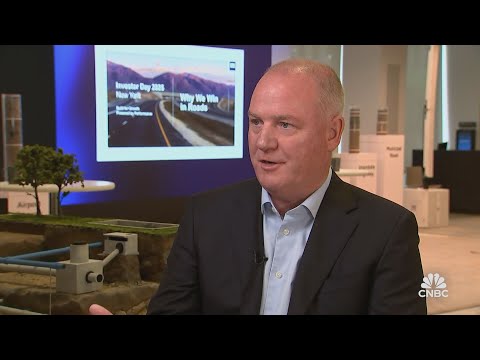
CRH CEO Jim Mintern on stock outperforming the materials sector
CNBC Television· 2025-09-30 15:59
Business Outlook & Strategy - CR is positioned as the number one infrastructure player in the US, focusing on roads, water, and re-industrialization, which are considered three major mega-trends [2] - The company views the current infrastructure build as still in its early stages, with only approximately 40% of the funding deployed, anticipating a ramp-up phase into 2026 and beyond [3][4] - CR emphasizes a connected product offering beyond just aggregates and concrete, including water, communications, and energy infrastructure, positioning them as often the first on site for re-industrialization projects [32][33][15] - The company highlights its ability to compound capital effectively in the building material space, emphasizing its track record over the past 1 to 50 years [34] Market Dynamics & Opportunities - The US road materials market is valued at approximately $45 billion, with about 90% of CR's revenue in this sector coming from public sector customers, providing a stable and recurring revenue stream [6][7] - The US water ecosystem represents an approximately $100 billion opportunity, with CR largely focused on storm water and water storage, seeing high growth potential in this area [8] - Reshoring and tariff policies are seen as a net positive, driving the return of critical industrial infrastructure to the US and benefiting CR's business [16][15] - Potential interest rate cuts are expected to positively impact the residential sector, where the current affordability issue is hindering new build residential projects, needing rates to begin with a 5% to stimulate growth [17][19] AI Buildout & Related Projects - CR is involved in AI buildout projects, including large chip manufacturing plants and data center projects, supplying subterranean infrastructure like water coolant, energy, and communications [21][22][24] - For a hypothetical $1 billion AI project, CR's involvement extends beyond just supplying rocks, encompassing water, ventilation, and other infrastructure needs from the green field location [25][26] - Nuclear energy is identified as a potential opportunity, with CR having expertise in nuclear facilities, particularly from international projects, which are heavy users of their products [29][30]