Interchange Fees

Search documents
The Death of Credit Card Rewards: What 650 Million Cardholders Need To Know
Coin Bureau· 2026-01-25 12:45
Recently, US President Donald Trump promised to set an interest rate cap of 10% on credit cards. At the same time, US politicians quietly tabled a bill that would significantly lower credit card swipe fees. What does this have to do with crypto, I hear you ask.Well, 200 million Americans have an estimated 650 million credit cards due to the rewards these cards offer. rewards that are funded by interest and fees. So, what happens when the rewards on traditional credit cards decline and the rewards on crypto ...


Walmart wants out of card class
Yahoo Finance· 2025-12-16 10:27
Core Viewpoint - Walmart is seeking to decertify a class of plaintiffs in card fee litigation against Visa and Mastercard, arguing that large merchants have distinct interests that are not being represented adequately in the proposed settlement [2]. Group 1: Legal Actions and Class Representation - Walmart has requested U.S. District Judge Brian Cogan to either decertify the class of plaintiffs or allow large national merchants to opt out of the mandatory class [2]. - The company claims that the interests of large national merchants are being compromised by the plaintiffs and their lawyers, who are accused of prioritizing their own relief over those interests [2][5]. - Walmart describes the proposed settlement as "nakedly inequitable to large national merchants," highlighting a fundamental conflict of interest that disqualifies the current class representatives [2]. Group 2: Interchange Fees and Payment Methods - Walmart has been proactive in seeking ways to reduce interchange fees associated with credit and debit card transactions [3]. - The retailer is exploring alternative payment methods, including pay-by-bank options and instant payments, to mitigate these fees [3]. - The proposed settlement's modification of the "honor all cards" rule is deemed ineffective for large merchants, as they must accept customers' preferred payment types [4]. Group 3: Negotiation and Market Competition - Walmart argues that allowing large merchants to reject certain card types without enabling competition among issuers does not comply with antitrust laws [5]. - The company insists that it should be able to negotiate interchange rates directly with issuing banks to secure lower rates in exchange for its business [5]. - Walmart criticizes the class lawyers for their treatment of the company during negotiations, indicating a disregard for the interests of large national merchants [5].

Merchants assail card fees pact
Yahoo Finance· 2025-12-15 10:07
Core Viewpoint - Merchant groups are opposing a settlement aimed at resolving long-standing litigation regarding interchange fees set by Visa and Mastercard, claiming it grants excessive legal immunity to these networks [1][4]. Group 1: Settlement Details - The settlement proposed would reduce posted credit interchange rates by ten basis points for five years and impose a 1.25% rate for standard consumer cards over an eight-year period [4]. - Merchants would gain the right to refuse certain higher-cost Visa and Mastercard-branded credit cards, deviating from the networks' "honor all cards" policy, and would be allowed to impose surcharges on specific cards [4]. Group 2: Merchant Objections - Merchants, including major organizations like the National Restaurant Association and Walmart, argue that the settlement resembles a previously rejected agreement and does not enforce significant changes in how interchange fees are determined [2][3]. - The objections highlight concerns over the temporary nature of the fee caps and the lack of fundamental reforms in the fee-setting process, which they believe undermines antitrust laws [3][4]. Group 3: Legal and Class Action Implications - The settlement is criticized for providing Visa and Mastercard with immunity from future litigation regarding their fees, which some merchants argue perpetuates an antitrust violation [4]. - Walmart has requested the court to decertify the class action, allowing large merchants to opt out or redefine the class to exclude them, claiming that the settlement primarily benefits a smaller subgroup of merchants [5].


Visa and Mastercard Merchant Settlement Aimed at Rewards Cards
PYMNTS.com· 2025-11-09 22:16
Core Viewpoint - Visa and Mastercard are nearing a settlement with merchants that will lower interchange fees and provide more flexibility for merchants in card acceptance [2][3][5] Group 1: Settlement Details - The proposed settlement would reduce credit card interchange fees, currently between 2% and 2.5%, by an average of approximately 0.1 percentage points over several years [3] - Merchants would gain the ability to reject certain types of credit cards, allowing them to not accept all cards from a network if they choose [5][6] - The new agreement may categorize credit card acceptance into different types, such as rewards cards and commercial cards, which could impact consumer shopping behavior [5][6] Group 2: Legal Background - The legal battle began in 2005 when merchants accused Visa, Mastercard, and large banks of engaging in monopolistic practices regarding interchange fees and acceptance terms [7][8] - Previous attempts to settle, such as an agreement to reduce fees by 0.07 percentage points, were rejected by the court [8] Group 3: Consumer Impact - The potential changes could significantly affect consumers, as merchants may opt to decline high-fee rewards cards, which could lead to a loss of sales for those stores [5][6] - Research indicates that while many cardholders value loyalty rewards, only 20% redeem them at least once a month, suggesting varied consumer engagement with these benefits [9]
X @Bloomberg
Bloomberg· 2025-11-09 02:51
Industry Regulation - Credit card companies 可能需要根据协议条款降低交换费 [1] Negotiation Status - 该协议仍在讨论中 [1]
Chime shares jump in Nasdaq debut
CNBC Television· 2025-06-12 20:29
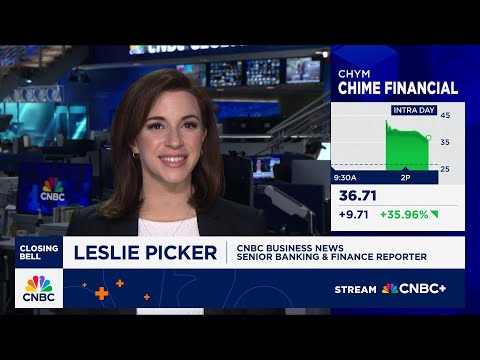
Yeah, Scott, quite the debut it's been today. Currently, shares are trading about 36% higher around 3667. This comes after Chime priced a dollar above the range at $27 per share, which at that time implied a fully diluted valuation of 11.6% billion, which is less than half the valuation Chime commanded back in 2021 in a private funding round.Uh, still of course the stock doing quite well today. Chime is a fintech company that provides banking services that target individuals making $100,000 a year or below. ...