Internet + Healthcare

Search documents
民生证券:首予京东健康“推荐”评级 Q3营收与盈利增长强劲
Zhi Tong Cai Jing· 2025-11-18 07:40
Core Viewpoint - JD Health (06618) shows strong revenue and profit growth in Q3 2025, with accelerating growth rates, supported by expanded insurance payment coverage, offline service expansion, and deepening AI medical applications, reinforcing its leading position in the pharmaceutical e-commerce sector [1] Performance - In Q3 2025, JD Health achieved revenue of 17.12 billion yuan, a year-on-year increase of 28.7% from 13.3 billion yuan, with growth accelerating from 23.7% in Q2 [2] - Operating profit reached 1.243 billion yuan, a significant year-on-year increase of 125.3% [2] - Non-IFRS operating profit was 1.378 billion yuan, up 59.9% year-on-year, while Non-IFRS net profit was 1.902 billion yuan, reflecting a 42.4% increase [2] Operational Data - JD Health continues to expand insurance payment coverage and upgrade service networks, with online insurance payments benefiting nearly 200 million people, a substantial increase from over 100 million year-on-year [3] - As of June 30, 2025, the platform had over 150,000 merchants, an increase of over 50,000 from the end of 2024 [3] - The "AI Jingyi" intelligent service user base surpassed 50 million, and offline service expansion included the opening of new medical beauty stores and health check centers [3] Strategic Cooperation - In Q3 2025, JD Health signed strategic cooperation agreements with several well-known pharmaceutical companies, including Eli Lilly and Bayer China, to strengthen its position in the high-end drug supply chain [4] Medical AI Applications - JD Health partnered with Huazhong University of Science and Technology to create a leading smart outpatient service platform, promoting the application of AI products in hospital outpatient services [5] - The AI accompaniment system aims to enhance patient experience and improve medical resource utilization, with potential for replication in more hospital settings [5] Investment Recommendations - JD Health's leading position in pharmaceutical e-commerce is solid, with ongoing online insurance payment policies and the scaling of AI services expected to provide short- to medium-term catalysts [6] - Revenue forecasts for 2025-2027 are projected at 71 billion, 82.9 billion, and 95.5 billion yuan, with adjusted net profits of 6.3 billion, 7.4 billion, and 8.5 billion yuan, respectively [6] - The current stock price corresponds to P/E ratios of 32, 28, and 24 times for the respective years [6]

电子处方,卷成白菜价
Hu Xiu· 2025-08-25 03:06
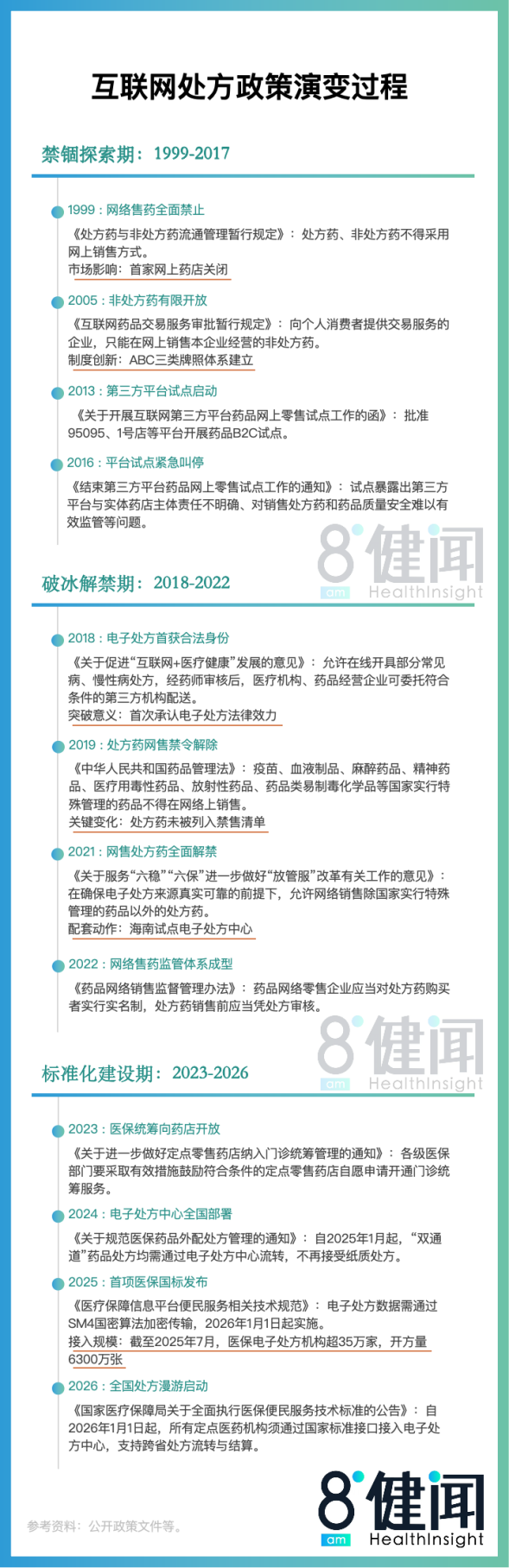
Core Insights - The online prescription drug market is experiencing significant growth, with sales projected to reach between 35 billion to 40 billion yuan in 2024 [1] - Prescription drugs have maintained a leading market share in the online drug sales sector for five consecutive years, outpacing over-the-counter drugs [2] - The growth of the online prescription drug market is supported by the increasing use of electronic prescriptions issued by internet hospitals [3] Market Dynamics - The average price of electronic prescriptions has decreased to between 0.4 to 0.6 yuan, contributing to the market's expansion [3] - Major platforms have reported an annual issuance of over 20 million prescriptions, with the total number of electronic prescriptions reaching hundreds of millions [6] - The electronic prescription industry is estimated to be nearing a scale of 1 billion yuan [6] Industry Structure - The electronic prescription process involves multiple stakeholders, including consumers, pharmacies, platforms, internet hospitals, and doctors, creating a complex supply chain [10] - Pharmacies pay an annual fee and a small review fee for each prescription issued, while platforms charge between 0.4 to 0.8 yuan for each prescription from third-party providers [8][9] - Doctors receive minimal compensation for each prescription, often around 0.4 yuan, and the process is increasingly dominated by AI, raising concerns about the thoroughness of prescription reviews [11] Regulatory Environment - The evolution of electronic prescription policies has transformed the medical market, with over 350,000 institutions connected to the medical insurance electronic prescription system as of July this year [16] - The shift in regulatory focus has moved from strict prohibition to a more balanced approach, allowing for the online sale of prescription drugs under certain conditions [20][21] - The regulatory landscape continues to evolve, with future standards expected to enhance safety and compliance in the electronic prescription process [22][23]