Labor force participation rate

Search documents
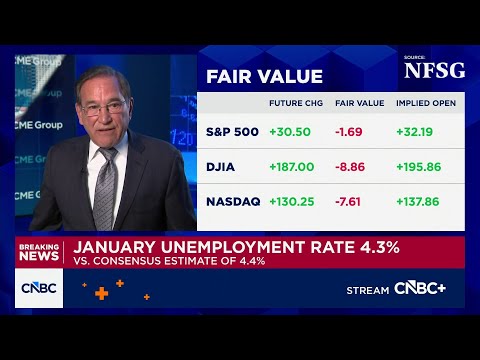
U.S. payrolls rose by 130,000 in January, more than expected; unemployment rate at 4.3%
CNBC Television· 2026-02-11 15:30
Hi, good morning, Kelly. Yes, it's job job jobs Wednesday. Not necessarily a Friday, but every bit as important.Non-farm payrolls for January coming in twice expectations at 130,000. 130K. That would be the juiciest going back to April of last year when it was 158.Now, if we look at a couple of months worth of revision, they came in at minus7,000. Now let's look for average hourly earnings month overmonth up 4/10en that's onetenth higher than both looking back and looking forward 4/10 would equal October la ...

X @Raoul Pal
Raoul Pal· 2025-11-24 12:03
Macroeconomic Analysis - The "Magic Formula" indicates GDP growth is increasingly reliant on debt due to declining population and productivity growth [3] - Private sector debt remains around 120% of GDP, with the public sector at a similar level [3] - Economic growth is significantly consumed by servicing private-sector debts, rendering it unproductive [3] - Government debt growth is offsetting demographic decline [5] - Debt growth exceeding GDP is being monetized [6] - Liquidity is the primary driver in the current economic environment [8] Demographic Trends - Birth rates have been declining since the late 1950s, impacting the labor force participation rate [4] - The labor force participation rate is expected to continue declining due to structural demographic issues [4] - Aging populations and automation contribute to deflationary pressures [5] Monetary Policy & Investment Implications - Governments are issuing new debt to cover old interest, with central banks absorbing it through quantitative easing (QE) [7] - A substantial amount of interest needs to be monetized, exceeding GDP capacity [8] - Bitcoin thrives in a world of perpetual currency debasement [9]
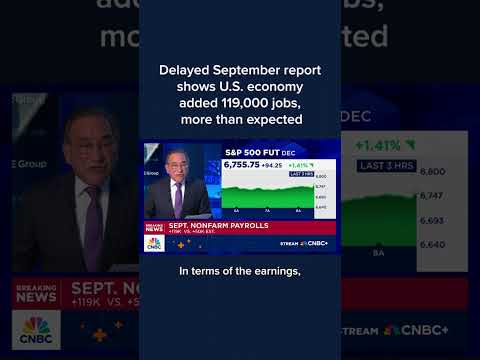
Delayed September jobs report shows U.S. economy added 119,000 jobs, more than expected
CNBC Television· 2025-11-20 15:29
Employment Growth - Non-farm payrolls increased by 119,000 in September, the highest since April's 158,000 increase [1] - The previous month's (August) job growth was revised down from 22,000 to a loss of 4,000 jobs [1] Unemployment Rate - The unemployment rate unexpectedly rose from 43% to 44% [1] - The last time the unemployment rate was at or above this level was in October 2021, at 45% [2] Labor Force Participation - The labor force participation rate increased to 624%, matching the level in May [2] - To find a higher labor force participation rate, one must go back to April of this year, when it was 626% [2] Average Hourly Earnings - Month-over-month average hourly earnings increased by 021% [3] - This increase is considered weak, as expectations were for a 03% increase, and the June increase was 02% [3] - A lower month-over-month increase was last seen in August 2023, at 011% [3] - Year-over-year average hourly earnings increased from 37% to 38% [3] - This 38% increase is the highest since July's 39% increase [3] - The high water mark for year-over-year average hourly earnings for the year remains at 39%, observed for four months [3]
US Employers Are Hiring, Despite Uncertainty | Presented by CME Group
Bloomberg Television· 2025-06-09 09:59
Employment Landscape - The non-farm payrolls report, while stronger than expected, indicates a slowing employment landscape [1] - Headline data decreased compared to the previous month, which was also revised downwards [1] - Employers may be reducing hiring due to tighter financial conditions, while incentivizing current employees with higher wages [1] Wage Growth & Labor Force - Strong wage growth coupled with a lower labor force participation rate was observed [1] Monetary Policy Implications - Continued wage pressures may keep inflation elevated, potentially delaying Federal Reserve rate cuts [2] - The low unemployment rate provides no immediate impetus for a rate cut [2]