Long-Term Investing

Search documents
Nebius Emerges As Nvidia's Next AI Infrastructure Play
Seeking Alpha· 2026-03-13 16:32
Core Insights - The article discusses the author's investment journey, emphasizing a passion for value investing and a disciplined approach to analyzing companies [1] Group 1: Investment Philosophy - The focus is on identifying mispriced quality companies and understanding resilient business models across economic cycles [1] - The author employs a fundamentals-first approach, utilizing financial statements and DCF models for analysis [1] Group 2: Community Engagement - The author shares insights on Seeking Alpha to contribute to a community of investors who prioritize clear thinking over hype [1] - The goal is to provide research-backed commentary on various investment opportunities, including under-the-radar compounders and misunderstood tech platforms [1]



X @The Motley Fool
The Motley Fool· 2026-02-09 10:50
WIN WITH STOCKSOwn 25+ businesses.Reinvest dividends.Hold through recessions.Ignore day-to-day noise.Keep adding money regularly. ...
SCHQ: Favorable Outlook For Long-Term Treasuries In 2026
Seeking Alpha· 2025-12-02 07:33
Group 1 - The individual began investing in high school in 2011, focusing on REITs, preferred stocks, and high-yield bonds, indicating a long-standing interest in markets and the economy [1] - Recently, the investment strategy has evolved to combine long stock positions with covered calls and cash secured puts, reflecting a more sophisticated approach to investing [1] - The investment philosophy is fundamentally long-term, with a primary focus on REITs and financials, while occasionally exploring ETFs and other stocks based on macro trade ideas [1]

T.D. Cowen's Craig Hutchison talks how to play nuclear power right now
CNBC Television· 2025-11-19 00:23
Uranium Market Outlook - The uranium sector is viewed as a long-term investment opportunity, with miners and developers aiming to supply uranium for the next 5 to 15 years [2] - The uranium market has been in deficit for the past 3 to 4 years and is expected to remain so until the end of the decade, with inventories currently covering the shortfall [2] - The industry anticipates a tight market for an extended period, emphasizing the need for a long-term perspective [3] Nuclear Energy Expansion - China is currently constructing 33 nuclear reactors, signaling a significant expansion of nuclear power [4] - Globally, 20 countries have pledged to triple nuclear capacity by 2050, while the US aims to quadruple it by 2050 [6] - There's a growing global acceptance of nuclear energy, with a shift towards reframing it as a green and stable energy source [6][7] Factors Driving Demand - Hyperscalers are looking to add 30 gigawatts of power, potentially through agreements with Small Modular Reactors (SMRs) [11] - A significant shift in power demand in the United States is expected to continue, leading to tight markets and support from utilities to meet the needs of hyperscalers [11][12] Government and Regulatory Support - There is a notable increase in government support for nuclear energy, a change from past perceptions of it as a "dirty" energy source [7] - A market shift in bureaucracy is allowing the restart of mothballed reactor sites, such as Three Mile Island [5]

长期资产回报研究——长期投资终极指南
2025-10-29 02:52
Summary of Deutsche Bank Research Institute Report on Long-Term Investing Industry Overview - The report focuses on long-term investing strategies and asset class performance across various macroeconomic environments, drawing on data from 56 economies over more than 200 years [2][6][11]. Key Findings Historical Performance of Asset Classes - Median global inflation-adjusted returns in USD terms show: - Equities: 4.9% p.a. - 60/40 Portfolio: 4.2% - Government Bonds: 2.6% - Bills: 1.9% - Gold: 0.4% - Cash: -2.0% [6][14]. - Gold has underperformed compared to financial assets historically, but in the 21st century, it has outperformed with a return of 7.45% p.a. [6][16]. - The best-performing equity markets over the last century were in Sweden (7.5% p.a.) and the US (7.2% p.a.), while Italy had the worst performance for equities (2.5% p.a.) and bonds (-1.1%) [6][19]. Economic Growth and Returns - Nominal GDP growth is a key driver of asset-class returns, averaging 5.7% annually since 1900 [6][19]. - Developed markets (DM) have seen a decline in nominal GDP growth, with projections of around 4% over the next five years, which is below historical averages [6][32]. - Real GDP growth in developed markets is at its lowest level in a century, reinforcing the link between economic growth and investment returns [6][41]. Investment Risks and Probabilities - The probability of equities underperforming cash over 25 years is only 0.8%, but this rises to 6.3% over 10 years and 13.6% over five years [10]. - For government bonds, the probability of underperforming inflation is around 25% across various time frames [10]. - A 60/40 portfolio has historically offered the lowest probability of nominal losses, with just a 0.1% chance of negative returns over 25 years [10]. Demographic Trends - Both developed and emerging markets are experiencing slow population growth, with 32 economies projected to see a decline in their working-age population by 2050 [9][54]. - Countries with declining working-age populations may struggle to sustain real GDP growth, impacting future investment returns [59][60]. Inflation and Returns - Historical data indicates that equities serve as an effective hedge against inflation, with nominal equity returns rising with inflation [50]. - However, real returns tend to decline slightly as inflation increases, suggesting that equities perform best in lower-inflation environments [50][52]. Currency Depreciation - Over the past century, only three economies (Switzerland, Singapore, and the Netherlands) have seen their currencies appreciate against the US dollar, while many have depreciated significantly [91][93]. - The US has been a significant relative winner in currency terms, influencing returns when measured in USD [97]. Additional Insights - The report emphasizes the importance of starting valuations in predicting long-term performance, with low P/E portfolios outperforming high P/E portfolios historically [9][81]. - The relationship between equities and bonds has reverted to a positive correlation post-COVID, suggesting that both asset classes may move in tandem more often in the future [83][87]. This comprehensive analysis provides valuable insights for investors looking to navigate long-term investment strategies in a changing economic landscape.

X @Raoul Pal
Raoul Pal· 2025-10-11 05:24
Risk Management - Avoid leverage to minimize potential losses [1] - Resist Fear Of Missing Out (FOMO) to prevent impulsive decisions [1] - Expect frequent pullbacks of around 35% in the market [1] Investment Strategy - Focus on holding a main portfolio of 3 to 5 top assets [1] - Consider a small "Degen bag" of less than 10% for trading [1] - Adopt a longer-term holding (HODL) strategy [1] - Buy The Fucking Dip (BTFD) when possible [1] Security & Perspective - Practice self-custody or multi-signature with good wallet hygiene [1] - Zoom out to gain a broader perspective and ignore short-term noise [1]
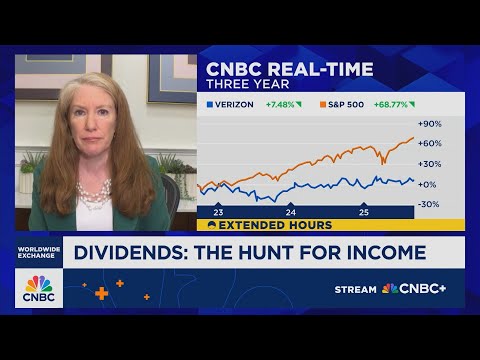
Harrington: Dividend funds can offer benefits, but be cautious about those offering huge returns
CNBC Television· 2025-09-15 11:57
Gen Z Dividend Investing Trends - Gen Z investors are increasingly interested in dividend investing as a way to supplement their income in an uncertain market [4] - Some Gen Z investors are drawn to high-yield dividend ETFs, but these can be very risky due to high leverage and underlying securities that are not dividend-oriented [2] - Experts advise Gen Z investors to be cautious about highly leveraged dividend ETFs and consider more traditional dividend funds [2][3] Dividend Investing Strategies - Dividend aristocrats, companies with a history of growing dividends for over 25 years, are a good starting point for dividend investing, although their average yield is just under 2% [6] - Investors should look for companies or funds with a long-term history of consistently paying dividends, even during economic downturns like 2008-2009 and the pandemic [7][8] - Dividend investing benefits from active management to understand the company or fund manager's philosophy regarding returning capital to shareholders through dividends and achieving capital appreciation [8][9] Balancing Dividend Yield and Price Appreciation - Investors should aim for a total return of 8-10% over the long term, combining dividend income and stock price appreciation [12] - A long-term approach is crucial in dividend investing, as income and capital appreciation are spread out over time [14] - While a high dividend yield is attractive, investors should also consider the potential for price appreciation and the overall long-term return [10][11]