Mastery

Search documents
people quit too soon
20VC with Harry Stebbings· 2026-03-18 05:00
The biggest mistake I see people make is they say, "That's just not me. I'm not a good speaker. That's just not me. I'm not good at social media. That's just not me." What they don't understand is everything is like the gym. No one walks into the gym and goes, "Treadmill, my old friend. I love going on you." The first time it's really hard. You suck. You sweat.It's tough. But you go again and you go again and again and you get better and better and better. And through repetition you drive quality.And a year ...

X @Andrew Tate
Andrew Tate· 2025-11-18 05:10
General Observation - The tweet suggests that mastery, given enough time, makes losing an impossibility [1] - The tweet references "Wudan," potentially alluding to a philosophy or system where mastery leads to inevitable success [1]
Taoism, Mastery, and Spontaneity | Leone Wright | TEDxUniversityCollegeRoosevelt
TEDx Talks· 2025-09-19 15:53
Core Philosophy - Taoism originated in China around the 4th century BCE, with the Tao Te Ching providing guidelines for a balanced life [4] - Taoism emphasizes adapting guidelines for living a happy and balanced life [5] - Taoism can be interpreted in numerous ways [5] Stages of Learning - The first stage is the childlike or natural stage, characterized by a lack of skill, spontaneity, and innocence [6][7] - The second stage is the learning stage, requiring concentration and dedicated practice to build skill [8][9] - The third stage is mastery (Woowoo), combining childlike spontaneity with intense skill gained from years of practice, resulting in effortless action [12] Application to Life - Taoism believes in an art of living, pointing to a state of consciousness in harmony with all of life [13] - Failure is normal, inevitable, and imperative to individual growth and mastery [15] - Whether learning a skill or the art of living, failure is necessary to achieve mastery [16]
Mastering the Inner Establishment | Geetha Shankar Subramanian | TEDxSt Pauls College
TEDx Talks· 2025-08-29 15:46
Personal Development & Philosophy - The speaker emphasizes the importance of inner mastery and integrity, contrasting external achievements with internal establishment [1] - The speaker's upbringing instilled character ethics such as fidelity, integrity, sincerity, honesty, modesty, and patience [1] - The speaker highlights the significance of humility and resilience over outward strength, drawing from a childhood story [3] - The speaker introduces a framework for inner establishment involving the "wishbone" (ambition), "backbone" (resilience), and "soul bone" (values) [4][13][14] - The speaker discusses managing physical, social, emotional, and mental wellbeing for inner establishment [15] - The speaker emphasizes the importance of conserving, preserving, and growing personal energy through lifestyle choices and emotional management [17][18][19] - The speaker describes a transformation process involving expansion, alignment, allowance, and desire [20] Career & Life Journey - The speaker's early experiences, including frequent school changes, fostered adaptability, perseverance, and hard work [1] - The speaker's career progressed unexpectedly, leading to a director position at an institute in Oman [9][10][11] - The speaker attributes success to the law of attraction and a feeling that the universe was supporting her [12]
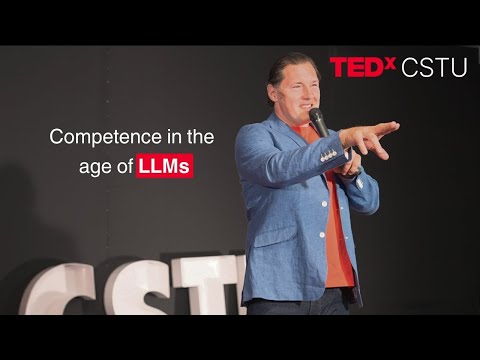
Competence in the Age of LLMs | Peter Danenberg | TEDxCSTU
TEDx Talks· 2025-08-18 16:11
LLMs and Cognitive Impact - LLMs may lead to neurological inertia and impact long-term competence and mastery [6] - Over-reliance on LLMs can cause engineers to outsource critical thinking, becoming verifiers instead of thinkers [15] - Microsoft's study suggests tool creators have a responsibility to challenge users and promote growth [16] Poetic vs Parastic LLMs - LLMs excel at the "poetic" art of generation (rhetoric), producing fluent text and compilable code [10] - The industry needs to explore "parastic" LLMs (dialectic) that challenge users to develop their own ideas [11][15] - Current LLMs are fundamentally poetic and may require retraining to become parastic [15] Achieving Competence in the Age of LLMs - Users should actively ask LLMs to challenge them and demonstrate mastery [17] - AI tool builders need to align models to challenge users, even if it impacts engagement metrics [17][18] - The goal is to create tools that "enkindle the soul" by fostering growth and lifelong learning [18]
The Habit of Flow: You’re Wired for Greatness | Deri LLEWELLYN-DAVIES | TEDxPromenade des Anglais
TEDx Talks· 2025-07-18 14:10
Core Concept of Flow State - Flow is a state of effortless action, characterized by loss of self and time, feeling completely alive, and deep focus [5][8] - Achieving flow requires aligning purpose, mastery, and passion [9] - Flow is not a one-time moment but a cycle that begins with struggle, followed by release, flow, and recovery [28][29] Triggers and Conditions for Flow - Purpose is essential for flow; without purpose, there is no flow [9] - Mastery, a journey of continuous improvement, is crucial; flow cannot be hacked [9][10] - Passion, fueled by genuine curiosity and intrinsic motivation, is the starting point for flow [9][12] - Balancing challenge and skills is vital to stay in the flow channel [18][19] Obstacles to Flow - Ego blocks flow; thinking one is a master can hinder growth and prevent flow [28] - Avoiding struggle prevents flow; struggle is a necessary part of the journey [29][30] - Failing to recover adequately after flow is neurochemically expensive and detrimental [32][33] - Boredom, resulting from a lack of learning and growth, is equally dangerous as being overwhelmed [27] Practical Application and Benefits of Flow - Mastering the basics of flow allows for curating it on demand [9] - Flow can be curated in everyday life, not just in extreme situations [39] - Curating flow daily leads to feeling great and making the world a better place [39][40] - Recovery, involving deep relaxation, is a critical skill for sustaining flow [33][34]