
Micro - drama industry standardization

Search documents
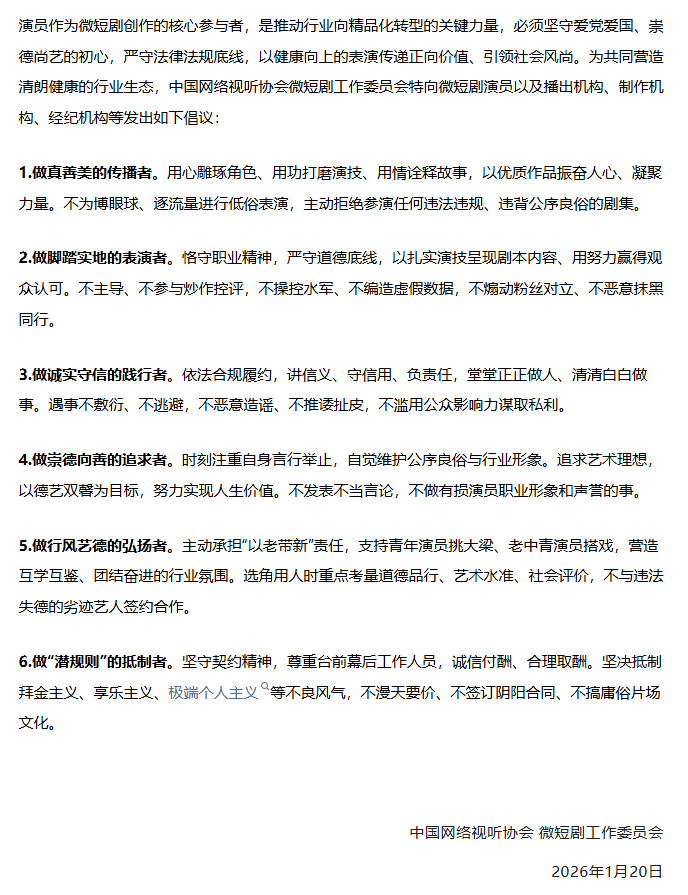
新时代微短剧演员职业操守倡议书发布,对短剧演员提出六点要求,多机构已响应
Yang Zi Wan Bao Wang· 2026-01-22 06:50
Core Viewpoint - The "New Appearance and New Atmosphere" initiative aims to establish professional ethics for micro-short drama actors, addressing the industry's current issues and promoting a healthier ecosystem in the micro-short drama sector [1][4]. Group 1: Requirements for Actors - The initiative outlines six key requirements for micro-short drama actors, emphasizing the need to be disseminators of truth, goodness, and beauty, and to reject vulgar performances aimed at gaining attention [2][3]. - Actors are urged to adhere to professional ethics, maintain moral standards, and present scripts with solid acting skills to earn audience recognition [2][3]. - The initiative calls for actors to avoid manipulating public opinion, engaging in false data creation, or inciting fan conflicts, thereby promoting honesty and integrity in their profession [3]. Group 2: Industry Context and Challenges - The micro-short drama industry has experienced explosive growth due to its "short, frequent, and fast" dissemination characteristics, but this rapid expansion has led to various issues, including low-quality content and unethical practices [4]. - There is a notable trend of prioritizing traffic over acting skills, with some actors resorting to tactics like buying followers and manipulating data to gain popularity, resulting in widespread audience dissatisfaction with acting quality [4]. - The initiative serves as a remedy for the industry's pain points, emphasizing the importance of actors' self-discipline and responsibility towards their roles, audiences, and the industry as a whole [4].

微短剧经费“吃回扣”观察:普遍存在,合不合理?
3 6 Ke· 2025-07-23 02:57
Core Viewpoint - The article highlights the prevalent issue of "kickbacks" in the micro-short film industry, stemming from a lack of standardized costs, personal relationships, and deficiencies in the production system, ultimately indicating a need for unified industry standards [1][9]. Group 1: Prevalence of Kickbacks - The phenomenon of "kickbacks" in micro-short film financing is widespread, with industry insiders sharing experiences that illustrate the current state of affairs [2]. - The absence of a unified standard leads to significant cost variability, with production costs for the same script varying dramatically based on the team hired [9]. - The industry operates on personal relationships, where costs can be negotiated based on familiarity, leading to ambiguous definitions of what constitutes a kickback [3][4]. Group 2: Production System Deficiencies - The lack of a robust production system results in inefficiencies and wasted costs, which are more detrimental than the issue of kickbacks [10]. - A well-structured production system can directly reduce costs and improve efficiency by minimizing unnecessary travel and ensuring timely coordination among crew members [12]. - The current state of the industry is characterized by a fragmented production approach, leading to delays and increased costs due to poor planning and coordination [10][12]. Group 3: Need for Standardization - The micro-short film industry lacks a unified production standard, which complicates the assessment of whether expenditures are justified based on the commercial outcomes achieved [9][11]. - Establishing clear production standards and improving the production system could help mitigate the issues of kickbacks and inefficiencies, allowing for better measurement of costs versus outcomes [13].