Momentum Strategy

Search documents
Momentum Strategy Delivered 506% Returns but Now There Are Warning Signs
247Wallst· 2026-02-18 03:05
Core Insights - The Invesco S&P MidCap Momentum ETF (XMMO) has delivered a remarkable 506.4% return over the past ten years, significantly outperforming the SPDR S&P MidCap 400 ETF (MDY), which returned 215.48% during the same period [1] - Recently, XMMO's one-year return of 14.82% has only slightly exceeded MDY's return of 12.69%, indicating a narrowing momentum edge [1] - A December 2025 analysis highlighted concerns regarding elevated valuations and degraded portfolio quality due to index reconstitution, suggesting that current holders should consider pairing XMMO with quality-focused mid-cap funds to mitigate valuation risks [1] Performance Metrics - XMMO has $5.2 billion in assets and a 0.35% expense ratio, providing concentrated exposure to mid-cap stocks with strong momentum [1] - The fund's top holdings include Ciena Corp (4.96%), Lumentum Holdings (4.33%), and Curtiss-Wright (4.19%), with a notable 26.2% allocation to the Industrials sector [1] - The ETF's long-term performance validates the momentum strategy, but the recent performance suggests that momentum factors are more effective over full market cycles [1] Investment Strategy - XMMO is designed for investors looking to overweight momentum within their mid-cap allocation rather than simply tracking a market-cap weighted index [1] - The strategy relies on price momentum persistence, which historically generates excess returns but comes with higher volatility [1] - The fund is best suited as a 10-20% satellite position within a diversified mid-cap allocation for growth-oriented investors who can tolerate above-average volatility [1]


This momentum fund has dodged U.S. stocks and trounced the competition
MarketWatch· 2026-01-22 15:52
Core Viewpoint - The article emphasizes the importance of diversifying investment portfolios beyond the concentrated U.S. stock market, especially after a prolonged bull market led by Big Tech [1]. Group 1: Market Performance - Over the past year, broad international stock indexes have outperformed the S&P 500 [2]. - Valuations for large-cap U.S. stocks remain high compared to those in developed markets outside the U.S. [2]. Group 2: Investment Strategies - Investors may consider a momentum strategy as an effective way to gain exposure to non-U.S. stocks [2].

多只资产配置产品发行,黄金ETF流入明显 ——海外创新产品周报20251020
申万宏源金工· 2025-10-21 08:01
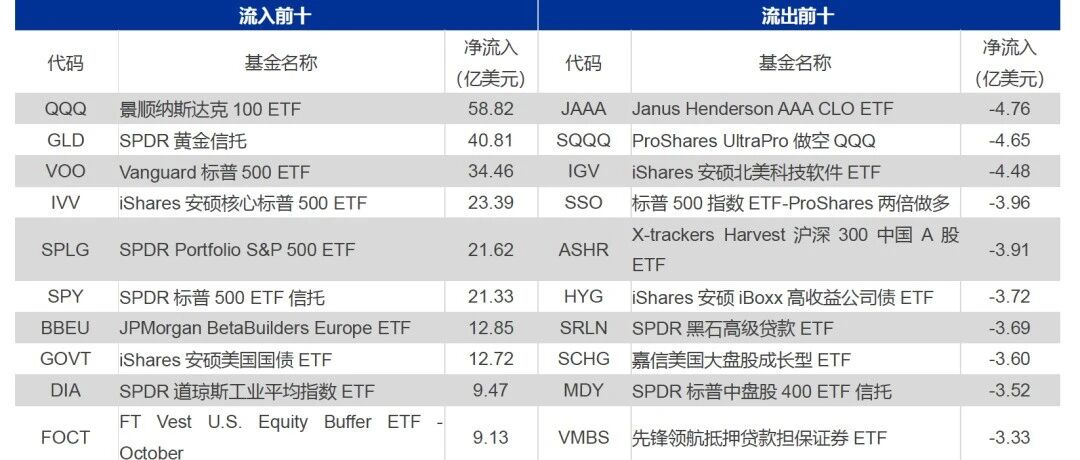
Group 1: New ETF Products in the US - A total of 22 new ETF products were launched in the US last week, including various types such as downside protection, leverage, thematic, allocation, and rotation products [1][2] - Seven new downside protection products were introduced, including Calamos' structured products linked to Bitcoin, which offer varying levels of protection (80%, 90%, 100%) [1] - Arrow Funds launched a Bitcoin strategy product that adjusts its allocation between Bitcoin and gold or cash based on market risk appetite [1] Group 2: ETF Fund Flows - US ETFs experienced significant inflows of nearly $50 billion last week, with domestic equities attracting over $25 billion, and commodity ETFs, particularly gold, also seeing substantial inflows [3][5] - The SPDR Gold Trust (GLD) was the second highest inflow product, with $40.81 billion, while the Invesco QQQ Trust (QQQ) led with $58.82 billion [5] Group 3: ETF Performance - Precious metal stocks have outperformed precious metal ETFs this year, with several mining-related ETFs showing gains around 150% [6][7] - The SPDR Gold Shares (GLD) and iShares Gold Trust (IAU) have both seen returns of approximately 63.73% and 63.91% respectively this year [7] Group 4: Mutual Fund Flows - As of August 2025, the total amount of non-money market mutual funds in the US reached $22.98 trillion, reflecting an increase of $0.41 trillion from July 2025 [8] - Domestic equity funds experienced outflows of around $20 billion, while bond products saw stable inflows exceeding $10 billion [8]
ETF experts weigh in: Looking beyond big tech and the rush into momentum funds
CNBC Television· 2025-08-04 22:17
Concentration Risk & Diversification - The market is seeing flows into equal-weighted S&P 500 funds, potentially driven by concerns about concentration risk with large companies like Nvidia (8% of S&P 500) and Microsoft (close to 7%) in ETFs like SPY and VO [1][2] - Investors are seeking diversification benefits through equally weighted approaches and actively managed ETFs [3] - Actively managed equity ETFs from firms like Toro Price, Capital Group, and Fidelity offer expert management decisions on stock selection, potentially mitigating concentration risk [4] - Diversification can serve as a hedge against concentration risk, protecting against excessive run-ups in individual names [5] - One solution to overconcentration risk is an ETF that equal weights 100 names from a quality-screened universe, matching the sector weights of the S&P 500 [6] - History shows that companies riding high can decline (e.g., Kodak, IBM, GE, Lucent, Cisco), so advisors should consider pruning back gains from Nvidia and Microsoft without incurring taxes [7] Momentum Strategies - The S&P 500 momentum index is up more than 34% this year, reflecting a "risk-on" sentiment [8] - Momentum strategies, like the Invesco S&P 500 Momentum ETF (SPMO), focus on stocks with the strongest relative strength and have been outperforming the broader S&P 500 [9] - Momentum ETFs contain stocks beyond just technology, including consumer discretionary (Kohl's, American Eagle), financials (JP Morgan), and consumer staples (Walmart, Costco) [10] - It's crucial to understand the specific holdings and construction of momentum ETFs to ensure they align with investment goals [11] - Momentum is a factor that has historically outperformed the broader marketplace [13]