Nested Learning

Search documents
英伟达-下一代 AI 推理模型-2026 年推理与内存需求的福音
2025-12-12 02:19
Summary of Key Points from the Conference Call Company and Industry Overview - **Company**: NVIDIA Corp (NVDA.O) - **Industry**: Artificial Intelligence (AI) and Graphics Processing Units (GPUs) Core Insights and Arguments 1. **Episodic Memory Functionality**: AWS introduced an episodic memory feature in its Bedrock AgentCore platform, enhancing AI agents' ability to understand context in interactions, which is crucial for their intelligence [2] 2. **Nested Learning Framework**: Google has developed a new framework called Nested Learning, which applies human learning principles to improve large language models (LLMs). This framework has led to the creation of a new model named Hope, which shows superior performance in reasoning and memory management [3][4] 3. **NVIDIA Rubin CPX GPU**: The Rubin CPX GPU, announced by NVIDIA, is designed for ultra-large context processing, offering up to 3x faster attention capabilities compared to previous models. It is expected to significantly reduce total cost of ownership (TCO) through the use of cost-efficient GDDR7 memory [10] 4. **Market Potential**: The Rubin CPX platform is projected to deliver a remarkable return on investment, with estimates suggesting a $5 billion revenue for every $100 million invested, indicating a potential 50x ROI [10] 5. **Valuation and Price Target**: The target price for NVIDIA is set at $270, based on a price-to-earnings (P/E) ratio of approximately 30x, which aligns with the company's historical average [12] Risks and Considerations 1. **Competition in Gaming**: There is a risk that NVIDIA could lose market share in the gaming sector, which may negatively impact stock performance [13] 2. **Adoption Rates**: Slower-than-expected adoption of new platforms could lead to lower sales in data centers and gaming [13] 3. **Market Volatility**: Fluctuations in the auto and data center markets could introduce volatility to NVIDIA's stock and valuation multiples [13] 4. **Cryptomining Impact**: The influence of cryptomining on gaming sales remains a concern, potentially affecting overall revenue [13] Additional Important Information - **Market Capitalization**: NVIDIA's market cap is reported at approximately $4.43 billion [5] - **Expected Total Return**: The expected total return for NVIDIA shares is projected at 48% [5] - **Analyst Contact Information**: Analysts Atif Malik and Adrienne Colby are available for further inquiries [6] This summary encapsulates the key points discussed in the conference call, highlighting NVIDIA's advancements in AI technology, market positioning, and associated risks.

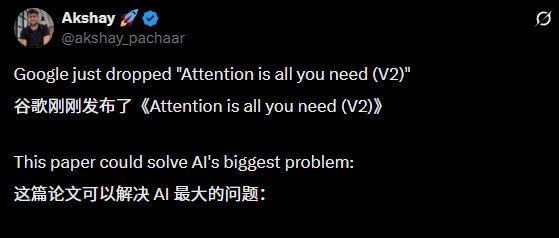
Google又发布了一篇可能改变AI未来的论文,这次它教AI拥有了记忆。
数字生命卡兹克· 2025-11-25 01:20
Core Viewpoint - The article discusses the limitations of current AI models, particularly their inability to form long-term memories, likening them to characters suffering from anterograde amnesia. It introduces the concept of "Nested Learning" as a potential solution to this issue, allowing AI to learn and retain information more effectively, similar to human memory processes [11][21][25]. Summary by Sections Introduction to Current AI Limitations - Current AI models, including GPT and others, face a critical flaw known as "anterograde amnesia," where they cannot retain new information after a conversation ends [11][21][25]. - This limitation results in AI being unable to learn from interactions, making each conversation feel like a new encounter with a blank slate [21][23]. Nested Learning Concept - The paper "Nested Learning: The Illusion of Deep Learning Architectures" proposes a new framework to address the memory retention issue in AI [7][25]. - It draws inspiration from human brain functions, particularly the different frequencies of brain waves that manage various types of memory processing [26][28][33]. Mechanism of Nested Learning - The proposed model, HOPE, incorporates self-modifying weight sequences and a multi-time-scale continuous memory system, allowing for different layers of memory retention [45][47]. - This model enables AI to process information at varying speeds, akin to human memory consolidation processes, where short-term memories are transformed into long-term memories during sleep [52][53]. Comparison with Existing AI Models - Current models operate as single-frequency systems, locking in their parameters post-training, which prevents further learning [42][43][44]. - In contrast, HOPE allows for dynamic updates to the AI's internal parameters based on user interactions, facilitating a more profound understanding and retention of information [66][70]. Performance Evaluation - The paper reports that HOPE outperforms existing models like Transformer++ and DeltaNet in various benchmarks, demonstrating its effectiveness in memory retention and learning capabilities [73]. Conclusion - The article emphasizes the potential of Nested Learning to revolutionize AI by enabling it to evolve and adapt over time, ultimately leading to a more intelligent and personalized AI experience [72][84].