New Employment Forms

Search documents
“位置型”与“云端型”就业你了解不?伴宠师需求增近68%,互联网医生平均月薪超两万
Yang Zi Wan Bao Wang· 2026-02-26 06:55
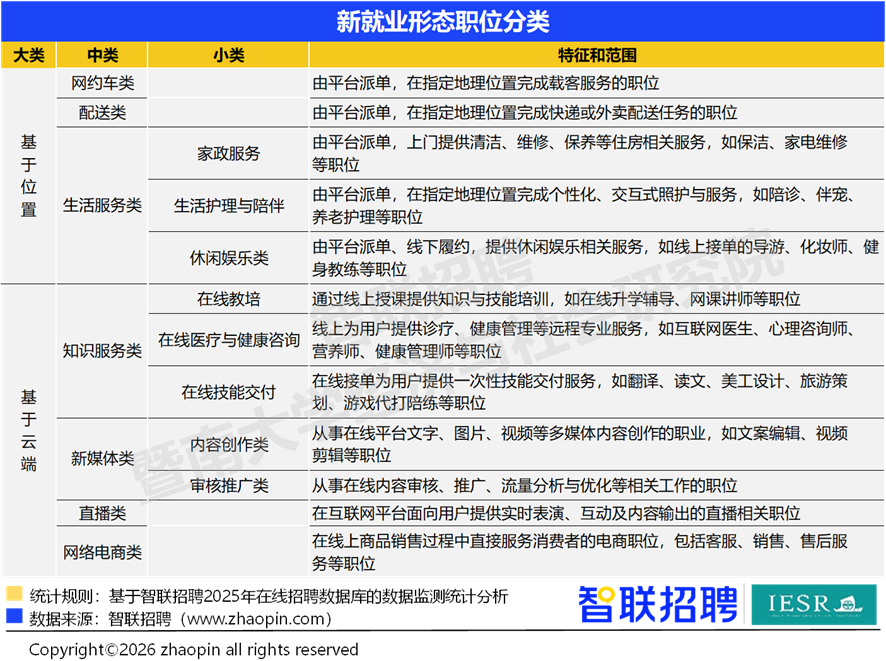
Core Insights - The report indicates a significant expansion of new employment forms reliant on internet platforms, with a notable increase in demand for emerging professions such as medical companions, pet care specialists, and gaming coaches [1][8]. Group 1: New Employment Forms - New employment forms are defined as innovative job models that efficiently match labor supply and demand through internet platforms, categorized into "location-based" and "cloud-based" types [2]. - Location-based jobs include ride-hailing, delivery, and home services, while cloud-based jobs encompass knowledge services, content creation, and e-commerce roles [3]. Group 2: Demand Trends - Location-based employment is highly concentrated in first-tier and new first-tier cities, accounting for nearly 70% of demand, while cloud-based jobs are more widely distributed in lower-tier cities, breaking geographical limitations [4]. - Location-based positions generally feature low entry barriers and medium to high income, with over 90% of jobs not requiring a degree and more than 80% offering average monthly salaries between 8,001 and 15,000 yuan [4]. - Cloud-based roles attract a younger, more educated demographic, with 60.2% of applicants being female and 65.1% aged 21-30, while location-based jobs predominantly attract older, less educated workers [4]. Group 3: Job Market Dynamics - The report highlights a dual increase in job postings and job seekers in the new employment sector, with job postings rising by 15.1% and job seekers by 11.0% year-on-year, indicating the sector's role in stabilizing and optimizing employment structures [7]. - The number of location-based job postings surged by 28.9%, while cloud-based positions remained stable, with online skill delivery roles experiencing a significant growth of 58.7% [7]. Group 4: Emerging Professions - The aging population and increased medical needs have led to a 30.7% rise in demand for medical companions, with over half of the positions not requiring a degree [8]. - The pet economy has driven a 67.9% increase in demand for pet care specialists, with over 76% of positions not requiring formal education but emphasizing practical experience [8]. - The gaming industry has seen a staggering 283.2% increase in gaming coaching roles, characterized by minimal educational and experience requirements [8]. - Internet doctor positions have grown by 47.4%, with an average monthly salary of 20,599 yuan, reflecting the high value of online medical services [9].

专访中央财经大学教授沈建峰:要给8400万灵活就业者系好社保安全带
2 1 Shi Ji Jing Ji Bao Dao· 2025-04-23 07:48
Core Viewpoint - Flexible employment and new employment forms have become a crucial part of China's labor market, with 84 million new employment form workers accounting for 21% of the total workforce [1] Group 1: Legal Challenges in Flexible Employment - The primary issue is the ambiguous definition of employment entities, leading to difficulties in identifying responsible parties in a multi-entity labor organization [5][6] - The second challenge is the difficulty in defining employment relationships due to the nature of flexible work, where workers can choose when to work and for whom, complicating the recognition of labor relations [6][7] - The third challenge involves the unique protection needs of workers in the digital age, including the lack of regulations on data protection and the management issues arising from algorithmic control [7][8] Group 2: Changes in Labor Relationship Recognition Standards - The recognition of labor relationships in new employment forms faces special challenges, including multi-entity employment and hidden control through technology [10][11] - The traditional standards for recognizing labor relationships need to adapt to the realities of platform-based work, emphasizing the need for a "fact-first" approach in determining labor relations [12] Group 3: Innovations in Social Insurance Systems - There is a need for a tailored social insurance system for flexible workers, as seen in companies like JD.com and Meituan, which are exploring new models for social insurance contributions [14][15] - Current regulations pose challenges for employers to provide social insurance due to the complexity of employment relationships in flexible work [15][16] - Recent pilot programs aim to address these issues by introducing occupational injury insurance and expanding coverage to more workers [16][17] Group 4: Taxation and Compliance Challenges - The blurred lines between labor remuneration and business income present significant challenges for tax compliance in the flexible employment sector [19][20] - The emergence of issues like tax evasion and fraudulent invoicing highlights the need for clearer distinctions and more substantial judgments in tax classifications [20][21] - Future tax reforms should focus on unifying tax policies across regions and leveraging technology to enhance tax collection and compliance in the flexible employment sector [21]