New Energy Vehicle Industry

Search documents
春节假期充电焦虑有效缓解
Jing Ji Ri Bao· 2026-02-27 22:23
Core Insights - The number of electric vehicle (EV) users and charging activities significantly increased during the Spring Festival holiday, with a record high of 602.10 million charging instances and 14,976.75 million kilowatt-hours of charging, marking a 52.01% increase in daily charging volume compared to the previous year [2] Group 1: Technological Advancements - Continuous improvements in new energy vehicle and charging technology have led to enhanced vehicle quality, performance, and charging efficiency, with mainstream electric models now offering a range of 400 to 700 kilometers, and some high-end models exceeding 800 kilometers [3] - The adoption of 800V high-voltage platforms and the expansion of ultra-fast charging networks have made it possible to charge vehicles to 80% in just 15 minutes, alleviating range anxiety for drivers [3] Group 2: Charging Infrastructure Development - As of the end of last year, there were 71,500 electric vehicle charging guns installed at highway service areas, covering over 98% of these areas, with approximately 10,000 high-power charging facilities addressing the issues of slow charging and long wait times [3] - The charging network's optimization is crucial for long-distance travel, ensuring that electric vehicle users can meet their energy needs during peak travel times [3] Group 3: Enhanced Service and Emergency Response - The Ministry of Transport and the National Energy Administration have implemented a Spring Festival support plan that includes identifying busy charging areas and deploying mobile emergency charging equipment to meet driver needs [4] - The upgraded "e-road smooth" app provides real-time charging station information, improving resource utilization by allowing charging stations to proactively guide vehicles [4] Group 4: Future Infrastructure Goals - According to the "Three-Year Doubling Action Plan for Electric Vehicle Charging Facility Service Capacity (2025-2027)," the goal is to establish 28 million charging facilities nationwide by the end of 2027, providing over 300 million kilowatts of public charging capacity to support more than 80 million electric vehicles [5] - The large-scale deployment of new infrastructure will not only bolster the development of the new energy vehicle industry but also accelerate the construction of a new power system, enhancing the dual advantages in the electric vehicle and energy supply sectors [5]


2025年全球铜冶炼市场现状分析:消费及通用产品、制冷领域与电子领域为全球精炼铜最大消费行业【组图】
Qian Zhan Wang· 2026-02-08 04:08
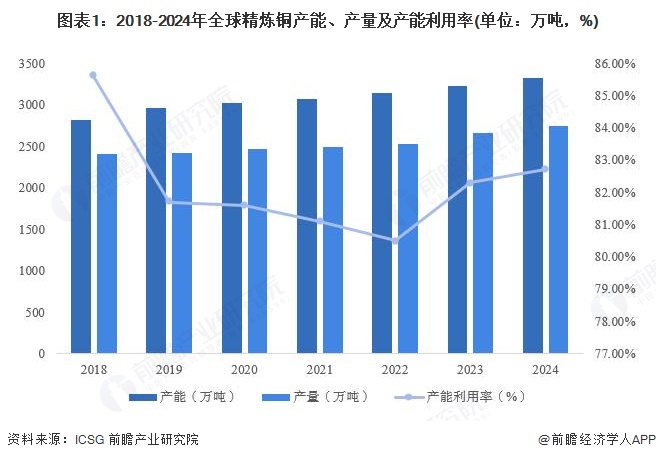
Core Insights - The global refined copper production capacity and output are projected to increase annually from 2018 to 2024, with a capacity of 33.236 million tons and an output of 27.486 million tons expected in 2024, resulting in a capacity utilization rate of 82.70% [1] - The global refined copper consumption is also on the rise, expected to reach 27.348 million tons in 2024, reflecting a year-on-year increase of 2.8% [5] - Major consumption sectors for refined copper include consumer and general products, refrigeration, and electronics, accounting for approximately 23% of total consumption, while the construction sector represents 26% [7] Production and Capacity - The refined copper production capacity is forecasted to reach 33.236 million tons by 2024, with a production output of 27.486 million tons, including 4.581 million tons of recycled refined copper, which is a 2.0% increase year-on-year [1] - The compound annual growth rate (CAGR) for global copper smelting output is estimated at 3.3% from 2024 to 2028, with a projected output of 33.20 million tons by 2030 [11] Demand Drivers - The demand for refined copper is primarily driven by the acceleration of global electrification, the booming electric vehicle industry, and large-scale renewable energy projects, all of which require copper for its excellent conductivity [14] - Additional demand growth is anticipated from the recovery of the global economy and increased infrastructure investments in construction, industrial, and consumer goods sectors [14] - The refined copper usage is expected to grow at a CAGR of 3.0% from 2025 to 2030, reaching 32.75 million tons by 2030 [14]
城市24小时 | 强势登顶,安徽拿下“双料”第一
Mei Ri Jing Ji Xin Wen· 2026-01-22 15:53
Group 1: Automotive Industry in Anhui - Anhui province is projected to produce 3.6865 million vehicles in 2025, including 1.7941 million new energy vehicles, both ranking first in the country [1] - Anhui is the first province in China to export over 1 million vehicles annually, with an expected export volume of 1.228 million vehicles in 2025, marking a 28.7% increase [1] - The automotive industry in Anhui has become the first single industry in the province to exceed 100 billion yuan in annual export value [1] Group 2: Industry Structure and Development - Anhui has established a complete automotive industry chain, with over 3,000 component manufacturers covering various sectors such as power batteries, electric motors, and intelligent networking [2] - Hefei and Wuhu are emerging as key cities in the automotive sector, with Hefei's new energy vehicle production expected to reach 1.376 million units in 2024, ranking second nationally [2] - Wuhu, driven by Chery Group, accounted for 46.2% of Anhui's total vehicle production in 2024 and nearly 80% of its export volume [2] Group 3: Strategic Initiatives - The "14th Five-Year Plan" for Anhui emphasizes the development of strategic emerging industries, particularly in intelligent connected new energy vehicles [3] - Anhui is implementing the "Hui Dong Global" initiative to promote international cooperation and open innovation in the automotive industry [3]