Preliminary Economic Assessment

Search documents
Gunnison Copper Project PEA Technical Report Reporting Post-Tax NPV8 of ~US$2.0 Billion and IRR of 22.5% is Now Filed
TMX Newsfile· 2026-03-31 20:00
Core Viewpoint - Gunnison Copper Corp. has filed an updated Preliminary Economic Assessment (PEA) for its Gunnison Copper Project, indicating strong economic viability and significant contributions to the U.S. copper supply [1][2]. Economic Assessment - The PEA outlines a large-scale copper project with an after-tax NPV8 of approximately US$2.0 billion, an internal rate of return of 22.5%, and a payback period of 3.9 years at a base case copper price of $4.60/lb [2][4]. - Under a higher copper price scenario of $5.75/lb, the after-tax NPV8 increases to approximately US$3.2 billion, with an internal rate of return of 31.8% and a payback period of 2.6 years [4]. Project Metrics - The project has a construction period of 24 months and a life of mine of 21 years, with a total of 641 million tons of mineralized material expected to be mined [6][7]. - The average annual copper production is projected to be 174 million pounds for the first 15 years, contributing significantly to U.S. refined copper production [7]. Economic Impact - The project is expected to create over 112,744 job years and generate $558 million in state and local taxes, $1.43 billion in federal taxes, and $21.9 billion in total economic output [4][5]. Financial Metrics - Key financial metrics at a $4.60/lb copper price include an average annual free cash flow of $366 million over the first 15 years and an EBITDA of $486 million [5][6]. - The cash cost is estimated at $1.70 per pound of copper, with sustaining cash costs of $2.00 and all-in sustaining costs of $2.05 per pound, positioning the project in the lower half of the global cost curve for copper mining [7]. Mineral Resource Estimate - The Gunnison Deposit's mineral resources are classified into Measured, Indicated, and Inferred categories, with a total of 846.1 million short tons at an average grade of 0.33% copper [10][12]. - The project has a significant amount of inferred resources, which are considered too speculative to be categorized as mineral reserves [4][9].


Blackrock Silver Announces Updated Preliminary Economic Assessment for Its Tonopah West Project in Nevada; +10 Year Mine Life Fortified by 90% Increase in Indicated Mineral Resources
TMX Newsfile· 2026-03-31 09:00
Core Insights - Blackrock Silver Corp. announced a Preliminary Economic Assessment (PEA) for its Tonopah West Project, highlighting significant improvements in resource estimates and economic metrics compared to the previous assessment [1][4][6]. Economic Highlights - The updated PEA indicates a substantial indicated resource base of 40.2 million silver equivalent ounces, nearly double the previous estimate [4][6]. - The mine life has been extended by 42% to 11.2 years, with payable silver and gold increasing by 14% and 17%, respectively [4][6]. - After-tax Net Present Value (NPV) increased by 34% to US$437 million, representing a 2.5 times return on the initial capital of US$190 million [4][6]. - The project is anchored to conservative long-term prices of US$31 per ounce for silver and US$2,700 per ounce for gold, ensuring resilience across price cycles [4][6]. Production and Cost Metrics - The PEA estimates total payable silver production of 36.4 million ounces and total payable gold production of 496,000 ounces over the life of the mine [7]. - The anticipated All-In-Sustaining Costs (AISC) are projected at US$17.44 per silver equivalent ounce, providing significant margin expansion potential [6][7]. - Initial capital costs are estimated at US$190 million, with an additional US$280 million for sustaining capital [9][10]. Resource Estimates - The updated mineral resource estimate includes 2.75 million tonnes grading 454 grams per tonne (g/t) AgEq, totaling 40.2 million ounces of AgEq [21][36]. - The inferred mineral resource is estimated at 5.54 million tonnes grading 466 g/t AgEq, equating to 83 million ounces of silver equivalent [21][36]. Mining and Processing - The project will utilize a processing plant with a design capacity of 1,800 metric tonnes per day, with potential for expansion [11]. - The extraction process will employ agitated cyanide leaching, with average recoveries of 91.6% for silver and 96.3% for gold [12][11]. Location and Infrastructure - The Tonopah West Project is located on patented mineral claims adjacent to the town of Tonopah, Nevada, benefiting from existing infrastructure and a streamlined permitting process [6][8].

Xali Gold Initiates Engineering and Permitting for both Operations and Exploration at Pico Machay Gold Project in Peru
Globenewswire· 2026-03-30 11:00
Core Viewpoint - Xali Gold Corp. has initiated engineering studies to update the Feasibility Study for its Pico Machay Gold Project, originally completed in 2009, with a focus on mineral processing and recovery optimization [1][3]. Engineering and Technical Studies - Adam Johnston, an experienced metallurgist, has been engaged to lead the engineering team for the updated Feasibility Study, focusing on mineral processing and metallurgical testing [1][2]. - The updated study will begin with a new Mineral Resource Estimate, followed by revised capital and operational cost estimates, culminating in a Preliminary Economic Assessment (PEA) [3]. - The company is also conducting additional metallurgical testwork to support the Feasibility Study and refine exploration targets for future drilling [3]. Project Development and Resource Estimation - Phase I of the systematic relogging of historical reverse-circulation drill cuttings has been completed, which will enhance the understanding of mineralization controls and support mine planning [4]. - Pico Machay is located in a historically productive mining district in the Southern Peru Epithermal Gold-Silver Belt, benefiting from existing infrastructure and community support [5]. Resource Potential - The Pico Machay project hosts a Historical Measured and Indicated Resource of 264,600 ounces of gold and an additional Historical Inferred Resource of 446,000 ounces of gold, based on historical drilling data [6]. - Previous engineering studies indicated a low-cost open pit heap-leach operation, with significant upside potential given that earlier studies were based on a long-term gold price of $700 per ounce [7].

LaFleur Minerals Files PEA Technical Report Supporting Restart of Gold Production at Beacon Gold Mill, Québec
TMX Newsfile· 2026-03-27 14:56
Core Viewpoint - LaFleur Minerals Inc. has filed an independent technical report supporting the Preliminary Economic Assessment (PEA) for its Swanson Gold Deposit and Beacon Gold Mill, indicating a significant step towards near-term gold production [1][2]. Project Overview - The Swanson Gold Project encompasses a land package of 19,214 hectares in the Abitibi Gold Belt, located approximately 60 km from the Beacon Gold Mill, which has a current processing capacity of 750 tonnes per day (tpd) and potential expansion to 1,250 tpd [10][17]. - The PEA evaluates the economic potential of transporting mineralized material from the Swanson Gold Deposit to the Beacon Gold Mill, utilizing established road access and potential rail infrastructure [11]. PEA Highlights - The PEA outlines a development scenario supporting the restart of gold production at the Beacon Gold Mill, demonstrating strong economics with a 65% after-tax Internal Rate of Return (IRR), C$101 million Net Present Value (NPV) at 5%, and an All-In Sustaining Cost (AISC) of US$1,569 per ounce [9]. - The base case contemplates mill throughput of approximately 1,250 tpd, with expansion potential to 3,000-4,000 tpd in longer-term scenarios [9]. - The project leverages existing infrastructure, including a recently refurbished Beacon Gold Mill with an independently evaluated replacement cost of $71 million [9]. Future Plans - Following the PEA, the company intends to advance engineering studies, continue metallurgical testing, and progress permitting and infrastructure initiatives to support bulk sampling and future mining operations [14].


Koryx Copper Announces Updated Mineral Resource Estimate for the Haib Copper Project, Southern Namibia
Globenewswire· 2026-03-25 11:00
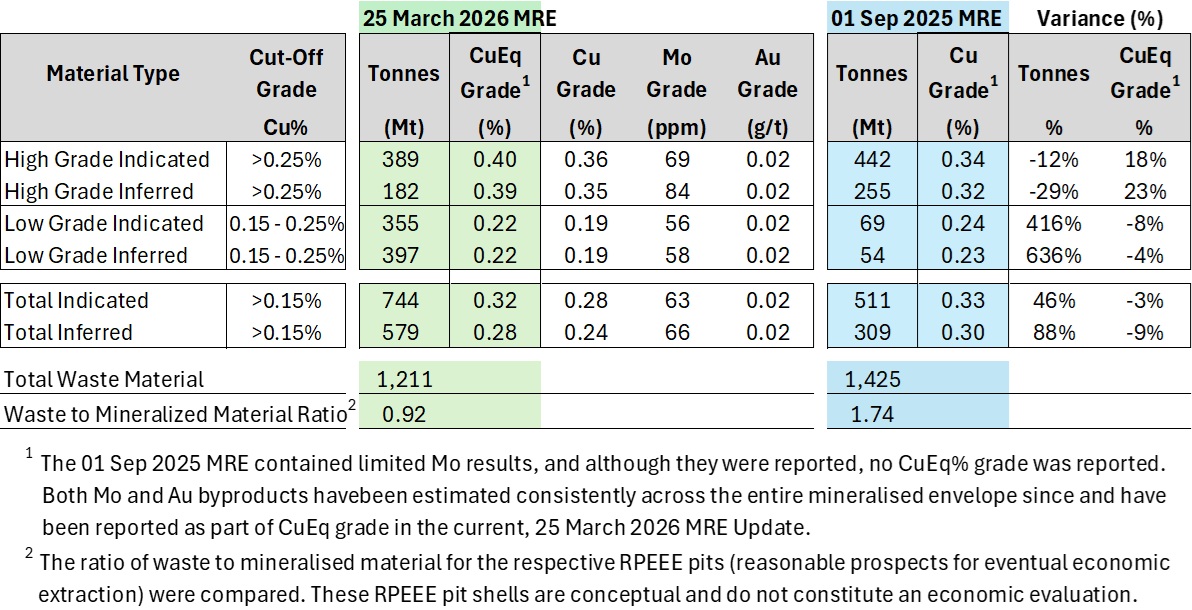
Core Insights - The updated Mineral Resource Estimate (MRE) for the Haib Copper Project shows significant increases in copper equivalent grades and total contained metals, alongside a reduction in the stripping ratio, enhancing the project's economic viability [4][5][6]. Group 1: Mineral Resource Estimates - The MRE as of March 25, 2026, indicates contained resources of 2,090,000 tonnes of copper (Cu) in the indicated category and 1,385,000 tonnes in the inferred category [1][6]. - Total contained copper equivalent (CuEq) is reported at 2,338,000 tonnes in the indicated category and 1,583,000 tonnes in the inferred category [1][5]. - The MRE reflects an 18% increase in high-grade indicated CuEq grade to 0.40% and a 23% increase in high-grade inferred CuEq grade to 0.39% [5][6]. Group 2: Stripping Ratio and Economic Viability - The stripping ratio has been reduced to 0.92 from 1.74, indicating improved efficiency in mining operations [1][5]. - The total contained Cu has increased from 2.6 million tonnes to 3.5 million tonnes, enhancing the overall copper inventory [8][11]. Group 3: Project Development and Future Plans - The Haib project is expected to have a mine life extending from 24 years to potentially over 35 years due to the addition of lower-grade mineralized material [9][11]. - The company plans to deploy 14 drill rigs to complete 50,000 meters of additional drilling by mid-2026, which will inform the next MRE update and the Preliminary Feasibility Study (PFS) [10][15]. Group 4: By-Product Resources - The updated MRE includes significant by-product resources: 487,900 ounces of gold (Au) and 103,600,000 pounds of molybdenum (Mo) in the indicated category, with 380,200 ounces of Au and 84,500,000 pounds of Mo in the inferred category [1][5][6].
Doubleview Gold Clarifies Preliminary Economic Assessment Results for the Hat Project; Updated Scenario B NPV Increased to C$7.27 Billion
TMX Newsfile· 2026-03-23 20:29
Core Viewpoint - Doubleview Gold Corp. has provided updates on the Preliminary Economic Assessment (PEA) for its Hat Project, highlighting significant improvements in the project's economic metrics, particularly due to the scandium recovery circuit [2][4]. Economic Assessment - The after-tax NPV(5%) for Scenario B at consensus metal prices has been revised to C$7.27 billion from C$6.94 billion, with an IRR of 19% [2] - At spot metal prices, the after-tax NPV(5%) for Scenario B increased to C$14.85 billion from C$14.52 billion, with an IRR of 32% [2] - The economic contribution of the scandium recovery circuit has been emphasized, increasing the difference in after-tax NPV between the base case (Scenario A2) and Scenario B to C$547 million [3] Project Economics - The PEA indicates a high-margin operation with an after-tax NPV(5%) of C$4.96 billion (A1), C$6.73 billion (A2), and C$7.27 billion (B) at consensus metal prices, and C$11.05 billion (A1), C$13.53 billion (A2), and C$14.85 billion (B) at spot prices [9] - The project supports a mine life of 25 years with a processing rate of 120,000 tonnes per day, underpinned by a resource base of 609 million tonnes at 0.43% CuEq in the Measured and Indicated categories [9][12] Production Profile - The project is expected to produce an average of over 74,000 tonnes of copper, 254,000 ounces of gold, 376,000 ounces of silver, and 2,700 tonnes of cobalt annually during the first 10 years [9] - Life-of-mine average production is projected at 67.6 kt Cu, 217 koz Au, 348 koz Ag, 2.5 kt Co, and 128 tonnes of scandium oxide per year [9] Capital and Operating Costs - Initial capital costs are estimated at C$3,552 million (A1), C$3,601 million (A2), and C$3,828 million (B) [42] - Average site operating costs are estimated at C$16.22 per tonne milled for Scenario A and C$21.92 for Scenario B, reflecting the additional processing requirements [47] Financial Metrics - The project generates average annual EBITDA of C$886 million (A1), C$1,071 million (A2), and C$1,284 million (B) [51] - Total post-tax free cash flow is estimated at C$10,050 million (A1), C$12,961 million (A2), and C$15,437 million (B) [52] Strategic Importance - The Hat Project is positioned as a primary North American source of copper, scandium, and cobalt, with significant contained resources [16] - The project benefits from a stable regulatory environment in British Columbia and aims to engage with local First Nations respectfully [16]

U.S. GoldMining Files PEA Technical Report for Its Whistler Project, Alaska
Prnewswire· 2026-03-23 10:30
Core Viewpoint - U.S. GoldMining Inc. has filed a technical report for its Whistler Gold-Copper Project, highlighting strong economic potential and a positive preliminary economic assessment (PEA) [1][2]. Economic Assessment Highlights - The after-tax net present value (NPV5%) at a 5% discount rate is estimated at $2.0 billion, with an internal rate of return (IRR) of 33% and an initial payback period of 2.1 years at base prices [2]. - At current spot prices, the after-tax NPV5% increases to approximately $4.9 billion, with an IRR of 62% and an initial payback period of 1.2 years [2]. - The project is expected to produce an annual average of 345,000 gold equivalent ounces (AuEq) over the first three years, with a life of mine average annual production of 246,000 oz AuEq over 14.6 years [2]. Production and Resource Contribution - Approximately 25% of the project's revenue is expected to come from copper, which is classified as a critical mineral by the U.S. Department of the Interior [2]. - The project encompasses several gold-copper porphyry deposits and exploration targets within a large regional land package of approximately 53,700 acres (217.5 square kilometers) [8]. Future Plans and Exploration - The company plans to advance mining studies and is optimistic about expanding the resource model through additional exploration work [2]. - Details of the 2026 exploration program, which includes testing promising porphyry gold-copper targets, are expected to be shared in the coming weeks [2].


Widest Caesium Drill Intercept to Date at the Helios Caesium Zone in Final Batch of 2025 Drill Results from Shaakichiuwaanaan
Prnewswire· 2026-03-18 21:00
Core Insights - The company reported the widest caesium drill intercept to date at the Helios Caesium Zone, indicating a new mineralized lens north of the Vega Zone with strong caesium grades [1][8][9] - A total of 57,024 meters of drilling was completed in 2025, with results for lithium, caesium, and tantalum now fully reported [1][9] - The Helios Caesium Zone is a new discovery with high-grade caesium, including an intercept of 1.0 m at 21.52% Cs2O [8][9] - The company plans to integrate new datasets into its exploration strategy and update geological models, which will support future feasibility studies [2][10] Drilling Results - The final batch of drill core assays reported results from 1,176 meters across 7 holes at the CV13 Pegmatite, confirming high-grade caesium mineralization [1][8] - Significant intercepts include 2.3 m at 4.65% Cs2O from drill hole CV25-999, located approximately 70 m north of the Vega Zone [1][8] - The CV13 Pegmatite hosts the world's largest in-situ pollucite-hosted caesium pegmatite Mineral Resource, comprising 0.69 million tonnes at 4.40% Cs2O (Indicated) and 1.70 million tonnes at 2.40% Cs2O (Inferred) [4][30] Future Plans - The company is focused on advancing its exploration strategy and updating the feasibility study for the CV5 Pegmatite, incorporating tantalum as a co-product [2][10] - An updated Preliminary Economic Assessment for the broader project covering lithium, caesium, and tantalum is also planned [2][10] - The geology team is interpreting the data to enhance geological models for the CV5 and CV13 pegmatites, including the Vega, Rigel, and Helios caesium zones [9][10] Market Context - Caesium mineral deposits are rare and represent a critical component of LCT pegmatite systems, which are the primary economic source of caesium supply [21][23] - The market for caesium compounds is largely opaque, with prices for caesium carbonate currently exceeding US$200/kg [22][23] - The discovery at Shaakichiuwaanaan has the potential to become a primary source of caesium supply for global markets, with applications in various industries including oil/gas drilling and solar panel technology [23]


Gold X2 Announces Filing of NI 43-101 Technical Report for the Moss Gold Project Preliminary Economic Assessment
TMX Newsfile· 2026-03-12 23:54
Core Viewpoint - Gold X2 Mining Inc. has filed an independent technical report for the Preliminary Economic Assessment (PEA) of its 100% owned Moss Gold Project in Ontario, Canada, indicating strong potential for a long-life mining operation with favorable production costs [1][5]. Group 1: Technical Report Details - The PEA is dated March 12, 2026, with an effective date of January 26, 2026, and was prepared in accordance with National Instrument 43-101 [2]. - G Mining Services (GMS) coordinated the report, covering various aspects such as property description, mineral processing, resource estimation, mining methods, and economic analysis [3]. - The technical report has been reviewed and approved by Nicolas Vanier-Larrivée from G Mining Services, ensuring its credibility [4]. Group 2: Company Overview - Gold X2 Mining is focused on acquiring and advancing primary gold assets in tier-one jurisdictions, aiming to deliver long-term value to shareholders [5]. - The Moss Gold Project has seen over $100 million in investment and approximately 100,000 meters of drilling, contributing to a total of over 300,000 meters drilled [5]. - The updated mineral resource estimate for the Moss and East Coldstream Deposits includes 2.458 million ounces of Indicated gold resources at 1.04 g/t Au and 4.209 million ounces of Inferred gold resources at 0.97 g/t Au [5].

CORRECTION FROM SOURCE: Allied Critical Metals Further Highlights Rapid Payback, Capital Efficiency and Infrastructure from Borralha PEA
TMX Newsfile· 2026-03-10 13:14
Core Viewpoint - Allied Critical Metals Inc. has provided additional economic and technical details regarding the Preliminary Economic Assessment (PEA) for its Borralha Tungsten Project in Portugal, confirming that the previously announced PEA economics remain unchanged while offering more clarity on capital efficiency and cash flow generation [1][2][3]. Economic Results - The PEA outlines three pricing scenarios for tungsten: - Base case at $962/mtu WO₃ (USD $704/mtu WO₃) with an NPV of $182.7 million (USD $134.0 million) and an IRR of 27.2% - Medium case at $1,365/mtu WO₃ (USD $1,000/mtu WO₃) with an NPV of $473.4 million (USD $346.6 million) and an IRR of 48.8% - High case at $2,049/mtu WO₃ (USD $1,500/mtu WO₃) with an NPV of $963.8 million (USD $706.4 million) and an IRR of 78.4% [5][6][8]. Capital Efficiency - The estimated initial capital cost for the Borralha Project is approximately $125 million (USD $91.5 million), reflecting a compact infrastructure layout designed to support efficient underground mining and processing operations [13][21]. - The project is expected to generate an average annual revenue of approximately $252.52 million (USD $184.89 million) and an average annual EBITDA of approximately $142.18 million (USD $104.10 million) at a tungsten price of USD $1,000/mtu WO₃ [8][22]. Infrastructure and Site Requirements - The Borralha Project benefits from a well-developed infrastructure platform, including a planned hydro-electric power connection, water supply and recycling systems, and road access, which minimizes environmental impact [25][30]. - The project design integrates processing, backfill, water management, and power supply systems to support efficient underground mining operations [30][36]. Mineral Resource Estimate - The PEA is based on the updated Mineral Resource Estimate for the Santa Helena Breccia, which includes 13 million tonnes at a grade of 0.21% WO₃ for measured and indicated resources, and 7.7 million tonnes at a grade of 0.18% WO₃ for inferred resources [12][11]. Market Context - Current tungsten market prices are reported to be significantly above the USD $1,000 per mtu sensitivity case presented in the PEA, reaching approximately $2,998 per mtu (USD $2,195 per mtu) as of March 6, 2026 [7][40]. - Tungsten is recognized as a critical raw material by the United States and the European Union, emphasizing the strategic importance of the Borralha Project in securing western sources of tungsten [40].