RWA(Real World Asset

Search documents
了解RWA项目必备的五大准备
Sou Hu Cai Jing· 2025-08-26 07:30
Core Concept - RWA (Real World Asset) is not merely about putting assets on the blockchain, but involves the digital representation of economic rights of real assets, ensuring their circulation in a trusted environment [3][4] - Understanding the value logic, rights structure, and liquidity characteristics of the target asset is crucial before starting [3] Team Formation - RWA projects require a diverse team, including traditional finance experts, legal compliance specialists, blockchain technology personnel, and asset partners to provide reliable underlying assets [4][5] Legal and Compliance Preparation - Compliance is the most complex yet vital aspect of RWA projects, with significant regulatory policy differences across regions and asset types [5][6] - Early investment in compliance can ensure project stability [5] Technical Framework - Key technical considerations include: - Determining whether the token qualifies as a security and adhering to relevant issuance and trading rules [6][8] - Designing legal entities to hold assets for risk isolation [6][8] - Establishing KYC/AML mechanisms to meet regulatory requirements [6][8] - Selecting the appropriate legal jurisdiction to avoid disputes [6][8] - Choosing between public or consortium blockchains based on transparency and control needs [6][8] - Ensuring smart contract security through professional audits [6][8] - Integrating reliable data sources to synchronize off-chain asset information with on-chain [6][8] - Selecting trustworthy custodians to safeguard underlying assets [6][8] Asset Selection - Initial projects should focus on standardized, stable cash flow assets like government bonds or rental properties [9] - A clear economic model should be designed, specifying the type of rights represented by the token (ownership, income rights, or debt rights) and the profit distribution mechanism [9] Conclusion - RWA projects have vast potential, but success relies on solid preparatory work across understanding, team formation, compliance, technology, and asset selection [10] - Thorough preparation is more important than entering the market blindly, as a strong foundation is essential for sustainable project development and value realization [10]

RWA项目的两种运作模式解析
Sou Hu Cai Jing· 2025-08-25 11:39
Core Insights - RWA (Real World Asset) is gaining attention from companies and investors as it digitizes real-world assets through blockchain technology, enhancing efficiency and transparency in asset circulation [1] Group 1: Mode 1 - Asset Monetization and Liquidity Optimization - The primary goal of this mode is to help companies optimize their asset structure and improve operational efficiency through asset digitization [3] - Companies can convert physical or financial assets into digital forms, improving cash flow and reducing capital occupation time [3] - The application of blockchain technology ensures transparency and traceability, enhancing trust among parties involved [3] Group 2: Mode 2 - Long-term Value and Sustainable Operations - This mode focuses on creating long-term value and stable operations by integrating cash-generating assets with digital tools for sustainable returns [4] - Successful implementation requires the project party to have professional asset management and operational capabilities, including systematic operations for asset selection and risk control [4] - Efficient revenue distribution through technology can create long-term value for all parties involved [4] Group 3: Choosing the Appropriate Mode - Companies should choose a mode based on their actual needs and conditions; the first mode is suitable for enhancing asset liquidity and resource allocation, while the second mode is for those with asset management expertise and long-term planning [6] - Compliance and risk control are essential foundations regardless of the chosen mode [6] - With technological advancements and improved regulations, RWA is expected to provide unique value in more fields, offering new possibilities for companies and participants [6]

当传统资产遇上“数字身份证”:浅析RWA上链的核心环节
Sou Hu Cai Jing· 2025-08-22 03:02
Core Insights - The concept of Real World Assets (RWA) is emerging at the intersection of finance and technology, focusing on the legal processes that underpin asset tokenization rather than the technology itself [1][3] Group 1: Understanding RWA - RWA does not involve physically moving assets onto the blockchain; instead, it records digital certificates representing specific rights to those assets [3][5] - The core value of these digital certificates relies on the legal validity of the underlying assets and associated legal documents [3][5] Group 2: Legal Framework - A thorough due diligence and legal confirmation process is essential for the underlying assets, which include real estate, government bonds, and artworks [5][6] - The establishment of a Special Purpose Vehicle (SPV) is crucial for risk isolation and operational convenience, allowing the asset to be held in a separate legal entity [5][6] - Legal documents such as asset transfer agreements and SPV establishment documents are key to separating the asset from its original owner [5][6] Group 3: Smart Contracts and Legal Mapping - Smart contracts play a vital role in mapping legal terms into computer code, ensuring that ownership, valuation, and compliance are clearly defined [6][7] - The Token Holder Agreement is a critical document that outlines the rights and obligations of token holders, with its core terms executed by the smart contract [7] Group 4: Benefits of RWA Tokenization - RWA tokenization addresses pain points in traditional asset transactions by enhancing transparency, efficiency, and accessibility [9][10] - Transactions are recorded on the blockchain, making them publicly verifiable and immutable, which significantly increases trust [10] - The process simplifies traditional asset transactions, potentially allowing for 24/7 trading and near-instant settlement [10] - Tokenization lowers investment barriers by converting large assets into smaller, more affordable shares, thus improving liquidity [10]
RWA项目手册1.0版本(九):RWA 项目落地的5大方案
Sou Hu Cai Jing· 2025-06-10 09:32
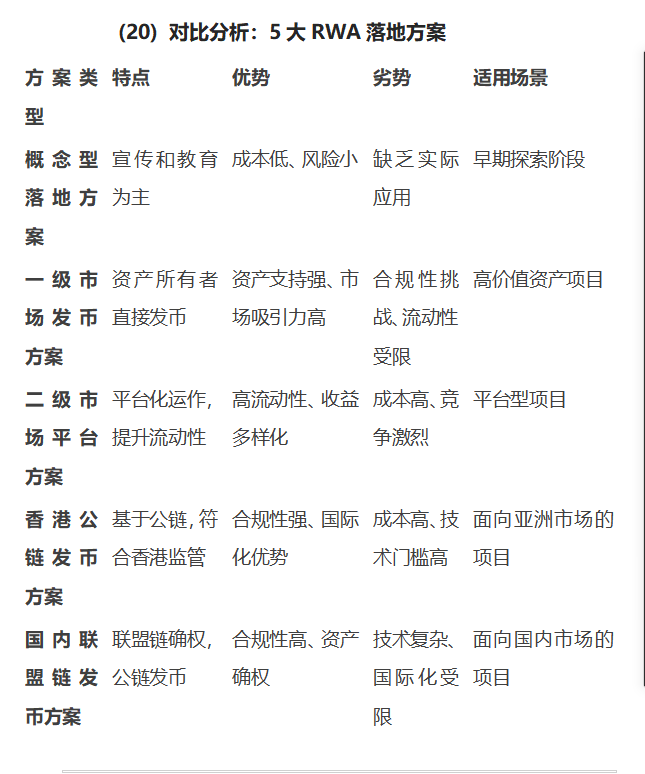
Core Insights - The article discusses five main landing solutions for Real World Assets (RWA) projects, each tailored to different project types, target markets, and compliance requirements [1]. Group 1: Conceptual Landing Solutions - The RWA conceptual landing solution focuses on promotion and education, aiming to attract investor and user attention through market research and preliminary pilots [1]. - Advantages include low cost, high flexibility, and low risk due to minimal compliance and funding issues [1]. - Disadvantages involve a lack of practical application and low market recognition, as it relies solely on concept validation [1]. - Suitable for early exploration stages or projects aiming to build market awareness through education [1]. Group 2: Primary Market Solutions - The primary market solution involves actual asset owners directly issuing tokens to digitize their assets [1]. - Advantages include asset backing for tokens, direct participation from asset owners, and strong market appeal due to potential asset-related returns [1]. - Disadvantages include compliance challenges, high technical requirements, and limited liquidity in the primary market [1]. - Suitable for enterprises or individuals with high-value assets looking to tokenize their asset value [1]. Group 3: Secondary Market Solutions - The secondary market solution focuses on building a trading platform for tokenized real assets, enhancing liquidity [1][2]. - Advantages include high liquidity due to active trading, user aggregation, and diverse revenue streams from transaction fees and asset management [3][4]. - Disadvantages involve high construction costs, complex compliance, and intense market competition [7]. - Suitable for enterprises or institutions capable of building platforms to enhance asset liquidity [4]. Group 4: Hong Kong Public Chain Solutions - This solution utilizes public chain technology in Hong Kong, aligning with local blockchain policies and compliance [6]. - Advantages include strong compliance, international appeal as a financial center, and high transparency [6]. - Disadvantages consist of high compliance costs, technical challenges, and a limited market scope primarily focused on Asia [6]. - Suitable for projects aiming to develop in the Asian market with a focus on compliance [10]. Group 5: Domestic Alliance Chain Solutions - This solution employs an alliance chain for asset confirmation and a public chain for token issuance, ensuring compliance with Chinese regulations [8]. - Advantages include high compliance, asset confirmation through technology, and localization benefits [8]. - Disadvantages involve technical complexity and potential changes in domestic policies affecting digital assets [8]. - Suitable for projects primarily targeting the Chinese market that seek asset confirmation and tokenization [11]. Recommendations - For early-stage projects, the RWA conceptual landing solution is recommended for low-cost market validation [9]. - High-value asset projects should consider the primary market token issuance solution for direct asset tokenization [9]. - Platform-based projects are advised to adopt the secondary market solution to enhance liquidity [9]. - Projects targeting the Asian market should utilize the Hong Kong public chain solution to leverage compliance advantages [10]. - Domestic projects should opt for the alliance chain solution to ensure adherence to local laws and policies [11].