Robot memory

Search documents
密歇根、斯坦福、Figure AI 联合牵头!机器人记忆基准 RoboMME 重磅发布!
机器人大讲堂· 2026-03-15 09:06
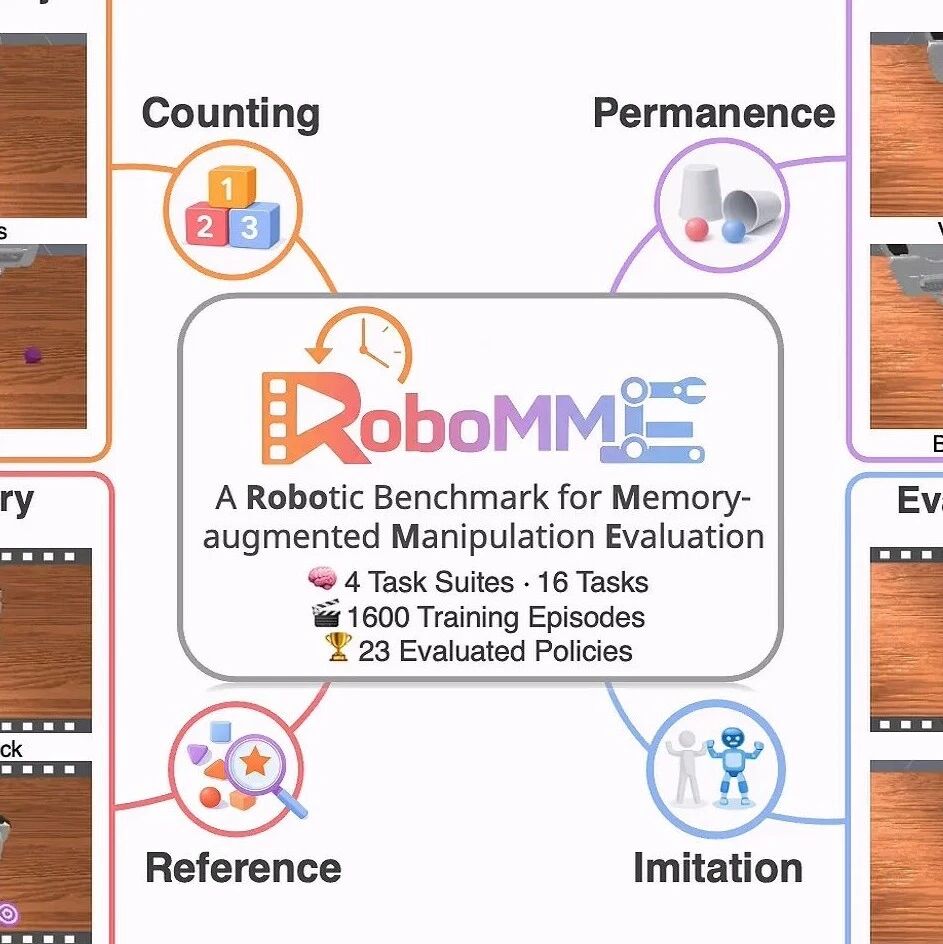
Core Insights - The article discusses the introduction of the RoboMME benchmark, which categorizes robot memory into four dimensions: temporal, spatial, object, and procedural, providing a unified evaluation standard for memory-enhanced robotic strategies [3][4][5]. Group 1: RoboMME Benchmark Overview - RoboMME benchmark is a collaborative effort by institutions like the University of Michigan and Stanford University, aimed at addressing the fragmented evaluation of robot memory [3]. - It includes 16 specific tasks and 770,000 high-quality training sequences, enhancing the assessment of memory capabilities in robots [3][4]. - The benchmark's design is inspired by human cognitive theories, breaking down memory needs into four core dimensions, each corresponding to specific tasks [6]. Group 2: Memory Dimensions and Tasks - Temporal memory focuses on event counting and sequence ordering, with tasks like BinFill and StopCube, where robots must track the number of objects placed and count occurrences accurately [8]. - Spatial memory emphasizes position tracking under occlusion and scene changes, exemplified by the VideoUnmaskSwap task, where robots must identify hidden objects based on prior visual information [8]. - Object memory deals with cross-time object identity recognition, as seen in tasks like PickHighlight and VideoRepick, where robots must remember and retrieve specific objects despite changes in their environment [8]. - Procedural memory is responsible for storing and reproducing action patterns, demonstrated in tasks like PatternLock and InsertPeg, where robots must replicate specific movements accurately [9]. Group 3: Evaluation of Memory Models - The research team developed 14 memory-enhanced VLA models based on the RoboMME benchmark, utilizing symbolic, perceptual, and recurrent memory representations [12]. - The performance of these models varies significantly, with perceptual memory models showing the best efficiency-performance balance, particularly in tasks requiring visual context [17]. - Symbolic memory models excel in counting tasks but struggle with time-sensitive tasks due to their inability to capture precise temporal dynamics [15]. Group 4: Human vs. Machine Performance - A comparison between human performance and the best-performing model (FrameSamp+Modul) revealed a significant gap, with humans achieving a success rate of 90.5% compared to the model's 44.51% [19][21]. - The differences stem from humans' superior ability to process ambiguous information, generalize memory across tasks, and recover from errors, highlighting areas for future research [21]. Group 5: Practical Implications - The RoboMME benchmark not only serves as an evaluation tool but also provides guidance for practical applications in robotics, suggesting that industrial robots could benefit from perceptual memory for assembly precision, while service robots might leverage symbolic memory for task planning [21].