Securities Transaction Tax

Search documents
Investors lost Rs 9.40 lakh cr in Budget Sunday crash
Rediff· 2026-02-01 12:47
Core Viewpoint - The market capitalization of BSE-listed companies experienced a significant decline of Rs 9,40,581.75 crore, dropping to Rs 4,50,61,658.60 crore (USD 4.90 trillion) in a single day due to the proposed increase in Securities Transaction Tax (STT) on derivatives by Finance Minister Nirmala Sitharaman [1][5]. Market Reaction - The BSE Sensex fell by 2,370.36 points or 2.88 percent, closing below the 80,000-mark at 79,899.42 during afternoon trading [4]. - The benchmark index ended at 80,722.94, down 1,546.84 points or 1.88 percent, marking a notable decline similar to the drop on February 1, 2020 [5][7]. Impact of STT Increase - The STT on futures contracts is set to increase from 0.02 percent to 0.05 percent, while the STT on options premium and exercise will rise to 0.15 percent from 0.1 percent and 0.125 percent respectively [6][9]. - This increase in STT is viewed negatively by active traders and the derivatives ecosystem, as it raises transaction costs and may reduce speculative volumes, impacting liquidity in futures and options [6][8]. Investor Sentiment - The proposed tax changes aim to moderate excessive derivatives activity and boost revenue, but they could dampen retail participation during bullish market phases and affect short-term broking revenues [8]. - The overall market sentiment was negative, with 2,375 stocks declining, while only 1,759 advanced and 175 remained unchanged on the BSE [12]. Sector Performance - Among the major companies, State Bank of India and Adani Ports saw declines of 5.61 percent and 5.53 percent respectively, while Tata Consultancy Services, Infosys, Sun Pharma, and Titan were among the gainers [11][12]. - Various indices experienced significant drops, with BSE PSU Bank falling by 5.60 percent and the metal sector declining by 3.85 percent [12].

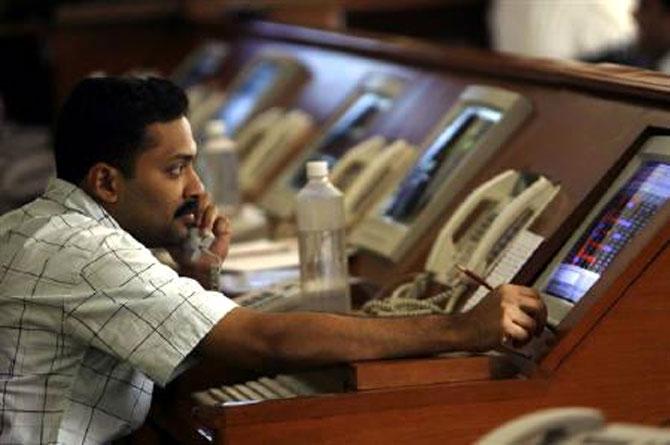
STT hike on Futures drags markets down; Sensex crashes 2,370 points
Rediff· 2026-02-01 11:22
Core Viewpoint - The Finance Minister's proposal to increase the Securities Transaction Tax (STT) on futures to 0.05% is expected to have a structurally negative impact on the capital market ecosystem, particularly affecting futures and options (F&O) driven businesses [1][11]. Market Reaction - The benchmark stock indices, Sensex and Nifty, experienced significant declines, with Sensex dropping by nearly 2% and settling at 80,722.94, down 1,546.84 points or 1.88% [2][3]. - The NSE Nifty fell by 495.20 points or 1.96%, closing at 24,825.45, with an intraday low of 24,571.75, a drop of 2.95% [3][7]. Impact on Trading and Liquidity - Higher transaction costs due to the increased STT are likely to reduce trading volumes, dampen short-term momentum, and lower profitability for active market participants [12][16]. - Foreign Institutional Investor (FII) participation in derivatives may decline as post-tax trading efficiency diminishes, which could negatively impact overall market liquidity [13][8]. Sector Performance - Among the 30 Sensex firms, State Bank of India and Adani Ports saw significant losses of 5.61% and 5.53%, respectively, with other companies like Bharat Electronics, ITC, Tata Steel, UltraTech Cement, and Reliance Industries also among the laggards [6][7]. - Conversely, Tata Consultancy Services, Infosys, Sun Pharma, and Titan were noted as gainers during this period [8][7]. Long-term Outlook - While the proposed STT increase is seen as a short-term dampener for capital market entities, some analysts suggest it may have positive implications in the long term [9]. - The budget also aims to support sectors affected by global trade tariffs and focuses on emerging areas such as data centers, semiconductors, and biopharma, which may provide some resilience to the market [10].