Sinkhorn - Knopp算法

Search documents
租了8张H100,他成功复现了DeepSeek的mHC,结果比官方报告更炸裂
机器之心· 2026-01-19 08:54
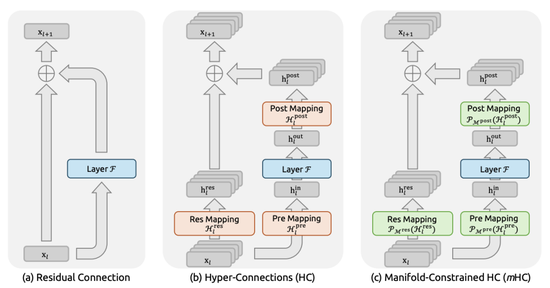
Core Insights - DeepSeek's mHC architecture addresses numerical instability and signal explosion issues in large-scale training by extending traditional Transformer residual connections into a multi-stream parallel architecture [1][5] - The mHC model has garnered significant attention in the AI community, with successful reproductions yielding better results than the original DeepSeek paper [5][6] Group 1: mHC Architecture - The mHC model utilizes the Sinkhorn-Knopp algorithm to constrain the connection matrix to a doubly stochastic matrix manifold, ensuring stability during training [1][25] - Traditional residual connections in Transformers have remained unchanged since 2016, relying on a single information flow, while mHC introduces multiple parallel streams for enhanced expressiveness [9][14] - The mHC architecture maintains stability by preventing signal amplification, which can lead to catastrophic failures in large models [20][28] Group 2: Experimental Results - In experiments with 10M parameters, the original hyper-connection (HC) model exhibited a signal amplification of 9.2 times, while mHC maintained stability with an amplification of 1.0 [36][61] - Scaling up to 1.7B parameters, the HC model showed an alarming amplification of 10,924 times, highlighting the instability associated with larger models [54][66] - The experiments demonstrated that while HC models accumulate instability, mHC models consistently maintain structural integrity across different training conditions [70][71] Group 3: Implications and Future Directions - The findings suggest that while traditional residual connections are stable, they may not be optimal for larger models, as mHC offers a balance between expressiveness and stability [57][58] - Future research aims to explore scaling laws further, particularly at the 10B parameter scale, where significant amplification trends are anticipated [101] - The mHC approach not only mitigates instability but also eliminates the risk of catastrophic failures in large-scale training scenarios [93][96]


梁文锋DeepSeek新论文!接棒何恺明和字节,又稳了稳AI的“地基”
Xin Lang Cai Jing· 2026-01-02 05:27
Core Insights - DeepSeek has introduced a new architecture called mHC (Manifold-Constrained Hyper-Connections), which significantly improves the residual connection component of the Transformer architecture, a foundational element that has seen little change since its inception in 2015 [1][3] Group 1: Historical Context - The evolution of neural network architectures began with ResNet, introduced by Kaiming He in 2015, which addressed the vanishing gradient problem and enabled the training of very deep networks [3] - The Transformer model, released in 2017, adopted residual connections as a standard feature, forming the basis for many leading models today [3] Group 2: Technical Comparisons - Hyper-Connections, proposed by ByteDance in 2024, expanded the single residual flow into multiple parallel streams, enhancing model performance but introducing stability issues during training [5][10] - mHC aims to resolve the stability problems associated with Hyper-Connections by constraining the connection weight matrix within a specific mathematical space, ensuring that signal amplification does not occur [10][12] Group 3: Mathematical Innovation - The core innovation of mHC involves using a Doubly Stochastic Matrix for the connection weights, which guarantees that the output does not exceed the maximum input value, thus preserving energy conservation [10][12] - The implementation of mHC utilizes the Sinkhorn-Knopp algorithm to achieve the desired matrix properties efficiently, allowing for end-to-end training without introducing new hyperparameters [11][12] Group 4: Engineering Excellence - DeepSeek's approach to implementing mHC demonstrates significant engineering capabilities, including the development of custom CUDA kernels and operator fusion techniques to minimize computational delays [16] - The ability to integrate innovative mathematical solutions into practical training environments highlights DeepSeek's competitive advantage in the AI research landscape [16]

DeepSeek改造何恺明残差连接!梁文峰亲自署名,十年首次重大升级
Xin Lang Cai Jing· 2026-01-01 11:45
Core Insights - DeepSeek has introduced an upgraded version of the residual connection, a fundamental component of deep learning proposed by Kaiming He in 2016, marking a significant evolution in the field [1][27]. Group 1: Residual Connections and Hyper-Connections - Residual connections have remained unchanged for a decade, serving as the cornerstone of deep learning architectures, allowing signals to pass directly from shallow to deep layers without modification [5][31]. - The emergence of Hyper-Connections (HC) aims to expand the residual flow width from C dimensions to n×C dimensions, introducing three learnable mapping matrices to manage information flow [7][32]. - Experiments by the DeepSeek team indicate that the Hres matrix, responsible for internal information exchange within the residual flow, contributes significantly to performance improvements [7][32]. Group 2: Challenges with Hyper-Connections - When HC is extended to multiple layers, the composite mapping no longer retains the identity property, leading to sudden loss spikes and gradient fluctuations during training [9][34]. - The research team calculated that the amplification factor of the composite mapping in HC peaked at 3000, indicating that signals could be amplified or attenuated drastically during inter-layer propagation [10][35]. Group 3: Double Random Matrix Constraints - The core idea of the DeepSeek paper is to constrain the residual mapping matrix to a specific manifold formed by double random matrices, known as the Birkhoff polytope [11][36]. - This constraint provides three key theoretical properties: norm preservation, combinatorial closure, and a geometric interpretation that enhances feature fusion stability [14][39][40]. - The Sinkhorn-Knopp algorithm is employed to project any matrix onto this manifold, resulting in a significant reduction in signal gain from 3000 in HC to approximately 1.6 in mHC [16][41]. Group 4: Engineering Optimizations - The expansion of residual flow width incurs additional memory access costs, with detailed analysis showing that standard residual connections require reading 2C elements and writing C elements, while HC requires significantly more [19][44]. - The DeepSeek team developed infrastructure optimizations, including kernel fusion and specialized kernels for the Sinkhorn-Knopp algorithm, to reduce memory access and improve computational efficiency [19][43]. - The paper presents an optimization formula for recomputation strategies, aligning recomputation boundaries with pipeline stage boundaries for enhanced performance [20][45]. Group 5: Experimental Validation - The paper validates the proposed methods on MoE models of sizes 3B, 9B, and 27B, with an expansion rate of n set to 4, demonstrating stable training curves and a loss reduction of 0.021 compared to the baseline [22][47]. - In downstream task evaluations, mHC outperformed HC by 2.1% in the BBH reasoning task and 2.3% in the DROP reading comprehension task, showing superior performance across most tasks [22][48]. - Internal large-scale training experiments confirmed these findings, with mHC introducing only a 6.7% additional time overhead when n=4 [25][50].