
Small Cap Investing

Search documents
Small Cap Bargains in Brazil
Daily Reckoning· 2026-02-25 23:00
Core Thesis - Brazilian stocks, particularly small caps, are expected to experience significant upside as the market transitions from fixed income to equities, driven by a favorable economic environment and declining interest rates [3][8][17] Investment Performance - The Brazilian ETF EWZ has increased by 54% over the past year, indicating strong market performance [1] - Duquesne Family Office acquired approximately 3.5 million shares of the iShares MSCI Brazil ETF, valued at around $112 million, signaling confidence from prominent investors [2] Market Conditions - Brazilian investors currently have only 9% exposure to stocks, with a staggering 91% in fixed income, due to historical underperformance of stocks and high inflation rates [7] - The central bank's interest rate is expected to begin easing in March, making stocks more attractive to local investors [8] Earnings Growth Potential - Brazilian companies are projected to see earnings per share (EPS) growth of 11% annually through 2035, which could lead to a re-rating of Brazilian valuations [13] Small Cap Opportunities - The iShares small cap ETF EWZS, which includes 70 smaller Brazilian companies, is trading at low valuations with an average P/E ratio of 9 and a price/book ratio of 1.1, compared to higher ratios in U.S. small cap indices [15] - Small caps are positioned to benefit from the economic rebound in Brazil, making them an attractive investment option [16][17]


Using ETFs to Capitalize on Small Cap & Silver Volatility
Youtube· 2026-02-05 01:00
Macro Economic Overview - The current macroeconomic environment appears strong, highlighted by a robust ISM manufacturing number, indicating a healthy economy [1] - The S&P 500 earnings have increased by 9% year-over-year, reflecting positive performance during the earnings season [2] Small Cap Performance - Small-cap stocks are significantly outperforming larger counterparts, with earnings up 25% year-over-year so far this earnings season [3] - There is a continued interest in small-cap investments, with specific mention of ProShares' high-income ETF focused on the Russell 2000 [4] Silver Market Insights - Silver has experienced considerable volatility, with a notable sell-off followed by a rebound, and is currently up 161% year-over-year [5][6] - The dual nature of silver as both an industrial metal and a precious metal provides it with unique investment characteristics, making it a potential buy during pullbacks [7] New Investment Products - ProShares has launched a new ETF, the ProShares Coindesk 20 ETF, which includes the 20 largest cryptocurrencies beyond Bitcoin and Ether, indicating a diversification into the cryptocurrency market [9]

We've been waiting for the 'all-clear' from the Fed for a 'really long time': Goldman Sachs director
Youtube· 2025-12-12 00:15
Core Viewpoint - The sentiment is shifting towards a bullish outlook on small-cap stocks, driven by recent Federal Reserve actions and economic indicators suggesting a stable economy rather than a weak one [1][2][3]. Economic Indicators - The GDP growth forecast for Q3 is mid to low 3% and is expected to be in the low 2% range for Q4 and mid-2% for the following year, indicating a stable economic environment [3][4]. Federal Reserve Actions - The Federal Reserve has reduced the policy rate by 75 basis points since September and 175 basis points since the previous September, positioning the Fed to monitor economic developments closely [4]. Small-Cap Market Insights - There is a belief that despite some Russell 2000 stocks being unprofitable, there are significant opportunities in the small-cap sector, particularly in profitable companies [6][7]. - The outlook for earnings in the Russell 2000 is projected to be in the mid to high teens, outperforming the S&P 500 [7]. Market Dynamics - The current market environment is characterized by a shift where previously lagging stocks, including small caps, are beginning to gain momentum, which is seen as a positive sign for future leadership in the market [11]. - Increased M&A activity in the small-cap space is noted, with strategic buyers becoming more active, particularly in healthcare and technology sectors [12].

4 ETFs to Consider From an Undervalued Part of the Market
Youtube· 2025-11-13 16:30
Core Insights - The discussion emphasizes the advantages of small cap ETFs over individual small cap stocks, highlighting diversification as a key benefit [2][3] - Investors are advised to consider costs, including fees and trading expenses, when selecting small cap ETFs [4][5] - The podcast notes that passive index funds generally have higher success rates compared to active funds in the small cap space [7][8] Small Cap ETFs vs Individual Stocks - Diversification is crucial as most small cap stocks may not outperform in the long term, making ETFs a more effective way to capture winning stocks [2][3] - Holding a broad portfolio through ETFs allows investors to access a wider range of small cap stocks [3] Key Considerations for Small Cap ETFs - Cost is a significant factor, with attention to both management fees and trading costs, especially for micro cap stocks [4][5] - Investors should understand the index that the ETF tracks and examine the portfolio for sector exposures and style box variations [13] Active vs Passive Strategies - Passive small cap index funds tend to perform better than active funds, but active ETFs are gaining popularity in the small cap space [6][8] - Concentrated strategies in active ETFs can pose risks due to the inability to limit new investors [8][9] Index Selection - Different indexes like S&P 600 and Russell 2000 offer various approaches to small cap investing, with specific requirements for profitability impacting index composition [11][13] - Understanding the differences in index methodologies is essential for investors [12][13] Market Trends and Investor Sentiment - Recent outflows from small cap ETFs may indicate a contrarian investment opportunity, suggesting that it could be a favorable time to invest in small caps [14][15] - The principle of "no pain, no premium" in factor investing suggests that underperformance can lead to future outperformance [15] Recommended Small Cap ETFs - Vanguard Small Cap ETF (VB) and iShares Core S&P Small Cap ETF are highlighted as top choices for market beta exposure, both offering low fees [17][18] - For active small cap ETFs, Dimensional US Small Cap ETF (DFAS) and Avantis US Small Cap Equity ETF (AVSC) are recommended for their focus on value and profitability [20][21]
Investment firm president says this stock is 'gushing cash'
Youtube· 2025-10-22 06:30
Group 1: Investment Opportunities - The Atlanta Braves are considered a trophy asset, providing a rare opportunity for individual investors to buy into a sports team, especially as the stock is currently undervalued at around $40 per share, with an estimated worth of $60 based on conservative assumptions [2][3] - Madison Square Garden Sports, which owns the Knicks and Rangers, has an enterprise value of $5.5 billion, while comparable assets like the Lakers have been valued at $10 billion, indicating significant upside potential [4] - Uber is highlighted as a strong investment, with the company generating substantial cash flow and expected to benefit from the advent of autonomous vehicles, countering previous concerns about profitability [6][7] Group 2: Company Analysis - Unified, the third-largest garment rental company in the U.S., is currently priced at $170 per share, with a previous acquisition offer from Cintas at $270, suggesting potential for future growth [8][9] - Unified is described as a family-controlled business, which requires careful consideration, but it possesses a cash-rich balance sheet, making it a stable investment in a high-priced market [9]



Does Eliminating Unprofitable Small Caps Improve Long Term Small Cap Index Performance?
Investment Moats· 2025-10-15 00:35
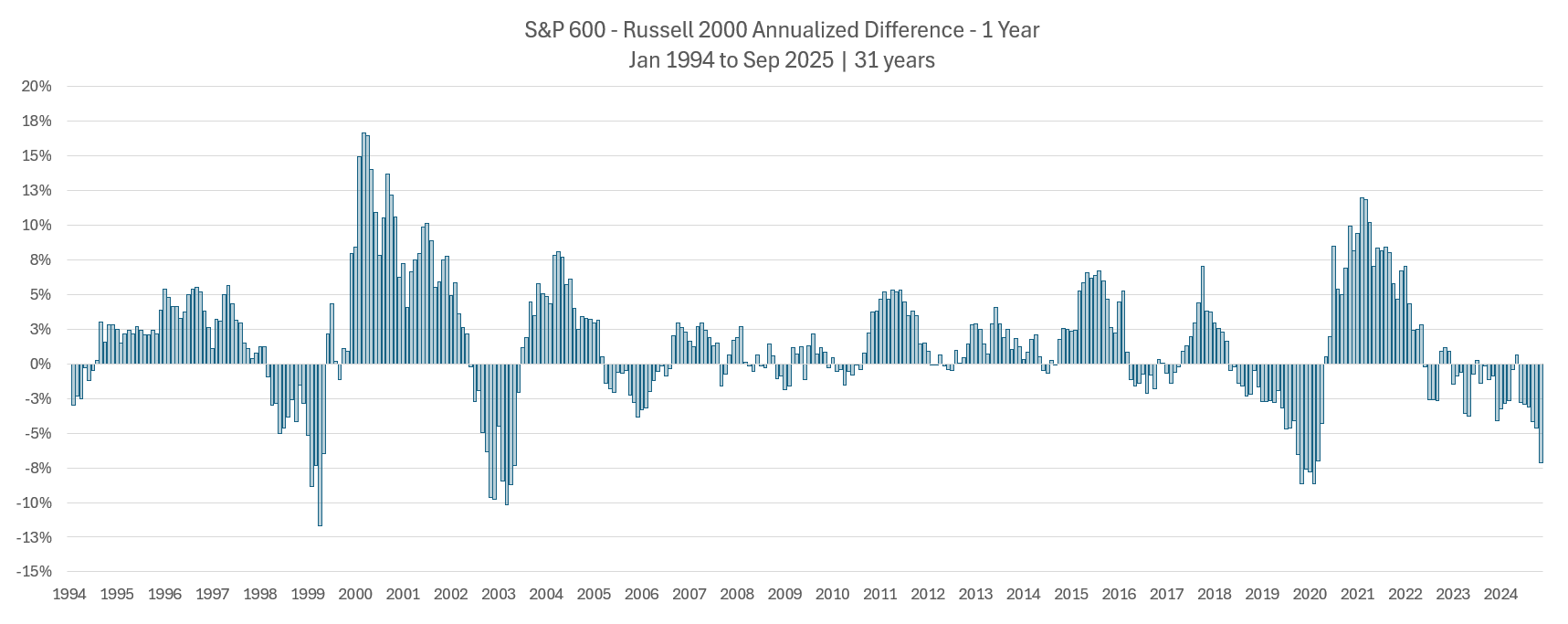
Core Insights - The article discusses the performance comparison between the S&P 600 and the Russell 2000, emphasizing the impact of profitability on investment returns [11][28]. - It highlights that the S&P 600, which requires companies to be profitable, has consistently outperformed the Russell 2000, which includes a significant number of unprofitable firms [10][14][28]. Group 1: Performance Comparison - The S&P 600 has shown better performance over various time frames compared to the Russell 2000, with most one-year, five-year, and ten-year rolling returns favoring the S&P 600 [14][19][22]. - Historical data indicates that investing in the S&P 600 for any ten-year period over the past 31 years would yield positive returns [26][28]. - The S&P 600's requirement for positive GAAP earnings contributes to a higher quality of aggregate earnings and cash flow, leading to improved returns [28][30]. Group 2: Investment Strategy - A systematic investment strategy that focuses on high profitability stocks can yield better returns compared to a strategy that includes low or non-profitable stocks [5][11]. - The article suggests that a diversified basket of profitable stocks can provide stable cash flow and high yield, akin to a long-term fixed income investment [7][8]. - The performance of the Russell 2000 is negatively impacted by its higher proportion of unprofitable companies, which dilutes overall returns [10][14].
Small Cap Investing: Act On Active, Pass On Passive
Seeking Alpha· 2025-09-30 09:10
Group 1 - The article does not provide any specific content related to a company or industry [1]

X @Bloomberg
Bloomberg· 2025-07-26 18:06
Market Trends - Retail investors are increasingly important in small and mid-cap investing due to the rise of passive investing and institutional investors moving up the market cap scale [1] Investment Opportunities - Companies that understand and cater to retail investors may present investment opportunities [1]