Store Expansion Strategy

Search documents
GO Investor Alert: Grocery Outlet Holding Corp. Securities Fraud Lawsuit - Investors With Losses May Seek to Lead the Class Action After Allegedly Concealing Unsustainable Store Expansion: Levi & Korsinsky
Globenewswire· 2026-03-23 20:00
Core Viewpoint - Grocery Outlet Holding Corp. is facing a class action lawsuit due to significant financial missteps, including a 27.9% decline in share price following the announcement of store closures and impairment charges, raising concerns about the sustainability of its growth strategy [2][4]. Financial Performance - On March 5, 2026, Grocery Outlet shares fell by $2.45, closing at $6.34, after the company announced the closure of 36 underperforming stores and recognized $110 million in non-cash impairment charges [2]. - The company missed its full-year guidance on nearly all major financial metrics, indicating a troubling financial outlook [2]. Expansion Strategy - The lawsuit alleges that the company expanded too quickly, opening numerous new locations in fiscal 2025, which masked its inability to achieve organic comparable store sales growth [3][4]. - Comparable store sales for fiscal 2025 grew only 0.5% on a 52-week basis, significantly missing the low end of guidance [3]. Impairment Charges - The company recorded $110 million in non-cash impairment charges related to the long-lived assets of the closed stores, along with an additional $149 million in non-cash goodwill impairment [5]. - These write-downs are viewed as indicative of a flawed growth strategy that prioritized store count over financial viability [5]. Legal and Regulatory Context - The class action lawsuit highlights the need for transparency regarding store expansion and profitability, particularly in the discount grocery sector [6]. - The lead plaintiff deadline for the lawsuit is set for May 15, 2026, emphasizing the urgency for affected shareholders to act [2][7].



ROST Expands With 17 New Locations, Signals 2026 Growth Pipeline
ZACKS· 2026-03-10 15:25
Core Insights - Ross Stores, Inc. (ROST) is advancing its store expansion strategy with the opening of 17 new locations in the U.S. during February and March 2026, which is part of its fiscal 2026 expansion plan [1][9] - The company plans to open approximately 110 new stores in fiscal 2026, including around 85 Ross Dress for Less and 25 dd's DISCOUNTS outlets, indicating a total unit growth of roughly 5% this year [2][9] - Management is optimistic about the strong performance of stores opened in 2025, which supports continued investment in new locations and contributes to local employment opportunities [3] - Ross Stores sees significant potential for expansion in the U.S. market, with a long-term goal of approximately 2,900 Ross Dress for Less locations and 700 dd's DISCOUNTS stores [4][9] - The company operates a successful off-price retail model that caters to middle-income shoppers, benefiting from a strong consumer preference for value [5] - Ross Stores maintains a solid financial position with ample cash and manageable debt levels, allowing for continued investment in growth and shareholder returns [6] Expansion Strategy - The new stores are located across 11 states, enhancing the company's geographic presence, particularly in the Mountain, Midwest, Northeast, and key Sunbelt markets [2] - dd's DISCOUNTS has expanded in California and Texas and opened its first location in Utah, reflecting a targeted approach to market penetration [2] Financial Performance - Ross Stores has seen a 15.9% increase in shares over the past three months, outperforming the industry growth of 10.7% [7]


Here's Why Boot Barn's Store Expansion Strategy Looks Compelling
ZACKS· 2026-02-13 16:20
Core Insights - Boot Barn Holdings, Inc. (BOOT) is experiencing strong performance from its new store openings, consistently exceeding sales and earnings expectations across all U.S. regions [1][8] - The company aims to expand its store count to 1,200 locations nationwide, having ended the fiscal third quarter with 514 stores, including a record 25 openings during the quarter [1][8] Expansion Strategy - The new store openings are projected to generate approximately $3.2 million in annual sales during their first full year, with an expected payback period of under two years [2][8] - Boot Barn plans to open 15 additional stores in the fiscal fourth quarter, bringing the total for fiscal 2026 to 70 new stores, with a targeted annual growth rate of 12% to 15% for fiscal 2027 [4][8] Market Growth - Growth in non-legacy markets such as Florida, Jersey City, and the Northeast has been particularly promising, with sales and customer profiles resembling those in legacy markets like California, Arizona, and Texas [3] Financial Performance - Boot Barn's shares have increased by 5.4% year to date, outperforming the industry average of 3.9%, and the company holds a Zacks Rank of 1 (Strong Buy) [5] - The forward price-to-earnings ratio for BOOT is 22.17, which is higher than the industry average of 18.38 [6] Earnings Estimates - The Zacks Consensus Estimate for BOOT's earnings indicates a year-over-year growth of 26% for the current fiscal year and 16.1% for the next fiscal year [14]


Can Boot Barn's 15% Unit Growth Plan Deliver Long-Term Gains?
ZACKS· 2025-11-13 19:06
Core Insights - Boot Barn Holdings, Inc. (BOOT) is targeting 15% unit growth in fiscal 2026 as part of its long-term strategy to expand its market presence across the U.S. The company plans to open approximately 70 new stores this fiscal year, following the opening of 59 stores last fiscal year, maintaining a consistent double-digit growth rate for the fourth consecutive year [1][9]. Expansion and Performance - Over the last 12 months, Boot Barn has opened 64 new stores, contributing to an 18.7% revenue growth in the second quarter of fiscal 2026. Each new store is expected to generate around $3.2 million in annual sales and recover its investment within two years [2][9]. - By midyear, Boot Barn had already opened 30 of the planned new locations, indicating strong execution and demand across various markets [2]. Market Opportunity - The total addressable market for Boot Barn has increased to $58 billion from $40 billion. Management believes that the store count in the U.S. could reach 1,200 stores. The pipeline for fiscal 2027 appears strong, with around 20 projected openings in the first quarter, supporting the expectation of sustained double-digit growth beyond this year [3][9]. Competitive Landscape - Boot Barn faces competition from companies like Buckle, Inc. and Urban Outfitters, Inc. Buckle opened two new stores and plans to open four more by the end of the year, while Urban Outfitters opened 14 new stores in the second quarter of fiscal 2026 and anticipates opening approximately 69 new stores for the full year [4][5]. Financial Performance - Boot Barn's shares have increased by 17.9% year-to-date, contrasting with a 17.6% decline in the industry. The company holds a Zacks Rank 2 (Buy) [6]. - From a valuation perspective, Boot Barn trades at a forward price-to-earnings ratio of 23.5X, which is higher than the industry average of 16.24X [8]. - The Zacks Consensus Estimate for Boot Barn's fiscal 2026 and 2027 earnings suggests a year-over-year increase of 20.5% and 13.8%, respectively. The company has delivered a trailing four-quarter earnings surprise of 5.4% on average [11].

Will Ross Stores' Store Expansions and Other Initiatives Aid?
ZACKS· 2025-10-20 14:16
Core Insights - Ross Stores, Inc. (ROST) is enhancing shopper experience and driving growth through strategic initiatives, including store openings and expansions, resulting in increased comparable store sales [1][3] Store Expansion - The company completed its fiscal 2025 store-expansion plans by opening 40 new stores, including 36 Ross Dress for Less and 4 dd's DISCOUNTS outlets across 17 states [2] - In the current fiscal year, Ross Stores has added a total of 90 new stores, bringing the total to 2,273 locations across 44 states, the District of Columbia, Guam, and Puerto Rico [2] Growth Projections - Ross Stores aims to achieve at least 2,900 Ross Dress for Less and 700 dd's DISCOUNTS stores in the long term, indicating a strong commitment to growth through store expansion [3] - In the second quarter of fiscal 2025, the company's revenue increased by 5% year over year, supported by a 2% gain in comparable store sales, with expectations of 2-3% comps growth in the third and fourth quarters [3] Marketing and Customer Engagement - The company's marketing strategy emphasizes its off-price model and consistent value through various channels, including digital platforms and traditional advertising, to strengthen its position as a leading off-price retailer [4] - Ross Stores is focused on attracting and retaining a diverse customer base that seeks high-quality merchandise at affordable prices [4] Long-term Outlook - Ross Stores is well-positioned for long-term growth, supported by steady store openings, effective execution, and financial resilience [5]
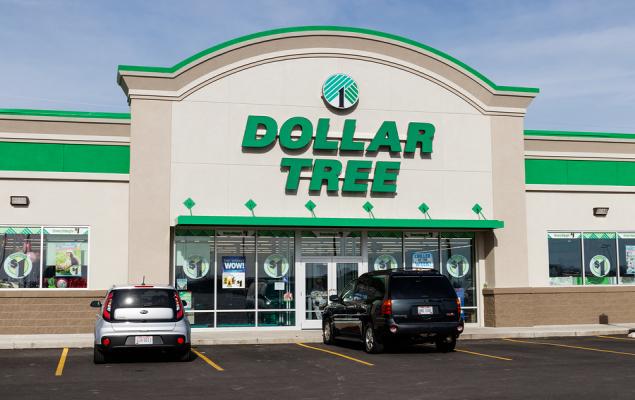
Will Dollar Tree's Strategic Initiatives and Store Expansions Aid?
ZACKS· 2025-10-01 15:01
Core Insights - Dollar Tree, Inc. (DLTR) is enhancing customer experience and driving growth through strategic initiatives, including store conversions and expansions [1] Financial Performance - The company reported a 6.7% increase in same-store sales for consumables and a 6.1% increase for discretionary items in Q2 of fiscal 2025 [2][9] - Dollar Tree added 2.4 million new customers over the trailing 12 months, with frequent shopper visits increasing to 11% from 9% [3][9] Store Strategy - In Q2, Dollar Tree opened 106 new stores and converted nearly 585 stores to the 3.0 multi-price format, which has shown superior performance in traffic and sales [3][4][9] - The 3.0 store format is expected to enhance overall profitability and same-store sales, with plans to convert about half of the store base by year-end [4] Expansion and Partnerships - The company is benefiting from steady store openings and investments in distribution centers, which support revenue growth [5] - Dollar Tree's partnership with Uber Eats reflects its strategic approach to meet customer needs and enhance shopping convenience [5]