Supply - Demand Mismatch

Search documents
涨!涨!涨!地缘风险叠加美元走弱,贵金属年末狂飙,黄金、白银、铂金齐创历史新高
Zhi Tong Cai Jing· 2025-12-27 00:28
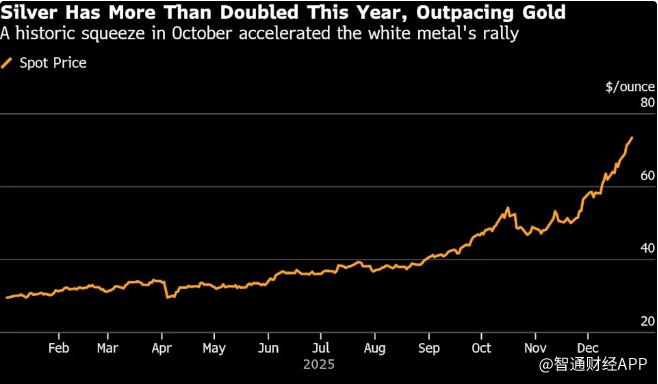
Group 1 - Precious metals have experienced a historic rally at the end of the year, driven by escalating geopolitical tensions, a weakening dollar, and low market liquidity [1] - Gold prices reached over $4,540 per ounce, silver surged over 10% to surpass $79 per ounce, and platinum hit a record high of over $2,400 per ounce [1] - Analysts highlight that safe-haven demand is a significant driver of the current price increases, with the low liquidity at year-end amplifying price volatility [1] Group 2 - Precious metals have shown "epic performance" this year, with gold up approximately 70% and silver over 150%, potentially marking the best annual performance since 1979 [2] - Factors contributing to this surge include continuous purchases by central banks, inflows into exchange-traded funds (ETFs), and three interest rate cuts by the Federal Reserve this year [2] - The largest precious metals ETF, SPDR Gold Trust, has seen its gold holdings increase by over 20% this year, playing a crucial role in driving gold prices to new highs [2] Group 3 - Silver's price increase has been particularly intense, driven by a supply mismatch and continued inflow of speculative funds following a historic "short squeeze" in October [3] - The concentration of silver inventory in New York and ongoing investigations into the national security risks of key mineral imports are closely monitored by traders [3] - Platinum prices have risen over 40% this month, with strong physical demand and a projected global supply deficit for the third consecutive year, primarily due to disruptions in South Africa [3]
涨!涨!涨!地缘风险叠加美元走弱 贵金属年末狂飙 黄金、白银、铂金齐创历史新高
智通财经网· 2025-12-26 23:27
Group 1: Market Performance - Precious metals have experienced a historic rally at the end of the year, driven by escalating geopolitical tensions, a weakening dollar, and low market liquidity [1][3] - Gold prices surged to over $4,540 per ounce, while silver rose more than 10% to surpass $79 per ounce, and platinum reached a record high of over $2,400 per ounce [1][3] - Year-to-date, gold has increased by approximately 70%, and silver has risen over 150%, both on track for their best annual performance since 1979 [3][4] Group 2: Driving Factors - Increased demand for safe-haven assets, particularly gold and silver, has been a significant driver of the recent price increases due to geopolitical uncertainties, including U.S. actions against Venezuela and military operations against ISIS [3][4] - The weakening of the U.S. dollar, which fell 0.7% this week, has also supported precious metals, as their prices are typically inversely related to the dollar's strength [3][4] - Central bank purchases, inflows into exchange-traded funds (ETFs), and the Federal Reserve's interest rate cuts have contributed to the bullish trend in precious metals [3][4] Group 3: Supply and Demand Dynamics - The global largest precious metal ETF, SPDR Gold Trust, has seen its gold holdings increase by over 20% this year, significantly influencing the recent price highs [4] - Silver's price surge is attributed to a supply mismatch following a historic short squeeze in October, with ongoing speculative inflows exacerbating the situation [4][5] - Platinum has seen a price increase of over 40% this month, driven by strong physical demand and a projected global supply deficit for the third consecutive year, primarily due to disruptions in South Africa [5]

Deepseek预测:10月有色金属,要紧盯好这两个方向
Sou Hu Cai Jing· 2025-10-07 16:32
Core Viewpoint - The non-ferrous metals industry is undergoing unprecedented changes driven by the global energy revolution, with traditional pricing models being disrupted by the Federal Reserve's anticipated interest rate cuts in 2025, leading to intensified competition between liquidity-driven premiums and supply-demand fundamentals [2][3]. Group 1: Copper Market - The global copper ore grade is continuously declining, and new discoveries are sharply decreasing, resulting in a significant supply constraint with a development cycle of 8-10 years [2]. - The Grasberg copper mine accident in Indonesia in 2025 is expected to widen the global copper concentrate supply-demand gap to 268,000 tons [2]. - Demand remains robust in traditional sectors like electricity and construction, while AI data centers require six times more copper per unit than traditional equipment, and electric vehicle charging stations require 0.8 kg of copper per kilowatt installed [2]. - LME copper prices increased by 11.4% year-on-year in Q1 2025, reaching a historical high of $10,857 per ton in May 2025, before a rapid decline of 19% due to overextension of interest rate cut expectations [2]. Group 2: Aluminum Market - The domestic aluminum industry is facing a "ceiling" policy limiting production capacity to 45 million tons, shifting the competitive focus to cost control and industry chain collaboration [6]. - The price drop of alumina has led to an expansion of profits by 300 yuan per ton for electrolytic aluminum, with companies like Shenhuo and Yun Aluminum benefiting from integrated self-supplied electricity, achieving over 27% year-on-year net profit growth [6]. - The demand for aluminum in lightweight transportation and electric vehicles is expected to grow by 15%, supported by government policies [6]. - Technological advancements, such as the AI-driven Gemini-2.0-Flash project, aim to reduce energy consumption in aluminum production by 200 kWh per ton [6]. Group 3: Rare Metals and Strategic Commodities - The pricing logic for rare metals like rare earths, antimony, and tungsten has evolved beyond supply-demand dynamics, becoming strategic assets in global competition [6]. - After the consolidation of China's rare earth industry, six major groups control 90% of global supply, with a 40% reduction in price volatility due to the 2025 export quota system [6]. - Antimony, essential for photovoltaic glass, faces supply chain anxiety due to a three-week global inventory and export bans from the Democratic Republic of the Congo [6]. - Future demand for lanthanide elements is expected to surge due to solid-state batteries, with a 50% increase in neodymium-iron-boron usage for robotics and a 70% reliance on magnesium alloys for low-altitude economic aircraft [6]. Group 4: Industry Risks and Challenges - Resource nationalism is rising, leading to frequent adjustments in mining taxes in resource-rich countries like Indonesia and Chile, with compliance costs for companies like Zijin Mining increasing by 12% annually [7]. - Domestic electrolytic aluminum companies face increased green electricity requirements, rising from 10% to 30% by 2030, which pressures short-term profits due to necessary technological upgrades [7]. - When copper prices exceed $10,000 per ton, downstream cable and appliance manufacturers may see profit margins drop below 5%, potentially leading to policy interventions due to imbalanced profit distribution across the industry [7]. - Global mining investment is projected to grow by 6.2% in 2025, but less than 1% of that is allocated to deep processing and R&D, indicating a structural mismatch that could limit long-term industry resilience [7]. Group 5: Overall Industry Outlook - The non-ferrous metals industry stands at a crossroads, facing both opportunities and challenges brought by the energy revolution, with the ability to navigate volatility and risks determining the sustainability and success of companies and the industry as a whole [9].