Supply Chain Reconstruction

Search documents
开工抢彩头,不如深耕这层商业逻辑
Sou Hu Cai Jing· 2026-02-24 07:33
Core Insights - The essence of starting a new business year lies in reconstructing business logic rather than merely engaging in ceremonial activities [1][6][14] Group 1: Strategic Thinking - Businesses should not let ceremonial activities replace strategic thinking; the real "start" involves clarifying growth logic for the year ahead [1][6] - The focus should be on efficiency and resource restructuring rather than merely expanding customer reach [1][6] Group 2: AI and Customer Engagement - Utilizing AI tools can transform "cold customers" into "regular customers" by enabling precise customer targeting and engagement [3][4] - Traditional customer acquisition methods are becoming obsolete; the new paradigm is for customers to find businesses through AI-driven insights [3][4] Group 3: Supply Chain Reconstruction - Supply chain reconstruction is crucial for enhancing profitability by eliminating middlemen and directly connecting producers to consumers [6][7] - Digital cloud warehouses allow businesses to deliver products directly to consumers, improving efficiency and reducing costs [6][7] Group 4: Light Franchise Model - The "light franchise" model reduces barriers to entry for entrepreneurs by eliminating high fees and inventory requirements [9][10] - This model allows individuals to leverage their personal networks and digital platforms for sales without the burden of traditional business costs [9][10] Group 5: Asset Linking - The shift in business logic from "owning assets" to "linking assets" enables companies to utilize external resources effectively [12][13] - Building a personal or corporate IP is essential for attracting partnerships and resources in the new business landscape [12][13] Group 6: Actionable Steps - Companies should start by implementing small changes, such as using AI for targeted marketing or connecting with supply chain platforms [14] - The focus should be on clarity of logic and efficiency to unlock new growth opportunities in the upcoming year [14]


广东稳坐山姆开店第一大省,沃尔玛重仓大湾区
2 1 Shi Ji Jing Ji Bao Dao· 2026-01-05 04:41
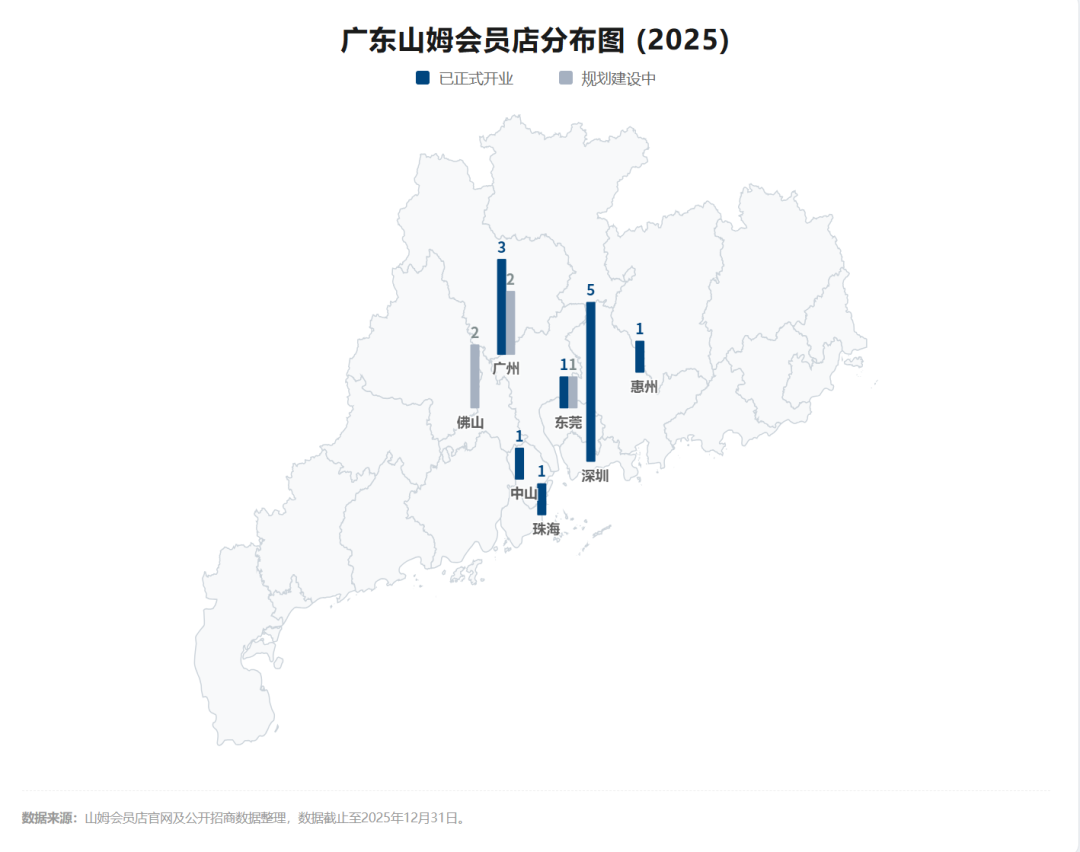
Core Viewpoint - Walmart's Sam's Club is accelerating its expansion in Guangzhou, indicating a strong confidence in the region's economic potential and consumer demand, particularly in the Guangdong province [4][13]. Expansion Plans - The main structure of the Sam's Club project in Baiyun District, Guangzhou, has been completed and is expected to open by the end of 2026 [2][8]. - Sam's Club opened its third store in Guangzhou in December 2025, marking a record year with a total of 10 new stores opened in China [3][5]. - A framework agreement was signed for a new store in Huangpu District, further expanding Sam's presence in Guangzhou [4]. Market Dynamics - The rapid expansion in Guangzhou is seen as a response to the city's strong consumer spending power and the growing demand for high-quality products [6][13]. - The first store in Tianhe District achieved record sales and significant foot traffic, reinforcing Walmart's confidence in the local market [7]. Competitive Advantage - Sam's Club maintains a high membership renewal rate of 90%, indicating strong customer loyalty and a successful membership model [10]. - The unique value proposition of Sam's Club, including exclusive products and competitive pricing, appeals to the affluent consumer base in Guangzhou [10][14]. Regional Strategy - Guangdong province is becoming a strategic base for Sam's Club, with plans to open four new stores in 2026, which will significantly increase its market presence [11][15]. - The average sales per store in Guangdong are higher than in other regions, showcasing the area's strong purchasing power [13]. Consumer Behavior - The introduction of cross-border shopping services for Hong Kong and Macau residents has increased foot traffic and sales at Sam's Club locations [14]. - The shopping experience is enhanced through unique offerings and services that cater to the emotional and practical needs of consumers [14]. Financial Performance - Walmart China's net sales reached $6.1 billion (approximately 42.9 billion RMB) in the third quarter of fiscal year 2026, with a year-on-year growth of 21.8% [15]. - Sam's Club's sales in China surpassed 120 billion RMB, reflecting a growth of about 20% compared to the previous year [15].

郑州超市主力阵容大轮换!谁在离场?谁在崛起?丨极刻
Sou Hu Cai Jing· 2025-06-18 01:41
Core Viewpoint - The entry of local supermarket Huayu Baijia into the former Walmart location in Zhengzhou reflects a significant shift in the local retail landscape, indicating a competitive transformation in the Zhengzhou supermarket market, where local brands are gaining prominence over foreign ones [1][2][3]. Group 1: Market Dynamics - The former Walmart Zhengzhou Jinshui Road store, which closed in May 2017, remained vacant for eight years before Huayu Baijia's planned entry [2][3]. - The local supermarket sector in Zhengzhou is experiencing a major reshuffle, with brands like Huayu Baijia, Pang Donglai, and Guoquan Shihui emerging as key players [1][6]. - The competitive landscape has shifted from being dominated by foreign brands to a rise in local brands, with Huayu Baijia being referred to as a "dark horse" in the industry [3][6]. Group 2: Company Profiles - Huayu Baijia, founded in 2008, has expanded from community stores to core urban areas and now operates 22 stores across several cities in Henan [3][6]. - Other local brands, such as Luoyang Dazhang and Xianfeng Life, have also entered the Zhengzhou market, indicating a collective rise of local supermarkets [6][10]. - The decline of foreign brands like Carrefour and Auchan in Zhengzhou highlights the changing preferences of consumers and the competitive edge of local supermarkets [6][10]. Group 3: Historical Context - The evolution of the supermarket industry in Henan can be categorized into three phases: initial learning, aspiration, and counterattack, with local brands now surpassing their foreign counterparts [8][12]. - The entry of foreign brands in the early 2000s initially dominated the market, but local brands have since adapted and evolved to meet consumer needs [10][12]. - The shift in consumer behavior and the rise of e-commerce have forced local supermarkets to innovate and strengthen their supply chains, allowing them to thrive despite challenges [12][18]. Group 4: Competitive Strategies - Local supermarkets are focusing on supply chain resilience and differentiation to attract consumers back to physical stores [18][21]. - The emergence of various retail formats, such as membership stores and discount shops, reflects the changing consumer demands for value and experience [21]. - Local brands are increasingly investing in private label products and unique shopping experiences to create a competitive advantage over e-commerce [21].