
Utilization and Storage)

Search documents
吃碳吐油 变“废”为宝 探访我国首个实现年注碳百万吨的油田
Zhong Yang Ji Wei Guo Jia Jian Wei Wang Zhan· 2026-01-26 06:13
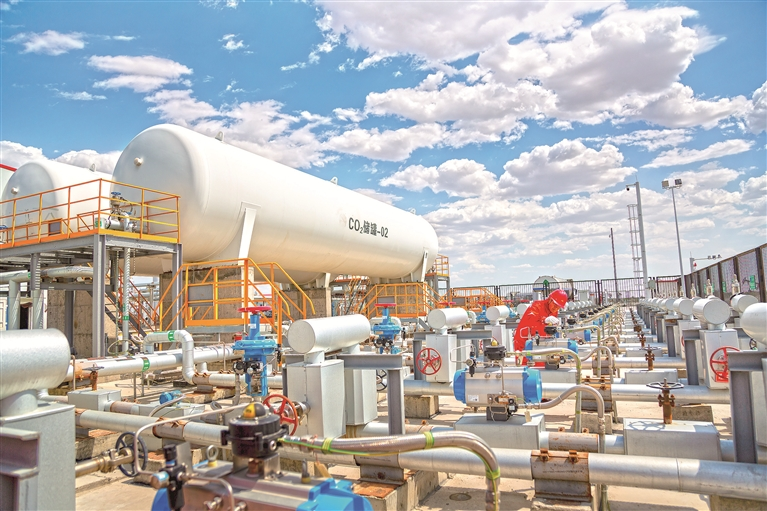
Core Viewpoint - The Xinjiang Oilfield has achieved a significant milestone by becoming the first oilfield in China to inject over 1 million tons of carbon dioxide annually by 2025, playing a crucial role in the country's dual carbon goals and the transformation of traditional industries through green low-carbon technologies [4][12]. Group 1: CO2 Injection Technology - The CO2 injection method enhances oil recovery by increasing pressure and reducing viscosity, allowing for the extraction of oil trapped in rock formations [5][7]. - CO2 injection can improve oil recovery rates by 10% to 20% compared to water injection, potentially raising total recovery rates to between 40% and 60% [7]. - The Xinjiang Oilfield has been exploring CO2 capture, utilization, and storage (CCUS) technologies for over 20 years, with successful pilot projects demonstrating significant increases in oil production [8][10]. Group 2: Environmental Impact and Carbon Management - The CO2 used for oil extraction is sourced from industrial emissions in the surrounding areas, ensuring a high purity level of over 99% after processing [11][12]. - Approximately 80% of the injected CO2 is permanently stored underground, while the remaining 20% is recycled back into the system, contributing to a circular economy [12]. - The current daily CO2 injection rate has reached over 4,800 tons, with a cumulative injection surpassing 200,000 tons, equating to the carbon absorption of 18 million mature trees annually [12]. Group 3: Challenges and Future Directions - The application of CCUS technology is still in its early stages, facing challenges such as carbon source supply and complex geological structures that hinder accurate modeling [10]. - The Xinjiang Oilfield is committed to overcoming these challenges by enhancing collaboration with carbon source providers and improving geological research to better understand underground reservoirs [10][12]. - The ongoing advancements in CCUS technology are expected to facilitate the large-scale application of carbon management strategies across various oilfield types in Xinjiang [10].


“三板斧”推进节能减碳 | 大家谈 如何当好“碳路先锋”
Zhong Guo Hua Gong Bao· 2025-09-12 03:12
Core Viewpoint - Energy conservation and carbon reduction are crucial for achieving carbon peak and carbon neutrality, with the oil and chemical industry playing a significant role in this transition through three main strategies. Group 1: Capacity Transformation - The first strategy involves accelerating capacity transformation by promoting carbon capture, utilization, and storage (CCUS) projects, which will lead to industrialization of various petrochemical facilities [1] - The industry should focus on developing the hydrogen energy sector, increasing investments in projects like wind and solar hydrogen production, seawater hydrogen production, and blue hydrogen purification technologies [1] - Efforts should be made to deeply utilize waste heat and pressure from petrochemical facilities to minimize energy waste [1] Group 2: Process Reengineering - The second strategy emphasizes process reengineering, breaking down traditional production silos through raw material substitution, process innovation, energy restructuring, by-product recycling, and digital empowerment [2] - Petrochemical companies should prioritize low-carbon raw material substitution and adapt processes to reduce redundancy [2] - High-efficiency, low-consumption processes should replace traditional methods, promoting interconnectivity among facilities to reduce waste [2] - Advanced equipment should replace outdated machinery, focusing on steam production facility upgrades and using green gas alternatives [2] - Accelerating the construction of CCUS projects and resource recycling for waste catalysts and liquids is essential [2] Group 3: Carbon Emission Management - The third strategy involves improving the carbon emission management system by implementing a lifecycle carbon accounting and trading management system for petrochemical production [3] - A complete system should be established that quantifies carbon emissions, manages them, and incentivizes reductions through market mechanisms [3] - The entire process from crude oil extraction, transportation, refining, chemical synthesis, to product usage and disposal should be clearly defined for carbon accounting and assessment [3]