Western sanctions

Search documents
Russian Urals oil trades at close to widest discounts since 2022 in India, sources say
Reuters· 2026-01-26 13:42
Core Insights - Russian February Urals crude oil cargoes are trading at the widest discounts against dated Brent in Indian ports since 2022 due to intensified pressure from Western sanctions [1] Group 1 - The discounts for Russian Urals crude oil cargoes in India have reached significant levels, indicating a shift in market dynamics [1] - The intensified pressure from Western sanctions is a key factor influencing the pricing of Russian crude oil [1]

India's MRPL scouts for Venezuelan oil as it halts Russian imports
Reuters· 2026-01-19 08:18
Core Viewpoint - Mangalore Refinery and Petrochemicals Ltd is shifting its oil sourcing strategy by exploring purchases of Venezuelan oil due to the cessation of Russian oil imports in compliance with Western sanctions [1] Group 1: Company Actions - The company is halting imports of Russian oil as a direct response to Western sanctions [1] - Mangalore Refinery and Petrochemicals Ltd is actively seeking to purchase Venezuelan oil to replace the halted Russian oil imports [1] Group 2: Industry Context - The decision reflects a broader trend in the oil industry where companies are adjusting their supply chains in response to geopolitical pressures and sanctions [1]

Exclusive-Hyundai not in a position to buy back Russian auto factory, source says
Yahoo Finance· 2025-12-29 10:49
Group 1 - Hyundai is unable to repurchase its former manufacturing plant in Russia due to the ongoing war in Ukraine, with the buyback option set to expire next month [1][3][5] - Hyundai and its affiliate Kia were once the largest foreign carmakers in Russia, having sold their St. Petersburg plant in 2024 after operations were suspended in March 2022 due to the invasion of Ukraine [2][6] - The sale of the plant to AGR Automotive Group was for a symbolic amount of 140,000 won ($97) and included a two-year buyback option, which is now nearing expiration [3][4] Group 2 - The ongoing conflict in Ukraine and Western sanctions against Russia have hindered Hyundai's ability to act on the buyback option, with uncertainty surrounding the potential for negotiating an extension [5][6] - Most foreign carmakers have exited the Russian market due to reputational risks and operational challenges, with Hyundai reporting a 287-billion-won loss from the sale of its Russian assets [6][7] - The plant that Hyundai sold is now producing vehicles under the Solaris brand, which was previously associated with Hyundai's own models for the Russian market [7]
X @Bloomberg
Bloomberg· 2025-12-17 09:33
Geopolitics and Trade - Western sanctions led India to curb purchases of Russian Urals oil [1] - A fleet of tankers carrying Russian Urals oil has expanded off China's east coast [1]
VTB CEO says Russian firms are eyeing Global South for expansion
Yahoo Finance· 2025-12-01 15:11
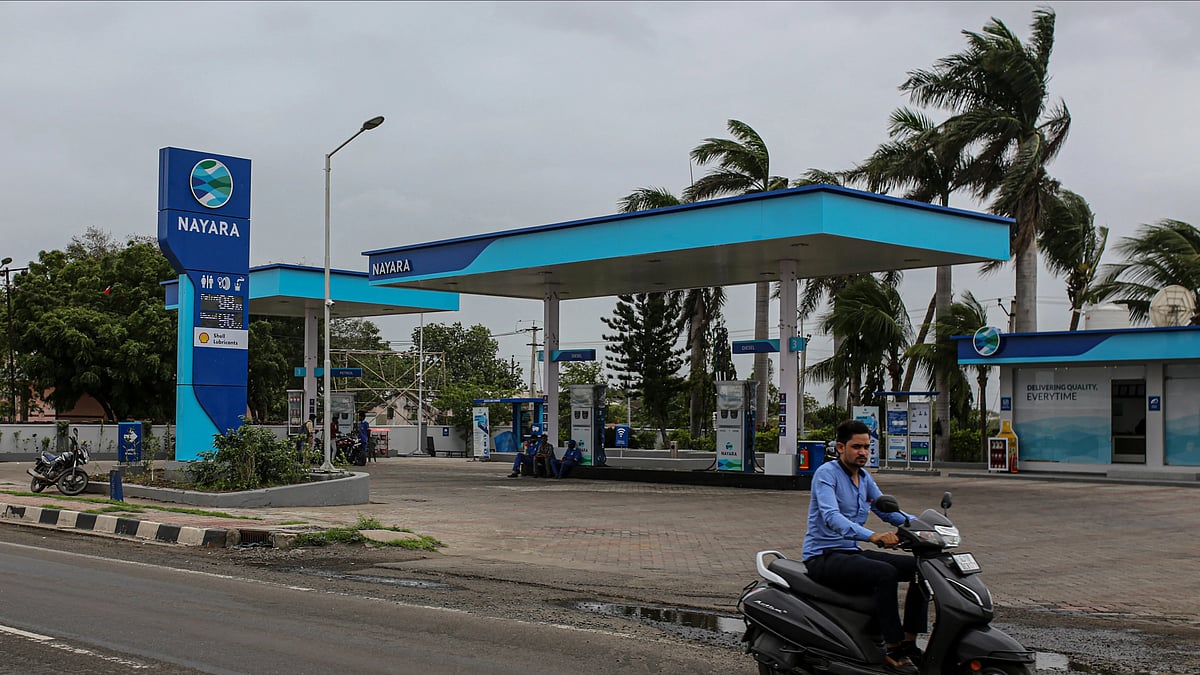
Group 1 - Russian companies are focusing on expansion opportunities in the Global South despite Western sanctions, as stated by Andrei Kostin, CEO of VTB [1][2] - VTB has been involved in foreign acquisitions of oil companies, including the acquisition of India's Essar Oil, now known as Nayara Energy, in 2017 [2] - Nayara Energy is targeting the domestic Indian market exclusively, with no plans for exports, and continues to operate despite previous sanctions [3] Group 2 - Kostin believes that Russian oil companies like Rosneft and Lukoil will find new opportunities similar to VTB's shift in focus after sanctions [4] - The demand for Russian oil remains strong, and any restrictions that increase oil prices benefit exporters [4] - VTB plans to expand its presence in India by opening an office in Mumbai, recognizing India's potential to increase exports to Russia, particularly in machinery and pharmaceuticals [6]

China’s Sanctioned Yulong Thrives on Russian Oil
Yahoo Finance· 2025-10-28 23:00
Core Insights - The article discusses the significant shift in Shandong Yulong Petrochemical's crude sourcing, primarily moving to Russian oil due to Western sanctions impacting access to other suppliers [4][3][2] Group 1: Supply Chain Changes - Shandong Yulong has transitioned from a diverse supply portfolio to relying almost entirely on Russian crude, securing approximately 350,000 b/d for November delivery compared to only 100,000 b/d earlier in the year [2][4] - The refinery's operational capacity is currently at about 90% of its 400,000 b/d design, with Russian crude now providing nearly all its feedstock [2][5] Group 2: Impact of Sanctions - Western sanctions have inadvertently created a new trade dynamic, linking Russian producers with sanctioned Chinese refiners like Yulong, which now operates almost exclusively on discounted Russian oil [4][3][9] - The sanctions imposed by the UK and EU have restricted Yulong's access to Western supplies, forcing it to adapt its sourcing strategy [4][3] Group 3: Operational Efficiency - Yulong's operational efficiency has improved due to the lower costs associated with sourcing Russian crude, which has offset the deflation in product prices and maintained profitability despite an oversupplied market [6][5] - The refinery has achieved record-high throughput in September and October, running at approximately 90% capacity [5] Group 4: Future Supply Considerations - Analysts express concerns about Yulong's ability to secure the heavy crude necessary for consistent product output, although some suggest that Russia's Urals blend could serve as a suitable substitute [8][7] - Gazprom Neft may redirect its Arctic ARCO crude to Yulong, potentially supplying the heavy feedstock needed for efficient operations [9]
UCO Bank Gets Approval To Work With Sanctioned Refiner Nayara Energy
NDTV Profit· 2025-09-15 15:42
Core Insights - UCO Bank has received government approval to facilitate trade payments for Nayara Energy Ltd., following sanctions imposed by the EU on the refiner [1][2] - Nayara Energy, part-owned by Russian oil major Rosneft, is seeking assistance from UCO Bank to manage payments for crude oil imports and refined fuel product exports [3][6] - The refiner has faced operational challenges, including the need for advance payments and reduced run rates, due to the sanctions and withdrawal of domestic shipowners [4][5] Group 1 - UCO Bank's engagement with Nayara Energy comes after the latter was sanctioned by the EU, leading to a withdrawal of support from large financial institutions [1][5] - Senior executives from UCO Bank have met with finance ministry officials to discuss the execution of payments for Nayara, with operational details still being finalized [2] - Nayara Energy has approached the government for help in securing vessels for local transportation, as domestic shipowners have ceased operations with the company [4] Group 2 - Rosneft holds just over 49% of Nayara Energy, which represents nearly 8% of India's refining capacity and 7% of its retail-fuel network [6] - The sanctions have led to significant operational adjustments for Nayara, including a shift to advance payments and letters of credit prior to fuel shipments [4] - The State Bank of India, among other institutions, has ceased processing transactions for Nayara due to the risks associated with Western sanctions [5]