Meat Processing

Search documents
Smithfield Foods, Inc. (SFD) Announces it Initiated the Approval Process to Build a New Packaged Meats and Fresh Pork Processing Facility
Yahoo Finance· 2026-02-22 01:45
Smithfield Foods, Inc. (NASDAQ:SFD) is among the 11 Best High Growth Consumer Stocks to Buy Right Now. Smithfield Foods, Inc. (SFD) Announces it Initiated the Approval Process to Build a New Packaged Meats and Fresh Pork Processing Facility On February 16, 2026, Smithfield Foods, Inc. (NASDAQ:SFD) announced it had initiated the approval process to build a new state-of-the-art packaged meats and fresh pork processing facility in Sioux Falls, South Dakota. The proposed facility, subject to permitting and o ...

Smithfield to build $1.3B pork processing plant
Yahoo Finance· 2026-02-17 10:38
This story was originally published on Food Dive. To receive daily news and insights, subscribe to our free daily Food Dive newsletter. Dive Brief: Smithfield Foods said Monday it would spend up to $1.3 billion over the next three years on a new combined packaged meats and pork processing plant in Sioux Falls, South Dakota. The highly automated facility is set to be "the most modern of its kind in the U.S.," the pork giant said in a statement, and will help deliver "significant efficiency gains" to th ...
Smithfield Foods to Build New South Dakota Pork Plant
WSJ· 2026-02-16 16:00
Group 1 - The company plans a $1.3 billion investment to create a facility capable of slaughtering approximately 20,000 hogs per day [1] - This investment comes amid scrutiny from officials regarding the firm's connections to China [1]

JBS adds to Middle East presence with Oman venture
Yahoo Finance· 2026-02-09 12:04
Core Insights - JBS is establishing a joint venture in Oman with Oman Food Capital to enhance its manufacturing presence in the Middle East [1][2] - The venture will consolidate two production assets in Oman, focusing on poultry and meat processing [2][3] Group 1: Investment Details - JBS will invest $150 million in equity for an 80% stake in the joint venture, while Oman Food Capital will hold the remaining 20% [2] - The investment will primarily support the completion of A'Namaa's poultry plant and Al Bashayer's beef and lamb processing facility [3] Group 2: Production Capacity and Goals - The venture aims for a static industrial production capacity of approximately 300,000 tonnes per year, translating to daily processing of about 1,000 cattle, 5,000 lambs, and 600,000 chickens [4] - Production at the beef and lamb facility is expected to commence within six months, while the poultry site is set to start operations within a year [5] Group 3: Strategic Objectives - The initiative aligns with Oman's Vision 2040 program, which aims to diversify the economy and ensure food security for the population [3] - The venture will position Oman as a center for halal product production suitable for export to various markets [4]
Tyson Foods Tops Earnings Estimates on Strong Chicken Sales. The Stock Is Falling.
Barrons· 2026-02-02 12:33
Core Insights - The meat processor has exceeded both earnings and revenue estimates for its fiscal first quarter [1] Financial Performance - The company reported earnings that surpassed analyst expectations, indicating strong financial health [1] - Revenue figures also exceeded forecasts, reflecting robust demand and effective operational strategies [1]

Tyson Foods beats quarterly profit estimates on chicken demand
Yahoo Finance· 2026-02-02 12:05
Core Insights - Tyson Foods reported larger-than-expected quarterly earnings driven by strong demand for chicken products, despite significant losses in its beef business [1][3] - The U.S. cattle herd has reached a 75-year low, impacting beef supply and prices, while shifting demand towards more affordable chicken options [2] Financial Performance - Tyson's net sales increased by 5.1% to $14.31 billion in the first quarter, surpassing analyst expectations of $14.09 billion [3] - Adjusted earnings per share were reported at 97 cents, exceeding the forecast of 94 cents [3] Sales and Segment Performance - Chicken unit sales rose by 3.7% for the quarter, while beef sales volumes declined by 7.3% as beef prices surged by 17.2% [2] - The company anticipates a sales increase of 2% to 4% in fiscal 2026, with the midpoint exceeding analysts' estimates of 2.8% [3] Outlook and Adjustments - Tyson raised its adjusted income outlook for chicken, pork, and prepared foods for fiscal 2026, while reducing the projected loss for beef [4] - The company expects chicken segment operating income to range from $1.65 billion to $1.90 billion on an adjusted basis for fiscal 2026, an increase from the previous expectation of $1.25 billion to $1.5 billion [4] Operational Changes - Tyson initiated mass layoffs in January at a major beef plant in Lexington, Nebraska, which previously employed around 3,200 people, and plans to reduce operations at a beef plant in Amarillo, Texas [5]
JBS N.V. (JBS) to Double Production in Jeddah
Yahoo Finance· 2026-01-26 11:08
Group 1 - JBS N.V. is recognized as one of the most undervalued foreign stocks to buy, with analysts highlighting its potential for growth [1] - The company plans to double production at its chicken processing plant in Jeddah by the end of 2026, which is part of a strategy to enhance local food production and outperform Brazilian competitors [1][2] - The Jeddah plant, built last year, has enabled JBS to nearly quadruple its production in Saudi Arabia [2] Group 2 - JBS has expanded its partnerships in the region, including a significant investment deal with Halal Products Development Company aimed at facilitating their listing on the Riyadh stock exchange [3] - The company is constructing one of the largest units in Jeddah, with an annual capacity of approximately 40,000 tons of meat products [3] - Analysts on Wall Street have a bullish sentiment towards JBS, with a 12-month price target indicating more than 31% upside from the current stock level [4]
Charcuterie Artisans eyes production boost with La Quercia buy
Yahoo Finance· 2026-01-23 11:19
Core Insights - Charcuterie Artisans has acquired La Quercia Cured Meats, gaining ownership of its production plant in Norwalk, Iowa, and its entire product portfolio [1][2] - The acquisition aims to expand Charcuterie Artisans' portfolio of premium domestic charcuterie and enhance production capacity while honoring traditional methods [2][5] - Charcuterie Artisans plans to modernize the Norwalk facility, increasing its production capacity by 50%, focusing exclusively on prosciutto [4] Company Overview - Charcuterie Artisans is the parent company of Creminelli Fine Meats and Daniele, operating 660,000 square feet of manufacturing space across multiple locations and employing over 700 people [4][5] - La Quercia, founded in 2005, specializes in artisan American cured meats, including prosciutto and pancetta, and is known for its antibiotic-free products [2][3] - The acquisition follows a significant investment from an Industrial Opportunity Partners-managed fund aimed at expanding capacity and driving innovation [5] Strategic Intent - The CEO of Charcuterie Artisans views La Quercia as a "natural fit," emphasizing the alignment of their dedication to craft and quality [5][6] - The company intends to retain La Quercia's employees and maintain collaboration with the Lynch family and Premium Iowa Pork [3]
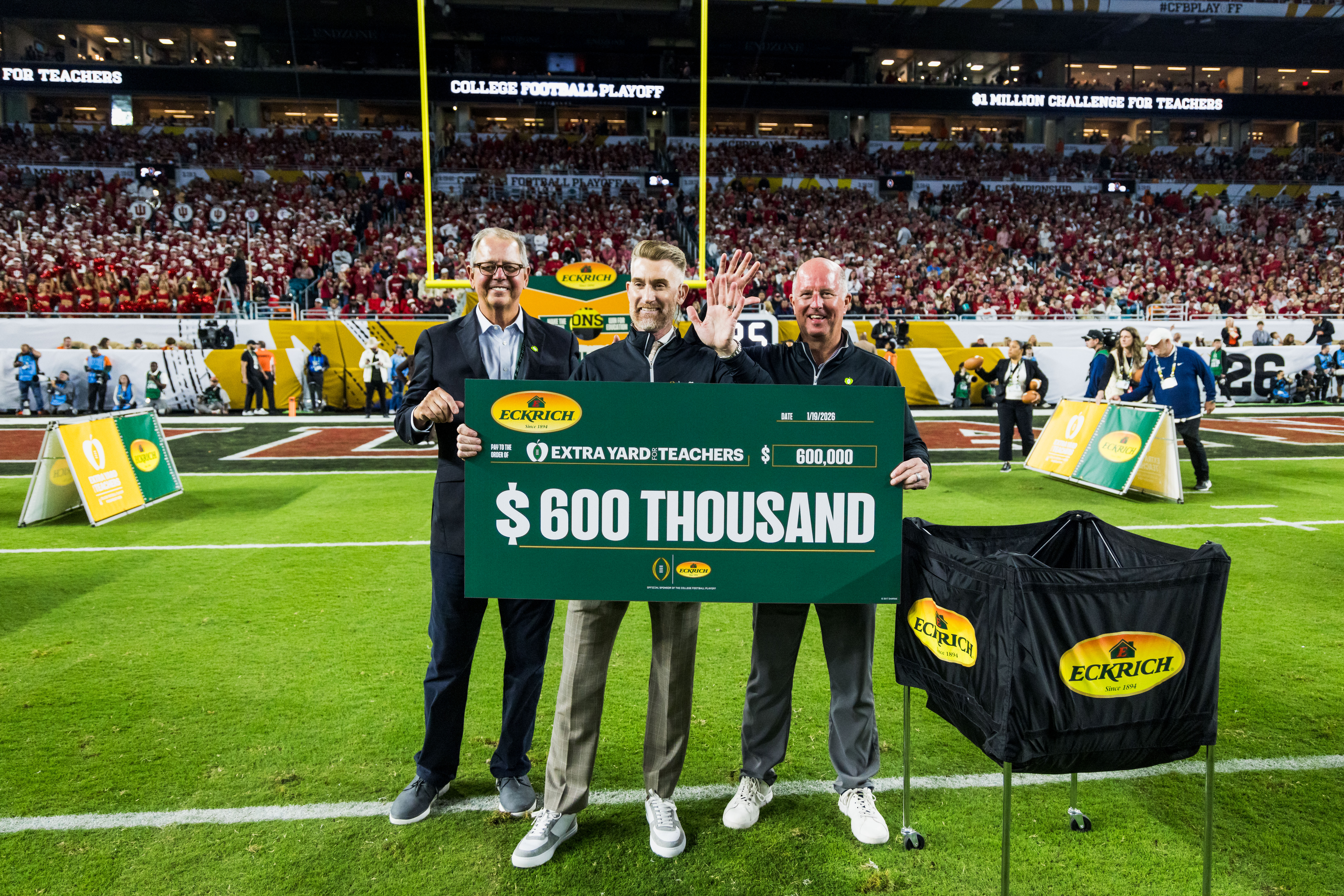
Eckrich® Scores Big for Education with $600,000 Donation at College Football Playoff National Championship
Globenewswire· 2026-01-20 13:55
Core Insights - Eckrich, as the Official Smoked Sausage and Deli Meat Sponsor of the College Football Playoff, has contributed significantly to educational initiatives through the Eckrich $1 Million Challenge for Teachers, unlocking $600,000 for educators nationwide [1][2] Group 1: Contributions to Education - Since the inception of the Eckrich $1 Million Challenge for Teachers, the brand has donated a total of $3.5 million to support educators [2] - The program allows nominated teachers to participate in a 15-yard throw challenge during college games, with the potential to win up to $1 million for their schools [4] - Although there was no winning throw this season, Eckrich provided $2,500 to support local education initiatives at each of the four games, totaling $10,000 in donations [5] Group 2: Recognition and Support for Educators - Eckrich honored Sarah Damato, a special education teacher from Pennsylvania, as the Eckrich Teacher of the Year, awarding her a trip to the 2026 CFP National Championship weekend and $5,000 for classroom projects [8] - The partnership with the CFP Foundation has been crucial in empowering teachers and enhancing educational outcomes, as noted by both Marty Smith and Britton Banowsky [7] Group 3: Additional Initiatives - Eckrich supported the Extra Yard Makeover program by donating $250,000 to five schools to revitalize central learning spaces [7] - The brand's mobile tour included visits to four schools, further promoting its commitment to education [4]
Stocks to Watch After December's CPI Report: CARS, CVNA, TSN
ZACKS· 2026-01-15 00:30
Group 1: Inflation Insights - December's CPI report indicates that inflation remains stable but not improving as desired by markets and the Federal Reserve, with core consumer prices rising 0.2% monthly and 2.6% yearly, the slowest pace since March 2021 [1] - Including all categories, CPI increased by 0.3% over the last month and 2.7% annually, with food prices rising 0.7% monthly and 3.1% annually, indicating inflation is still above the Fed's target of 2% [2] Group 2: Company Implications - Cars.com (CARS) and Carvana (CVNA) may benefit from lower used car prices, which saw a 1.7% unadjusted monthly decrease, potentially attracting more buyers to the used car market [4] - Tyson Foods (TSN) is currently facing challenges due to deeper losses in its beef segment caused by cattle shortages and rising input costs, leading to a Zacks Rank 4 (Sell) as EPS revisions trend lower for FY26 and FY27 [5] - EPS estimates for Tyson Foods have retracted over the last 60 days, with current estimates for the current quarter at 0.97 and next year at 4.64 [6]