冶钢原料

Search documents
海南矿业涨2.00%,成交额8377.00万元,主力资金净流出15.59万元
Xin Lang Zheng Quan· 2025-09-12 08:53
Core Viewpoint - Hainan Mining has shown a significant increase in stock price and trading volume, indicating positive market sentiment despite a decrease in net profit year-on-year [1][2]. Group 1: Stock Performance - As of September 12, Hainan Mining's stock price rose by 2.00% to 8.67 CNY per share, with a trading volume of 83.77 million CNY and a market capitalization of 17.325 billion CNY [1]. - Year-to-date, Hainan Mining's stock price has increased by 23.68%, with a 7.04% rise over the last five trading days and a 17.96% increase over the last 60 days [1]. Group 2: Financial Performance - For the first half of 2025, Hainan Mining reported a revenue of 2.415 billion CNY, reflecting a year-on-year growth of 10.46%, while the net profit attributable to shareholders decreased by 30.36% to 281 million CNY [2]. - Cumulatively, Hainan Mining has distributed 934 million CNY in dividends since its A-share listing, with 598 million CNY distributed over the last three years [3]. Group 3: Shareholder and Institutional Holdings - As of June 30, 2025, the number of shareholders for Hainan Mining decreased by 5.01% to 46,700, while the average number of circulating shares per person increased by 5.27% to 42,348 shares [2]. - Among the top ten circulating shareholders, Hong Kong Central Clearing Limited holds 10.596 million shares, an increase of 129,800 shares, while new entrants include Huaxia CSI 1000 ETF and GF CSI 1000 ETF [3].

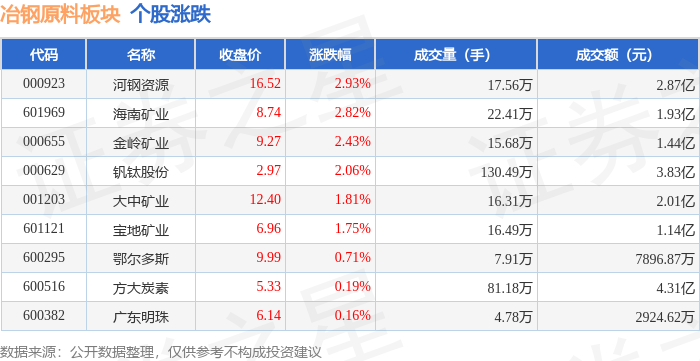
冶钢原料板块9月12日涨1.45%,河钢资源领涨,主力资金净流入1.51亿元
Zheng Xing Xing Ye Ri Bao· 2025-09-12 08:31
Market Overview - The steel raw materials sector increased by 1.45% on September 12, with Hebei Steel Resources leading the gains [1] - The Shanghai Composite Index closed at 3883.69, up 0.22%, while the Shenzhen Component Index closed at 12996.38, up 0.13% [1] Stock Performance - Key stocks in the steel raw materials sector showed the following performance: - Hebei Steel Resources (000923) closed at 16.52, up 2.93% with a trading volume of 175,600 shares and a turnover of 287 million yuan - Yidong Mining (601969) closed at 8.74, up 2.82% with a trading volume of 224,100 shares and a turnover of 193 million yuan - Other notable stocks include: - Dazhong Mining (001203) closed at 12.40, up 1.81% [1] Capital Flow - The steel raw materials sector experienced a net inflow of 151 million yuan from main funds, while retail investors saw a net outflow of 88.37 million yuan [1] - Detailed capital flow for selected stocks includes: - Hainan Mining (601963) had a main fund net inflow of 37.06 million yuan, but retail investors had a net outflow of 28.99 million yuan [2] - Fangda Carbon (600516) saw a main fund net inflow of 29.61 million yuan, with a retail net outflow of 42.71 million yuan [2] - Dazhong Mining (001203) had a main fund net inflow of 26.75 million yuan, while retail investors had a net inflow of 198,480 yuan [2]





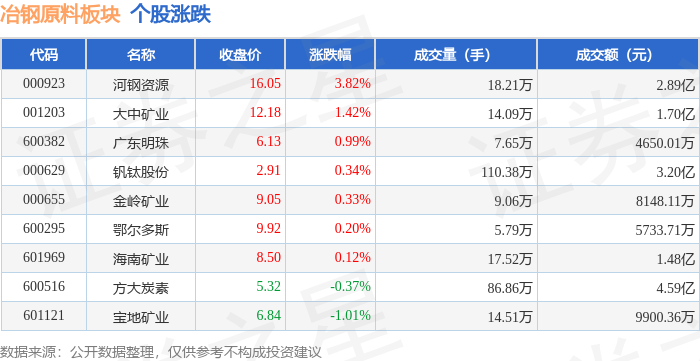
冶钢原料板块9月11日涨0.57%,河钢资源领涨,主力资金净流出2966.74万元
Zheng Xing Xing Ye Ri Bao· 2025-09-11 08:40
Market Overview - On September 11, the steel raw materials sector rose by 0.57% compared to the previous trading day, with Hebei Steel Resources leading the gains [1] - The Shanghai Composite Index closed at 3875.31, up 1.65%, while the Shenzhen Component Index closed at 12979.89, up 3.36% [1] Individual Stock Performance - Hebei Steel Resources (000923) closed at 16.05, with a gain of 3.82% and a trading volume of 182,100 shares, amounting to a transaction value of 289 million yuan [1] - Dazhong Mining (001203) closed at 12.18, up 1.42%, with a trading volume of 140,900 shares and a transaction value of 170 million yuan [1] - Guangdong Mingzhu (600382) closed at 6.13, up 0.99%, with a trading volume of 76,500 shares and a transaction value of 46.5 million yuan [1] - Other notable performances include Steel Titanium Co. (000629) at 2.91, up 0.34%, and Jinling Mining (000655) at 9.05, up 0.33% [1] Capital Flow Analysis - The steel raw materials sector experienced a net outflow of 29.67 million yuan from institutional investors, while retail investors saw a net outflow of 19.40 million yuan [1] - Conversely, speculative funds recorded a net inflow of 49.07 million yuan [1] Detailed Capital Flow by Stock - Fangda Carbon (600516) had a net inflow of 17.87 million yuan from institutional investors, but a net outflow of 18.77 million yuan from retail investors [2] - Hebei Steel Resources (000923) saw a minor net inflow of 1.85 million yuan from institutional investors, with retail investors experiencing a net outflow of 3.42 million yuan [2] - Dazhong Mining (001203) had a net outflow of 1.83 million yuan from institutional investors, while speculative funds contributed a net inflow of 3.97 million yuan [2] - Steel Titanium Co. (000629) faced a significant net outflow of 31.64 million yuan from institutional investors, but speculative funds provided a net inflow of 17.16 million yuan [2]


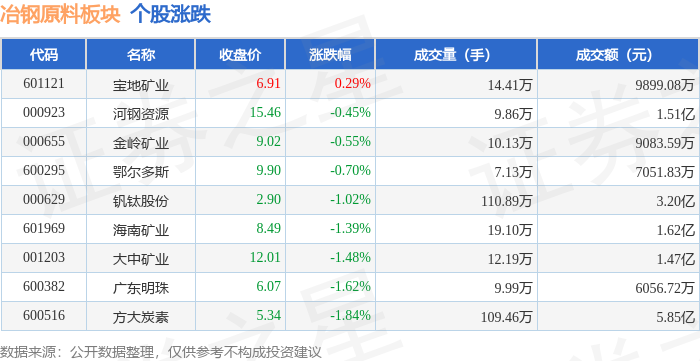
冶钢原料板块9月10日跌1.15%,方大炭素领跌,主力资金净流出1.65亿元
Zheng Xing Xing Ye Ri Bao· 2025-09-10 08:30
Market Overview - The steel raw materials sector experienced a decline of 1.15% on September 10, with Fangda Carbon leading the drop [1] - The Shanghai Composite Index closed at 3812.22, up 0.13%, while the Shenzhen Component Index closed at 12557.68, up 0.38% [1] Individual Stock Performance - Baodi Mining (601121) closed at 6.91, with a slight increase of 0.29% and a trading volume of 144,100 shares, totaling approximately 98.99 million yuan [1] - Hebei Steel Resources (000923) closed at 15.46, down 0.45%, with a trading volume of 98,600 shares and a turnover of about 151 million yuan [1] - Other notable declines include: - Fangda Carbon (600516) down 1.84% to 5.34, with a trading volume of 1,094,600 shares and a turnover of approximately 58.5 million yuan [1] - Hainan Mining (601969) down 1.39% to 8.49, with a trading volume of 191,000 shares and a turnover of about 162 million yuan [1] Capital Flow Analysis - The steel raw materials sector saw a net outflow of 165 million yuan from institutional investors, while retail investors contributed a net inflow of 157 million yuan [1] - The capital flow for individual stocks indicates: - Fangda Carbon had a significant net outflow of 77.22 million yuan from institutional investors, with retail investors contributing a net inflow of 83.58 million yuan [2] - Other stocks like Erdos (600295) and Dazhong Mining (001203) also experienced notable net outflows from institutional investors [2]

冶钢原料板块9月5日涨1.88%,方大炭素领涨,主力资金净流出1.07亿元
Zheng Xing Xing Ye Ri Bao· 2025-09-05 08:56
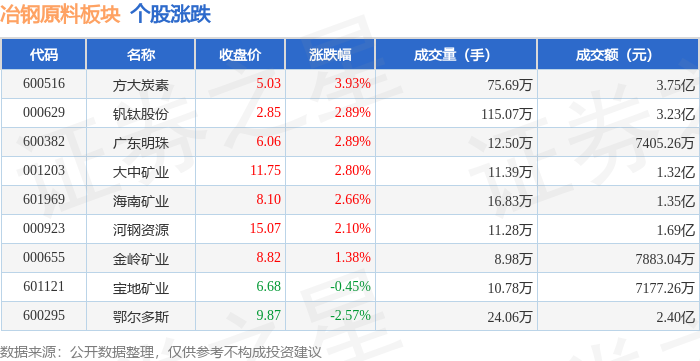
Market Overview - On September 5, the steel raw materials sector rose by 1.88% compared to the previous trading day, with Fangda Carbon leading the gains [1] - The Shanghai Composite Index closed at 3812.51, up 1.24%, while the Shenzhen Component Index closed at 12590.56, up 3.89% [1] Stock Performance - Key stocks in the steel raw materials sector showed the following performance: - Fangda Carbon (600516) closed at 5.03, up 3.93% with a trading volume of 756,900 shares and a turnover of 375 million yuan - Steel Titanium Co. (000629) closed at 2.85, up 2.89% with a trading volume of 1,150,700 shares and a turnover of 323 million yuan - Guangdong Mingzhu (600382) closed at 6.06, up 2.89% with a trading volume of 125,000 shares and a turnover of 74.05 million yuan - Other notable stocks include Dazhong Mining (001203) and HeSteel Resources (000923) with respective increases of 2.80% and 2.10% [1] Capital Flow - The steel raw materials sector experienced a net outflow of 107 million yuan from institutional investors, while retail investors saw a net inflow of 61.15 million yuan [1] - The detailed capital flow for key stocks indicates: - Steel Titanium Co. had a net inflow of 12.38 million yuan from retail investors but a net outflow of 1.24 million yuan from institutional investors [2] - HeSteel Resources saw a net inflow of 8.76 million yuan from retail investors but a net outflow of 0.31 million yuan from institutional investors [2] - Fangda Carbon experienced a significant net outflow of 29.98 million yuan from institutional investors, despite a net inflow of 14.51 million yuan from retail investors [2]
冶钢原料板块9月4日跌0.33%,广东明珠领跌,主力资金净流出1亿元
Zheng Xing Xing Ye Ri Bao· 2025-09-04 08:50
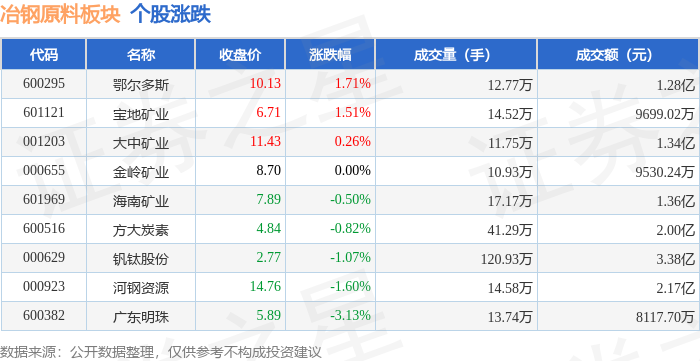
Market Overview - On September 4, the steel raw materials sector declined by 0.33% compared to the previous trading day, with Guangdong Mingzhu leading the decline [1] - The Shanghai Composite Index closed at 3765.88, down 1.25%, while the Shenzhen Component Index closed at 12118.7, down 2.83% [1] Stock Performance - Key stocks in the steel raw materials sector showed varied performance, with Erdos (600295) increasing by 1.71% to close at 10.13, while Guangdong Mingzhu (600382) fell by 3.13% to close at 5.89 [1] - The trading volume and turnover for major stocks included: - Erdos: 127,700 shares, turnover of 128 million yuan - Guangdong Mingzhu: 137,400 shares, turnover of 8.12 million yuan [1] Capital Flow - The steel raw materials sector experienced a net outflow of 100 million yuan from main funds, while retail investors saw a net inflow of 108 million yuan [1] - Detailed capital flow for selected stocks indicated significant outflows from major players, with Guangdong Mingzhu seeing a net outflow of 2.50 million yuan from main funds [2]
冶钢原料板块9月3日跌2.2%,大中矿业领跌,主力资金净流出1.02亿元
Zheng Xing Xing Ye Ri Bao· 2025-09-03 08:39
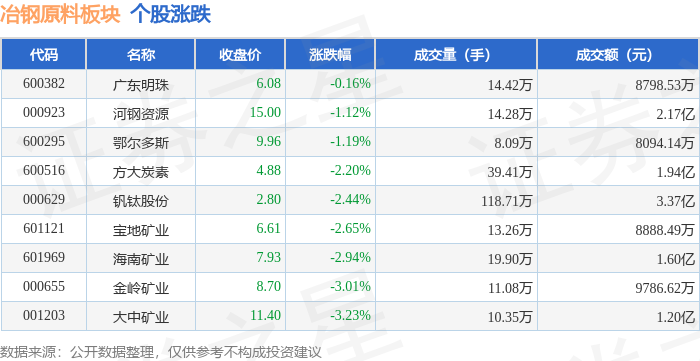
Market Overview - The steel raw materials sector experienced a decline of 2.2% on September 3, with major losses led by Dazhong Mining [1] - The Shanghai Composite Index closed at 3813.56, down 1.16%, while the Shenzhen Component Index closed at 12472.0, down 0.65% [1] Individual Stock Performance - Guangdong Mingzhu (600382) closed at 6.08, down 0.16% with a trading volume of 144,200 shares and a turnover of 87.99 million yuan [1] - Hebei Steel Resources (000923) closed at 15.00, down 1.12% with a trading volume of 142,800 shares and a turnover of 217 million yuan [1] - Ordos (600295) closed at 9.96, down 1.19% with a trading volume of 80,900 shares and a turnover of 80.94 million yuan [1] - Fangda Carbon (600516) closed at 4.88, down 2.20% with a trading volume of 394,100 shares and a turnover of 194 million yuan [1] - Steel Titanium Co. (000629) closed at 2.80, down 2.44% with a trading volume of 1,187,100 shares and a turnover of 337 million yuan [1] - Baodi Mining (601121) closed at 6.61, down 2.65% with a trading volume of 132,600 shares and a turnover of 88.88 million yuan [1] - Huaqiyueao (601969) closed at 7.93, down 2.94% with a trading volume of 199,000 shares and a turnover of 160 million yuan [1] - Dazhong Mining (001203) closed at 11.40, down 3.23% with a trading volume of 103,500 shares and a turnover of 120 million yuan [1] Capital Flow Analysis - The steel raw materials sector saw a net outflow of 102 million yuan from main funds, while retail investors contributed a net inflow of 111 million yuan [1] - The detailed capital flow for individual stocks indicates significant net outflows from major funds in several companies, including: - Hebei Steel Resources: -932,700 yuan from main funds [2] - Fangda Carbon: -6,929,800 yuan from main funds [2] - Dazhong Mining: -10,018,400 yuan from main funds [2] - Retail investors showed a net inflow in several stocks, with Dazhong Mining receiving 13,958,500 yuan from retail investors [2]
冶钢原料板块8月29日涨0.95%,鄂尔多斯领涨,主力资金净流出2730.21万元
Zheng Xing Xing Ye Ri Bao· 2025-08-29 08:36
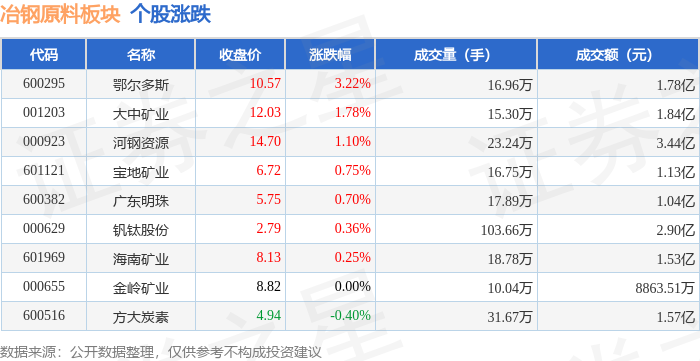
Market Overview - The steel raw materials sector increased by 0.95% on August 29, with Ordos leading the gains [1] - The Shanghai Composite Index closed at 3857.93, up 0.37%, while the Shenzhen Component Index closed at 12696.15, up 0.99% [1] Individual Stock Performance - Ordos (600295) closed at 10.57, up 3.22%, with a trading volume of 169,600 shares and a turnover of 178 million yuan [1] - Dazhong Mining (001203) closed at 12.03, up 1.78%, with a trading volume of 153,000 shares and a turnover of 184 million yuan [1] - Hebei Steel Resources (000923) closed at 14.70, up 1.10%, with a trading volume of 232,400 shares and a turnover of 344 million yuan [1] - Other notable performances include Baodi Mining (601121) at 6.72, up 0.75%, and Guangdong Mingzhu (600382) at 5.75, up 0.70% [1] Capital Flow Analysis - The steel raw materials sector experienced a net outflow of 27.3 million yuan from institutional investors and 6.1 million yuan from retail investors, while individual investors saw a net inflow of 33.4 million yuan [1] - Specific stock capital flows indicate that Baodi Mining had a net inflow of 13.69 million yuan from institutional investors, while it faced a net outflow of 13.90 million yuan from retail investors [2] - Guangdong Mingzhu saw a net inflow of 7.24 million yuan from institutional investors, with a net outflow of 7.41 million yuan from retail investors [2]
冶钢原料板块8月28日涨0.41%,广东明珠领涨,主力资金净流出9009.39万元
Zheng Xing Xing Ye Ri Bao· 2025-08-28 08:43
Group 1 - The core viewpoint of the news is that the steel raw materials sector experienced a slight increase of 0.41% on August 28, with Guangdong Mingzhu leading the gains [1] - The Shanghai Composite Index closed at 3843.6, up by 1.14%, while the Shenzhen Component Index closed at 12571.37, up by 2.25% [1] Group 2 - In terms of capital flow, the steel raw materials sector saw a net outflow of 90.09 million yuan from main funds, while retail investors contributed a net inflow of 57.77 million yuan [2] - Speculative funds recorded a net inflow of 32.32 million yuan into the sector [2]

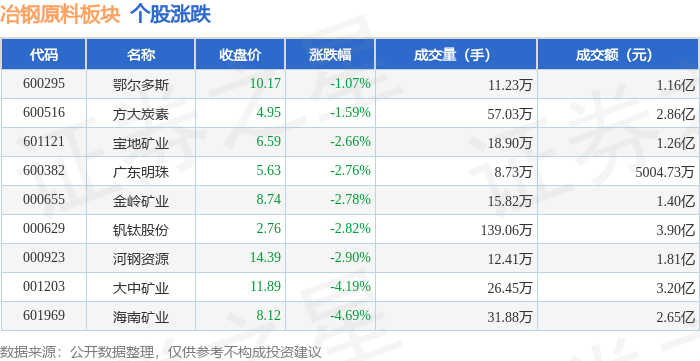
冶钢原料板块8月27日跌2.76%,海南矿业领跌,主力资金净流出1.81亿元
Zheng Xing Xing Ye Ri Bao· 2025-08-27 08:39
Market Overview - The steel raw materials sector experienced a decline of 2.76% on August 27, with Hainan Mining leading the losses [1] - The Shanghai Composite Index closed at 3800.35, down 1.76%, while the Shenzhen Component Index closed at 12295.07, down 1.43% [1] Individual Stock Performance - Major stocks in the steel raw materials sector showed varied performance, with the following notable declines: - Erdos (600295) closed at 10.17, down 1.07% - Fangda Carbon (600516) closed at 4.95, down 1.59% - Baodi Mining (601121) closed at 6.59, down 2.66% - Guangdong Mingzhu (600382) closed at 5.63, down 2.76% - Jinding Mining (000655) closed at 8.74, down 2.78% - Steel Titanium Co. (000629) closed at 2.76, down 2.82% - Hebei Steel Resources (000923) closed at 14.39, down 2.90% - Dazhong Mining (001203) closed at 11.89, down 4.19% - Hainan Mining (601969) closed at 8.12, down 4.69% [1] Capital Flow Analysis - The steel raw materials sector saw a net outflow of 181 million yuan from main funds, while retail investors contributed a net inflow of 121 million yuan [1] - The following stocks experienced significant capital flow changes: - Fangda Carbon (600516) had a main fund net inflow of 391.68 thousand yuan, while retail saw a net inflow of 9.67 thousand yuan [2] - Guangdong Mingzhu (600382) had a main fund net inflow of 44.28 thousand yuan, with retail investors contributing a net outflow of 178.64 thousand yuan [2] - Hainan Mining (601969) faced a main fund net outflow of 4947.26 thousand yuan, but retail investors had a net inflow of 2248.91 thousand yuan [2] - Dazhong Mining (001203) saw a main fund net outflow of 5003.81 thousand yuan, with retail investors experiencing a net outflow of 2832.20 thousand yuan [2]