Food Delivery

Search documents
Kroger Launches Fast, Convenient Delivery on Uber Apps Nationwide
Prnewswire· 2026-01-15 13:00
Core Insights - Uber Technologies, Inc. and The Kroger Co. have launched nearly 2,700 Kroger Family of Companies stores on Uber Eats, Uber, and Postmates, allowing customers nationwide to shop for groceries and household essentials with on-demand delivery [1][3] Group 1: Partnership Details - The collaboration aims to enhance access, choice, and value for millions of households, expanding beyond existing offerings like floral and sushi shops to include full store assortments from various Kroger banners [3] - Customers can schedule deliveries at their convenience, reflecting the evolving needs of consumers [5] Group 2: Promotional Offers - To celebrate the launch, Uber is providing discounts of up to 50% off the first order from selected Kroger banners, with additional benefits for Uber One members, including $0 Delivery Fee on eligible orders [4][8] Group 3: Company Backgrounds - The Kroger Co. serves over 11 million customers daily through a variety of retail food stores and eCommerce platforms, employing more than 400,000 associates [6] - Uber, since its inception in 2010, has facilitated over 68 billion trips and continues to innovate in the movement of people and goods [7]



JD's 'Wolf Pack' Is Ready To Eat Meituan's Lunch
Benzinga· 2026-01-13 16:12
Core Insights - The food delivery industry in China is undergoing significant changes as subsidies are being reduced, shifting the focus from cash-burning growth to cost efficiency in delivery operations [1][3]. Group 1: JD.Com's Strategy - JD.Com is investing heavily in automation, planning to deploy approximately 3 million delivery robots, 1 million autonomous vans, and 100,000 drones to reduce last-mile delivery costs [2][4]. - The company's five-year plan aims to automate the entire last-mile delivery process, utilizing software, sensors, and hardware instead of relying on human labor [4]. - JD's model allows for decreasing costs over time as technology improves, contrasting with the rising labor costs faced by competitors [5]. Group 2: Meituan's Challenges - Meituan continues to depend on a large workforce of nearly 7 million riders, which increases operational costs and regulatory pressures [2][5]. - The reliance on human labor makes Meituan vulnerable to inflationary pressures, as rising labor costs are hard-coded into their delivery model [5]. - Meituan is engaging in a price war by using financial resources, while JD is leveraging technological advancements to maintain competitive pricing [6].



中国互联网-监管将调查外卖平台-China Internet and Other Services-State Council to Investigate Food Delivery Platforms
2026-01-13 02:11
Summary of Conference Call Notes Industry Overview - **Industry**: Food Delivery Platforms in China - **Key Players**: Alibaba Group Holding (BABA), Meituan Core Points and Arguments 1. **Government Investigation**: The General Office of Anti-Monopoly and Anti-Unfair Competition Commission has initiated an investigation into food delivery platforms to ensure fair competition and reasonable pricing, addressing issues like excessive subsidies and aggressive price wars [2][3] 2. **Response from Companies**: Both BABA and Meituan have committed to cooperating with the investigation and adhering to relevant laws to promote orderly industry development [2] 3. **Intensified Competition**: Competition in the food delivery sector has escalated, with BABA expected to increase investments to capture market share, leading to significant cash burn concerns [4] 4. **Projected Losses**: BABA's quick commerce losses are projected to reach RMB 90 billion in fiscal year 2026 and RMB 60 billion in fiscal year 2027, raising market concerns about cash burn [4] 5. **Meituan's Financial Outlook**: Meituan is expected to incur an on-demand loss of RMB 27 billion in fiscal year 2025, followed by a profit of RMB 5 billion in 2026, although competitive pressures may impact margins [5] 6. **Investment Preferences**: The preference ranking for investments is BABA > PDD > Meituan > JD, with BABA's cloud services (Alicloud) expected to grow significantly [6] Additional Important Content 1. **Market Sentiment**: There is a growing concern regarding the cash burn of major players in the food delivery sector due to intensified competition, contrasting with earlier expectations of a more gradual competitive landscape [4] 2. **Regulatory Environment**: The investigation by the State Council is seen as a strong stance against the ongoing price wars and competitive involution in the food delivery sector [3] 3. **Future Growth Potential**: Alicloud is highlighted as a key growth driver for BABA, with expectations of revenue growth accelerating to over 35% in fiscal Q3 2026 and 40% in fiscal 2027 [6] This summary encapsulates the critical insights from the conference call regarding the food delivery industry in China, focusing on the competitive landscape, financial projections, and regulatory developments affecting key players.
外卖小哥送单初体验
Xin Lang Cai Jing· 2026-01-12 22:06
Core Viewpoint - The article highlights the integration of new employment groups into urban life in Bijie City, exemplified by the story of Zhang Bing, who becomes a food delivery rider to support his family after surgery on his child. The support systems in place for new workers are emphasized, showcasing the city's efforts to facilitate their transition into the workforce. Group 1 - Zhang Bing, a 46-year-old man, starts his first day as a food delivery rider in Bijie City, reflecting the integration of 32,000 new employment groups into urban life [1] - The job allows for flexible scheduling and the potential for increased earnings, making it an attractive option for individuals like Zhang who need to balance work with family responsibilities [1] - The delivery station provides comprehensive support, including equipment and guidance, to ensure new riders can start their jobs effectively [2] Group 2 - Zhang encounters challenges on his first day, such as a mix-up with an order, but receives assistance from experienced colleagues, which helps him navigate the situation [2] - By the end of his first day, Zhang successfully completes 15 deliveries, demonstrating an increase in efficiency as he becomes more familiar with the job [3] - The city has established various support mechanisms, including 42 mobile party organizations and 480 "Warm New" stations, to assist new employment groups, ensuring they feel supported and secure in their new roles [3]
AI差点骗过全世界,这个8.7万赞的帖子被揭穿后,我开始怀疑一切了
36氪· 2026-01-12 09:30
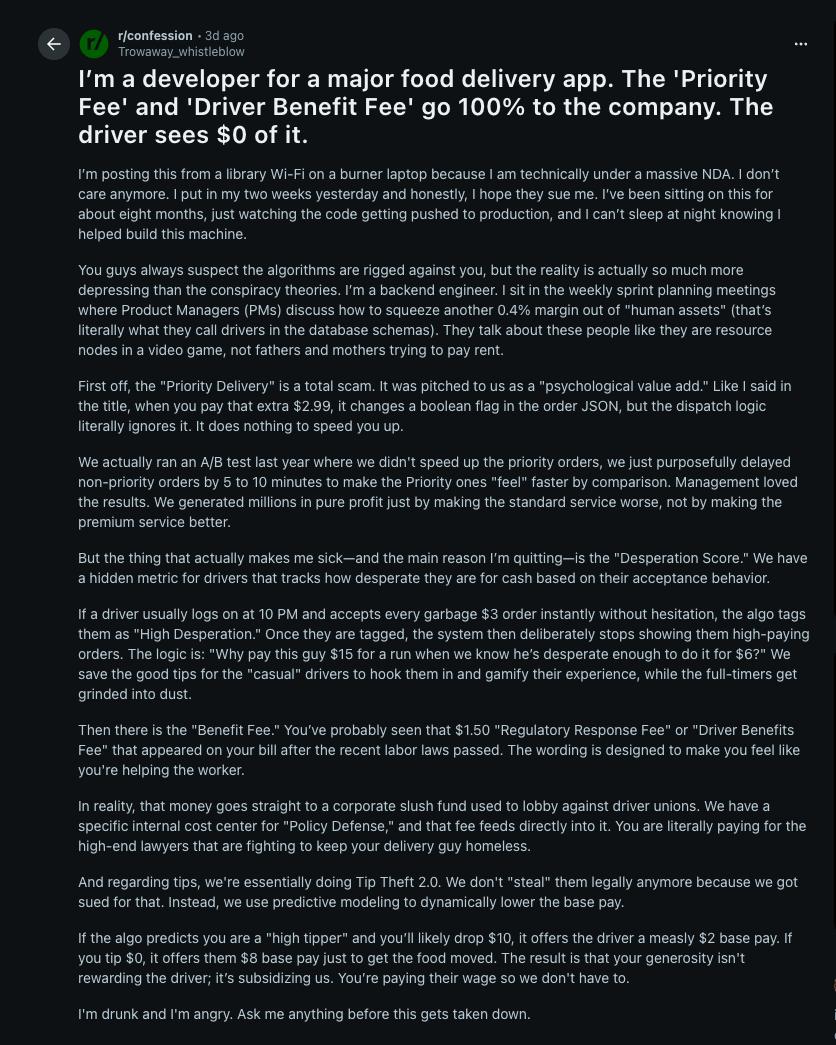
Core Viewpoint - The article discusses a recent incident involving a purported whistleblower from a food delivery platform, which turned out to be an AI-generated hoax, highlighting the challenges of verifying information in the age of AI [4][6][23]. Group 1: Incident Overview - A user claiming to be a software engineer from a food delivery platform alleged that the company manipulates algorithms to harm consumers and delivery workers [5][8]. - The allegations included tactics such as delaying regular orders to make paid priority orders appear faster and charging a "regulatory response fee" to lobby against driver unions [8][10]. - The whistleblower claimed the platform uses a "Desperation Score" to categorize drivers based on their willingness to accept low-paying orders, which affects their access to higher-paying jobs [8][10]. Group 2: Investigation and Verification Challenges - A journalist contacted the whistleblower for more information, but inconsistencies in the whistleblower's communication raised suspicions about the authenticity of the claims [14][19]. - The whistleblower provided a document claiming to be from Uber's market dynamics team, which contained detailed descriptions of the alleged practices, but also included irrelevant information about regulatory evasion [16][18]. - AI detection tools later confirmed that the employee ID provided by the whistleblower was likely generated or edited by AI, raising further doubts about the legitimacy of the claims [20][24]. Group 3: Broader Implications of AI in Information Verification - The article emphasizes that the rapid advancement of AI tools has made it easier for fraudsters to create convincing false narratives, increasing the difficulty for journalists to verify information [23][25]. - The phenomenon of deepfakes and AI-generated content is leading to a growing distrust in information, as the public may begin to view all information as potentially deceptive [26][28]. - The article concludes that the evolution of deepfake technology is contributing to a future characterized by uncertainty and skepticism towards factual information [28].

Meituan, Alibaba Shares Jump as China Seeks to Curb Price Wars
Yahoo Finance· 2026-01-12 08:56
Core Insights - China's top antitrust body has initiated a probe into competition practices in the food delivery sector, leading to a rise in shares of major companies like Meituan, Alibaba, and JD.com [1][4] Group 1: Market Reactions - Meituan's stock increased by 6.6%, marking its largest gain since May 29, while Alibaba's shares rose by 5.3% and JD.com's shares gained over 2% [1] - The overall sentiment in the Chinese tech sector was positive, with the Hang Seng Tech Index climbing by 3.1% [6] Group 2: Regulatory Actions - The State Council's anti-monopoly committee will investigate competition behaviors among delivery platforms through on-site checks, interviews, and surveys, as per the State Administration for Market Regulation [3] - Increased scrutiny is expected to support industry margins by curbing subsidy-led expansion and raising compliance costs for new entrants [2] Group 3: Industry Context - Since 2025, Beijing has intensified scrutiny of the retail sector due to significant investments in subsidies by major players like Alibaba, Meituan, and JD.com, which led to aggressive price wars [4] - Investors are optimistic that the ongoing probe will help mitigate the rampant discounting and subsidies that have negatively impacted profit margins for these companies [4]
AI差点骗过全世界,这个8.7万赞的帖子被揭穿后,我开始怀疑一切了
3 6 Ke· 2026-01-11 23:41
Core Insights - A new user named Trowaway_whistleblow claims to be a software engineer at a food delivery platform and is preparing to expose alleged company misconduct [1] - The story aligns with public perceptions of "evil capitalism" but is revealed to be an AI-generated hoax [2] Group 1: Allegations Against the Company - The whistleblower's post details how the platform manipulates algorithms to harm consumers and delivery workers, such as intentionally delaying regular orders to make paid priority orders appear faster [3] - The platform allegedly charges a "regulatory response fee" to lobby against driver unions, and calculates a "Desperation Score" for drivers based on their acceptance of low-paying orders [3] - The CEO of DoorDash, Tony Xu, publicly denied the allegations, stating that if anyone promotes such a culture, they would be fired [3] Group 2: Previous Legal Issues - DoorDash has previously faced lawsuits for stealing driver tips, resulting in a settlement of $16.75 million [4] - The exploitation of gig economy workers is not a new issue, as advocacy groups like Los Deliveristas Unidos have noted that such allegations resonate with the experiences of delivery workers [4] Group 3: Investigation and Verification Challenges - A journalist, Casey Newton, attempted to verify the whistleblower's identity but noticed inconsistencies, such as a spelling error in the whistleblower's communication [5] - The whistleblower provided a photo of an employee ID, which was later identified as AI-generated, raising concerns about the authenticity of the claims [11] - The rapid advancement of AI tools has made it easier for individuals to create convincing forgeries, complicating the verification process for journalists [14][15] Group 4: Broader Implications of AI in Information Verification - The rise of deepfake technology poses significant challenges for journalists, as it increases the difficulty of distinguishing between real and fabricated information [15][16] - The phenomenon of deepfakes contributes to a growing distrust in information sources, leading to societal uncertainty [16]
外卖骑手的时间被谁“偷”走了?
Xin Lang Cai Jing· 2026-01-11 00:40
Core Viewpoint - The claim that delivery platforms are "stealing time" from riders has been debunked, but issues related to timing rules and declining income are genuine concerns for delivery riders [1][4][6]. Group 1: Timing Rules and Delivery Pressure - A viral video claimed that a countdown of "1 minute" on the Taobao Flash Purchase app only equated to 42 seconds in real time, but this was proven to be a hoax [1][2]. - The current mainstream platforms use a "total time flat rate" timing rule, where the countdown starts from the moment an order is placed, encompassing the time taken by the merchant to prepare the food, the rider to pick it up, and the delivery itself [4][5][6]. - Many riders express concerns that the compressed timing creates a "psychological urgency," pressuring them to work beyond their limits, which raises safety risks [2][6]. Group 2: Rider Income and Workload - The number of delivery riders has increased significantly, with Meituan reporting a rise from 4.7 million in 2020 to 7.45 million in 2023, while Ele.me has over 4 million active riders [6]. - Despite the increase in riders, the average payment per order has decreased from approximately 8 yuan in 2020 to around 6 yuan now, leading to financial strain on riders [6][7]. - Riders report that the time constraints imposed by the platforms have reduced their delivery efficiency, with many stating they can only complete three to four orders in the time they previously managed seven to eight [6][7]. Group 3: Rider Demands and Platform Response - Riders are calling for a separation of the time allocated for food preparation and delivery, arguing that they should only be responsible for the time they can control [7]. - Complaints have been widespread regarding the timing system, which often starts the countdown before the merchant has even begun preparing the order, leaving riders with insufficient time for delivery [7].
离职程序员深夜忏悔用“绝望指数”算法害人:Uber Eats剥削外卖员让缺钱者狂接垃圾订单!如今竟被爆帖子是AI编的?网友:别再让AI背锅了
AI前线· 2026-01-10 04:10
Core Viewpoint - The article discusses the controversy surrounding a Reddit post by a self-proclaimed whistleblower from Uber Eats, which claimed systemic exploitation of delivery workers through algorithms. The post gained significant attention but was later revealed to be fabricated, raising questions about trust in information related to platform economies and algorithm governance [4][21]. Summary by Sections Incident Overview - A Reddit user, claiming to be an Uber Eats software engineer, posted allegations about the company's exploitation of delivery workers and consumers through its algorithms. The post described how the platform manipulates delivery speeds and charges fees to undermine driver unions [4][5]. Viral Spread and Public Reaction - The post received 86,000 upvotes and was widely shared, with millions of views across social media platforms. It resonated with public sentiment due to previous legal issues faced by delivery platforms like DoorDash, which had to pay $16.75 million for misappropriating driver tips [5][7]. Investigation and Debunking - Journalist Casey Newton investigated the claims and found inconsistencies in the whistleblower's communication and the authenticity of the provided evidence, including an employee ID and a lengthy internal document. Ultimately, it was confirmed that the whistleblower was not a real employee and the claims were likely fabricated using AI tools [12][19]. Implications for Trust and Information - The incident highlights the complexities of trust in the digital age, where misinformation can easily gain traction, especially in contexts where there are real concerns about labor exploitation. The article suggests that the debate over the authenticity of the claims reflects broader anxieties about algorithmic transparency and the integrity of information sources [21][27].

2025年Q3中国移动互联网流量季度报告
艾瑞咨询· 2026-01-07 00:03
Core Insights - The report indicates a slight growth in mobile internet traffic in Q3 2025, with user behavior shifting towards low-frequency deep usage. Monthly active devices reached 1.452 billion, a 0.83% increase from Q2 2025. Daily usage frequency decreased by 2.9% to 59.8 times, while usage duration increased by 2.3% to 282.9 minutes, indicating a deeper engagement from users [1][2][6]. User Changes - The proportion of unmarried users increased to 32.7%, up by 1.39% year-on-year, with growth driven by the unmarried demographic in mid-to-high tier cities. Users aged 35 and below accounted for 49.1% of the total, with a 4.2% increase in users from second-tier cities and above [2][8]. - User preferences vary significantly by age, with Gen Z (born after 2000) favoring gaming and entertainment, while the 25-30 age group shows a preference for parenting and childcare content [2][16]. Industry Changes - The food delivery sector saw a temporary surge in traffic due to intense competition among major players like Meituan and Ele.me, but subsequent growth has been weak. In contrast, the travel sector is experiencing steady growth, with a 15% year-on-year increase in usage duration [3][61]. - The artificial intelligence sector is witnessing rapid growth, with monthly active users reaching 470 million and a year-on-year increase of 321% in language model users, reflecting strong market demand [3][37]. - The gaming services sector is facing overall decline, with intensified competition among existing players, although MOBA and shooting games are experiencing growth [4][76]. APP Changes - In September 2025, the top three apps with over 100 million monthly active users were Railway 12306, Doubao, and Quanmin K Ge, while the top three apps with over 50 million monthly active users included Tencent Yuanbao, Soda Music, and Zhuanzhuan [5][81][82].