
Trusts

Search documents
信托业交年度社会责任答卷 去年16.68万亿资金流向实体经济
2 1 Shi Ji Jing Ji Bao Dao· 2025-09-30 03:01
Core Insights - The trust industry in China has directed 16.68 trillion yuan towards the real economy as part of its social responsibility efforts, with a total of 22.25 trillion yuan in trust assets under management by the end of 2024 [1][2] Group 1: Financial Support to the Real Economy - 28.81% of the trust funds are directly invested in the real economy, while 46.17% are indirectly supporting it through capital markets, totaling 16.68 trillion yuan [2] - The trust industry has provided significant funding for national strategic projects, including 1.12 trillion yuan for the Belt and Road Initiative and 2.67 trillion yuan for the Yangtze River Economic Belt [2] Group 2: Social Welfare and Livelihood Support - In 2024, the trust industry allocated 1.6 trillion yuan to inclusive finance, established 1,148 pension service trust projects with an investment of 14.493 billion yuan, and funded 289 rural revitalization projects with 430.4 million yuan [3] Group 3: Green Trust Initiatives - The scale of green trust projects reached 325.3 billion yuan, with 390 new projects added in 2024, marking a 21.5% increase year-on-year [4] - Trust companies have implemented over 20 "dual carbon" target guidelines and conducted 46 training sessions on green trust, with 4,520 participants [5] Group 4: Charitable Trust Developments - By the end of 2024, the cumulative number of charitable trusts reached 2,244, with a total scale of 8.507 billion yuan, reflecting a year-on-year growth of 30.07% in new registrations [5]
审视华能信托被骗17亿案:信托重返消金牌桌,助贷新规将带来什么?
Xin Lang Cai Jing· 2025-09-26 04:05
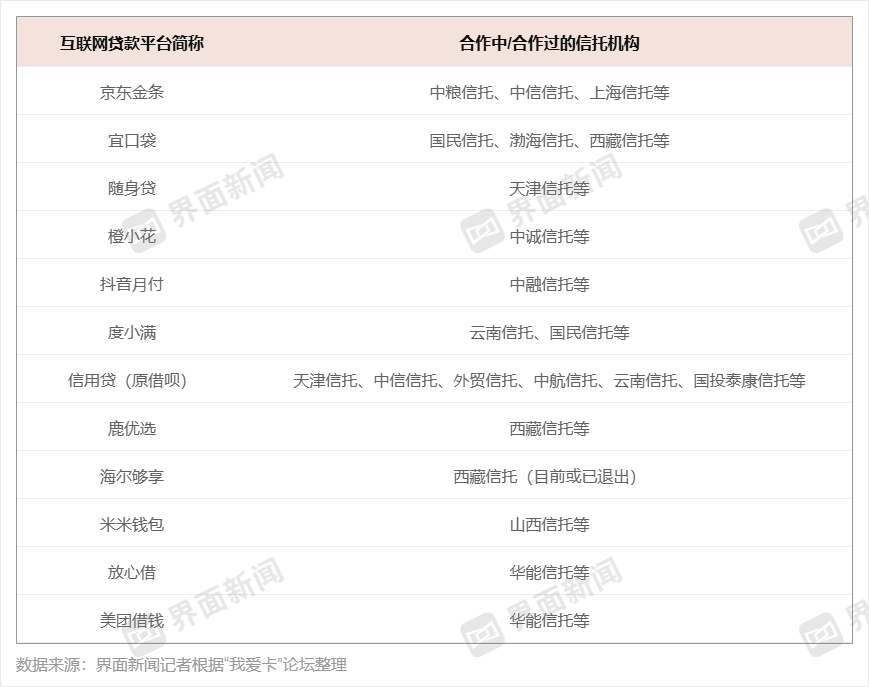
Core Viewpoint - The recent developments in the consumption finance trust business highlight a resurgence in the sector, driven by regulatory changes and market dynamics, despite the risks exemplified by the Huaneng Trust loan fraud case [1][4][14]. Group 1: Regulatory Environment - The local securities regulatory bureau has initiated a special self-inspection of asset-backed securities (ABS) related to Huaneng Trust's "credit guarantee loan" business to prevent similar fraud risks from affecting the ABS market [1]. - The implementation of the new lending regulations on October 1 is expected to impose stricter constraints on trust institutions involved in consumer loans, including limits on borrowing rates and platform management [2][7]. Group 2: Market Trends - In the first eight months of 2025, 26 trust companies issued consumption finance collective trust plans totaling 173.3 billion yuan, marking a year-on-year increase of over 50% [4][6]. - Major trust companies such as Tianjin Trust, Guomin Trust, and Huaxin Trust have significantly increased their issuance of consumption finance trust products, with some companies doubling their issuance compared to the previous year [4][6]. Group 3: Business Models - The consumption finance trust business, which primarily involves providing consumer loans, has evolved from a focus on non-standard financing to a more regulated environment due to increased scrutiny [3][11]. - The trust companies are now exploring various business models, including lending partnerships with banks and consumer finance companies, to mitigate risks and enhance profitability [10][12]. Group 4: Risks and Challenges - The Huaneng Trust loan fraud case serves as a cautionary tale for the industry, highlighting the risks associated with over-reliance on third-party platforms and inadequate risk management practices [14][15]. - The new lending regulations are expected to challenge traditional financing models, pushing trust companies to adapt their strategies to comply with stricter regulatory requirements [29][30]. Group 5: Future Outlook - The consumption finance trust business is anticipated to continue evolving, with a focus on compliance and proactive risk management becoming paramount for trust companies [29][30]. - The shift towards asset service trusts, particularly in prepayment funding services, is seen as a potential optimal solution for trust companies facing regulatory pressures [30].

不动产信托登记迎来“天津样本”,首创“持有+购买”双模式
2 1 Shi Ji Jing Ji Bao Dao· 2025-09-25 05:17
Core Viewpoint - Tianjin has become the fifth city in China to launch a pilot program for real estate trust property registration, integrating innovative systems to enhance financial services for the real economy and meet public needs [1][2]. Group 1: Pilot Program Overview - The pilot program is a collaboration among multiple governmental bodies in Tianjin, aiming to establish a comprehensive framework for real estate trust property registration [1][2]. - The program emphasizes three core objectives: creating a benchmark for financial innovation, guiding the trust industry back to its fundamental purpose, and leveraging the advantages of the free trade zone [2][3]. Group 2: Key Innovations - The pilot introduces three major innovations to optimize service experience and improve processing efficiency [4]. - The first innovation is the explicit identification of "revitalizing existing assets" as a core application scenario for real estate trusts, addressing issues related to asset liquidity and management [5]. - The second innovation allows for a dual approach of "holding + purchasing," enabling trustees to buy real estate, thus catering to both existing asset revitalization and new asset creation [6][7]. - The third innovation establishes a "transfer in + transfer out" dual process, enhancing transparency and efficiency in the registration process, with a complete cycle from establishment to exit [8].
坚持长期主义穿越周期 实现信托业高质量发展
Zhong Guo Zheng Quan Bao· 2025-09-24 20:17
Core Viewpoint - The trust industry has experienced significant fluctuations over the past 23 years, characterized by three distinct development phases: exploration, rapid growth, and adjustment [1][2]. Summary by Sections Development Phases - The trust industry can be divided into three phases based on asset scale: exploration period (2002-2006), rapid growth period (2007-2017), and adjustment period (2018-present) [2][3]. - During the exploration period, the industry laid the groundwork for future growth, despite slow growth and small scale [2]. - The rapid growth period saw trust assets increase from 4.8 trillion yuan to 26.25 trillion yuan, with annual growth rates exceeding 50% [2][3]. - The adjustment period began in 2018, with a decline in asset scale due to regulatory pressures, reaching a low of 20.49 trillion yuan in 2020, but has since started to recover [3][4]. Key Metrics - Trust assets peaked at 26.25 trillion yuan in 2017, representing a significant portion of the financial sector [3]. - The industry’s profit reached a peak of 82.4 billion yuan in 2017, followed by a decline as the industry adjusted [4]. Regulatory Environment - The introduction of the Trust Law in 2001 marked the beginning of a more regulated environment for the trust industry [2]. - Regulatory measures have been implemented to address risks associated with real estate trust businesses, including financial support policies for real estate projects [7]. Industry Risks and Misconceptions - The trust industry does not face systemic risks, as most companies have addressed issues related to non-standard funding pools and shareholder self-financing [6]. - The misconception of trust companies as "shadow banks" is addressed, emphasizing that they operate under strict regulatory oversight [7]. Future Outlook - The future of the trust industry is expected to focus on restructuring business models according to the three categories of trust services: asset service trusts, asset management trusts, and charitable trusts [8]. - The industry is anticipated to experience a second growth curve, particularly in asset service trusts, driven by regulatory encouragement and market demand [8][9]. - Long-term growth will depend on the industry's ability to manage risks, cultivate trust, and create value through services [10].
天津多部门联合印发《关于开展不动产信托财产登记试点的通知》
Zhong Zheng Wang· 2025-09-24 14:39
Core Viewpoint - The Tianjin municipal authorities have issued a notification to support the standardized development of real estate trust property registration, aiming to enhance the role of trusts in economic and social development and accelerate the establishment of a financial innovation operation demonstration zone [1] Group 1: Policy and Regulation - The notification includes several innovative institutional designs to ensure the standardized, accurate, and complete registration of real estate trust properties, effectively protecting the legal rights of trust parties [1] - The initiative aims to deepen the implementation of service industry expansion policies and create replicable and promotable experiences in real estate trust property registration [1] Group 2: Economic Impact - The measures are part of Tianjin's efforts to improve financial infrastructure, innovate financial service models, and empower the development of the real economy [1] - The local financial management bureau plans to continue promoting the notification through training and case implementation, encouraging qualified trust institutions, enterprises, and individuals to participate in the pilot program [1] Group 3: Future Directions - The initiative is expected to release the institutional innovation dividends of "Free Trade Zone + Real Estate Trust Registration," contributing to the construction of the financial innovation operation demonstration zone and supporting high-quality regional development [1]
Western Pacific Trust Company Declares Third Annual Dividend on Common Shares
Globenewswire· 2025-09-23 17:49
Core Viewpoint - Western Pacific Trust Company (WPTC) has declared its third consecutive annual dividend on common shares, reflecting the company's financial strength and commitment to shareholder value despite economic challenges [1][2][3]. Financial Performance - The declaration of the dividend follows a year of solid performance and advancements in WPTC's core business, maintaining competitive trust services amid market uncertainties [2]. - A dividend of $0.005 per common share will be payable on October 17, 2025, to shareholders of record as of October 2, 2025 [3]. Corporate Strategy - The company emphasizes its stable foundation and long-term strategy, showcasing confidence in its ability to create enduring shareholder value [3]. - The full amount of the dividend is designated as an "eligible dividend" under the Income Tax Act (Canada), encouraging shareholders to consult tax advisors regarding implications [4]. Company Overview - WPTC is a licensed trust company authorized to conduct non-deposit taking trust business in British Columbia, Alberta, and Saskatchewan [5].

吕天贵正式获批担任中信信托董事长
2 1 Shi Ji Jing Ji Bao Dao· 2025-09-20 02:07
Group 1 - The National Financial Regulatory Administration of Beijing approved the appointment of Lv Tianguo as the chairman and director of CITIC Trust Co., Ltd. [1] - Lv Tianguo previously served as the vice president of CITIC Bank before his appointment to CITIC Trust [1][2] - Lv Tianguo has over 30 years of experience in the Chinese banking industry and holds multiple professional qualifications [1][2] Group 2 - Lv Tianguo's career at CITIC Bank included various senior roles, culminating in his position as the business director starting in August 2018 [2][3] - The former chairman of CITIC Trust, Lu Wei, has returned to CITIC Bank as the president [3] - Lu Wei has a long history with CITIC Bank, having held multiple key positions since joining in 1997 [4]

吕天贵中信信托董事长任职资格获批
Xin Lang Cai Jing· 2025-09-19 13:20
Core Viewpoint - The appointment of Lü Tianguo as the chairman and director of CITIC Trust has been approved by the Beijing Financial Supervision Bureau, highlighting the importance of leadership changes within financial institutions [1] Company Overview - Lü Tianguo has a long tenure at CITIC Bank, having joined in January 2003 and held various senior positions including President of the Credit Card Center and General Manager of Retail Banking and Private Banking [1] - Since April 2021, Lü has served as the Vice President of CITIC Bank, indicating a strong background in banking operations and management [1] CITIC Trust - CITIC Trust is a significant member of the CITIC Group's financial sector, with a registered capital of 11.276 billion yuan [1] - The company is wholly owned by China CITIC Financial Holdings Co., Ltd., which is under the actual control of China CITIC Group Co., Ltd., emphasizing its strategic importance within the group [1]
中信信托董事长任职资格获批!这家信托变身国企!中植系管理人员公开审理 |周报
Sou Hu Cai Jing· 2025-09-19 12:46
Group 1 - CITIC Trust's chairman qualification has been approved, with Lv Tianguo appointed as chairman after over 30 years in the financial industry [2] - In 2024, CITIC Trust achieved operating income of 5.379 billion and net profit of 2.653 billion, maintaining key operating indicators in the top three of the industry for 15 consecutive years [2] Group 2 - Sichuan Trust has undergone a significant change in ownership, with Shudao Investment Group becoming the controlling shareholder, holding 58.6278% of the shares [3] - The approval also includes changes in the shareholding structure, with other shareholders holding various percentages [3] Group 3 - Wang Xin has officially taken over as chairman of Ping An Trust, following the approval from the regulatory authority [5] - In 2024, Ping An Trust's asset management scale reached 993 billion, reflecting a year-on-year growth of 49.88% [5] Group 4 - Guo Tong Trust has introduced a new leadership team, with the new party secretary, Tang Jian, making his first public appearance [6] Group 5 - Huaxin Trust announced that the signing window for investors will close on September 25, 2025, with no extension planned [7][8] - The company has communicated this deadline through various channels to ensure investors are aware [8] Group 6 - Lujiazui Trust has implemented a policy prohibiting financial managers from using personal WeChat accounts for client marketing and communication, effective October 1, 2025 [9] Group 7 - Lujiazui International Trust has appointed Wang Gang as the new chairman, following the approval from the regulatory authority [10]

中粮资本9月17日获融资买入3.36亿元,融资余额8.84亿元
Xin Lang Cai Jing· 2025-09-18 01:29
Core Viewpoint - On September 17, COFCO Capital experienced a significant increase in stock price by 10.02%, with a trading volume of 2.714 billion yuan, indicating strong market interest and activity [1]. Financing Summary - On the same day, COFCO Capital had a financing buy-in amount of 336 million yuan, with a financing repayment of 281 million yuan, resulting in a net financing purchase of approximately 54.43 million yuan [1]. - As of September 17, the total financing and securities lending balance for COFCO Capital was 892 million yuan, with the financing balance at 884 million yuan, representing 2.63% of the circulating market value, which is above the 90th percentile level over the past year [1]. - In terms of securities lending, COFCO Capital had no shares repaid on September 17, with 74,000 shares sold short, amounting to approximately 1.08 million yuan at the closing price, and a remaining short position of 545,900 shares valued at 7.97 million yuan, also above the 90th percentile level over the past year [1]. Company Overview - COFCO Capital Holdings Co., Ltd. is located in the Chaoyang District of Beijing and was established on December 29, 2004, with its listing date on June 3, 2010 [1]. - The company's main business activities include trust, futures, insurance, and banking, with revenue composition as follows: insurance segment 72.02%, trust segment 15.30%, futures segment 12.23%, and others 0.46% [1]. Shareholder and Financial Performance - As of August 29, COFCO Capital had 136,000 shareholders, an increase of 7.94% from the previous period, with an average of 16,941 circulating shares per person, a decrease of 7.35% [2]. - For the first half of 2025, COFCO Capital reported operating revenue of 4.893 billion yuan, a year-on-year decrease of 62.60%, and a net profit attributable to shareholders of 848 million yuan, down 27.83% year-on-year [2]. - Since its A-share listing, COFCO Capital has distributed a total of 1.503 billion yuan in dividends, with 850 million yuan distributed over the past three years [2]. - As of June 30, 2025, the top ten circulating shareholders included the Southern CSI 500 ETF, holding 13.6631 million shares, an increase of 1.6479 million shares from the previous period, and Hong Kong Central Clearing Limited, holding 13.4116 million shares, an increase of 613.64 thousand shares [2].
