Retail

Search documents
Natural Gas Services: Valuation Is Still Attractive Even After The Recent Uptrend
Seeking Alpha· 2025-12-09 19:04
Core Insights - The logistics sector has seen significant engagement from investors, particularly in the ASEAN and US markets, highlighting its growth potential and diversification opportunities [1] Investment Focus - The company has diversified its investments across various sectors including banking, telecommunications, logistics, and hotels, indicating a strategic approach to portfolio management [1] - The entry into the US market in 2020 reflects a growing interest in international investment opportunities, particularly in sectors like banks, hotels, and shipping [1] Market Trends - The popularity of insurance companies in the Philippines since 2014 suggests a shift in investment preferences among local investors, moving towards more diversified financial products [1] - The trend of using platforms like Seeking Alpha for analysis indicates a growing reliance on data-driven insights for investment decisions in both the ASEAN and US markets [1]



X @Bloomberg
Bloomberg· 2025-12-09 17:42
Billionaire Mike Ashley put up shares worth more than £600 million ($800 million) in his UK retailer Frasers Group Plc against a loan with HSBC Holdings, according to a filing on Tuesday https://t.co/vA40ZJA5Yw ...
Cramer Loves These Dividend Stocks
Yahoo Finance· 2025-12-09 16:19
Costco - Costco's membership model drives consistent revenue with renewal rates consistently above 90%, providing cash flow stability that supports dividend growth, making it attractive for income investors [1][5] - The company demonstrates resilience in inflationary environments through its bulk-buying model and private-label Kirkland brand, which help maintain low costs and strong margins [1] - Cramer emphasizes Costco's ability to thrive amid economic shifts, including inflation and consumer caution, as a reason to invest, especially with its global expansion and e-commerce growth [1][2] Eli Lilly - Eli Lilly is recognized for its explosive growth and reliable dividend, currently yielding about 0.69%, driven by blockbuster drugs like Mounjaro and Zepbound for weight loss and diabetes [6][10] - The company maintains a strong innovation pipeline and profitability, which supports dividend growth, positioning it well to handle patent cliffs compared to peers [7] - Recent late-stage trial results for orforglipron, an oral formulation for weight loss and diabetes management, reported significant success, indicating strong future potential for the stock [8][9] CVS Health - CVS Health is highlighted for its diversified business model, which includes retail pharmacies, health insurance through Aetna, and pharmacy benefit management, with a dividend yield of 3.36% [11][12] - The company is considered undervalued with a low price-to-earnings ratio relative to peers, despite strong cash flows that support its generous dividend [12] - Cramer points out CVS's strategic shift toward healthcare services, such as in-store clinics and telehealth, as a growth driver in a post-pandemic environment, making it a buy for investors seeking income and recovery upside [12][13]


It's been well telegraphed that the Fed will cut rates on Wednesday, says Bespoke's Paul Hickey
Youtube· 2025-12-09 15:51
Let's talk about the market reaction to all of this. Joining us this morning, Paul Hickeyi, co-founder at Bespoke Investment Group. Paul, it's great to have you back.Good morning. >> Good to be here. How you doing, Carl.>> I'm good. Uh, meantime, Hassets's on the tape as well. Do not expect mass layoffs from AI.How would you judge the market's ability to sort of game out all of these crazy long-term crossurrens. >> You know, I mean, I think there there are a lot of crossurrens and as we're talking about, th ...

Is Costco Stock a Buying Opportunity Before 2026?
The Motley Fool· 2025-12-09 15:00
Core Viewpoint - Costco is recognized as one of the best retailers globally, demonstrating exceptional execution of its strategy [1] Group 1 - The company is noted for its effective strategy execution, which sets it apart in the retail sector [1] - Costco's stock performance was referenced, with prices noted as of December 6, 2025 [1]

Looking for a Fast-paced Momentum Stock at a Bargain? Consider Victoria's Secret (VSCO)
ZACKS· 2025-12-09 14:57
Core Viewpoint - Momentum investing focuses on "buying high and selling higher" rather than the traditional "buying low and selling high" approach, aiming for quicker profits [1] Group 1: Momentum Investing Characteristics - Fast-moving trending stocks can be difficult to enter at the right time, as they may lose momentum if future growth does not justify their high valuations [2] - Investing in bargain stocks that have recently shown price momentum can be a safer strategy [3] Group 2: Victoria's Secret (VSCO) Analysis - VSCO has shown a significant price increase of 44.8% over the past four weeks, indicating growing investor interest [4] - Over the past 12 weeks, VSCO's stock gained 82.9%, demonstrating its ability to deliver positive returns over a longer timeframe [5] - VSCO has a Momentum Score of A, suggesting it is an opportune time to invest in the stock [6] Group 3: Earnings Estimates and Valuation - An upward trend in earnings estimate revisions has contributed to VSCO earning a Zacks Rank 1 (Strong Buy), which is associated with strong momentum effects [7] - VSCO is trading at a Price-to-Sales ratio of 0.64, indicating it is relatively cheap, as investors pay only 64 cents for each dollar of sales [7] Group 4: Additional Investment Opportunities - Besides VSCO, there are other stocks that meet the criteria of the 'Fast-Paced Momentum at a Bargain' screen, suggesting further investment opportunities [8] - The Zacks Premium Screens offer over 45 different strategies to help identify potential winning stocks based on various investing styles [9]


7 Surprising Stocks Warren Buffett Refuses To Own — and Why
Yahoo Finance· 2025-12-09 14:56
Group 1: Warren Buffett's Investment Strategy - Warren Buffett's net worth reached $153 billion, primarily due to strategic investments, which attract significant attention from investors [1] - Buffett's recent $4.3 billion investment in Alphabet stock led to a more than 10% increase in shares of Google's parent company within two weeks [1] Group 2: Tech Stock Exclusions - Buffett's investment strategy has led him to avoid aggressive purchases in tech stocks, which surprised investors with his recent Alphabet investment [2] - Notable tech stocks missing from Buffett's portfolio include Nvidia, Broadcom, AMD, Meta Platforms, and Microsoft, indicating a cautious approach towards sectors he does not fully understand [3][4][5] - Despite understanding banks well, Buffett has not invested in fintech firm SoFi Technologies, which has seen its stock more than double this year [6] Group 3: Walmart's Position in Buffett's Portfolio - Walmart was once a significant part of Buffett's portfolio, but he exited his position in 2018 due to Amazon's dominance in e-commerce, although Walmart's stock has outperformed Amazon's over the past five years [7]
Stock market today: Dow, S&P 500, Nasdaq rise as Fed meeting kicks off, JOLTS data shows openings rose
Yahoo Finance· 2025-12-09 14:36
US stocks turned into the green Tuesday morning as the Federal Reserve's December policy meeting kicked off and federal data showed job openings unexpectedly ticked higher even as layoffs jumped. The blue chip-heavy Dow Jones Industrial Average (^DJI) traded up by around 0.3%, while the benchmark S&P 500 (^GSPC) gained around 0.2%. The tech-heavy Nasdaq Composite (^IXIC), which initially led stocks down, turned around to gain of around 0.2% as the market emerged from a tight drop on Monday. US stocks fo ...
Improving Economic Signals Drives Participation In Direxion's Daily Retail Bull 3X Shares RETL ETF
Benzinga· 2025-12-09 13:49
Economic Overview - The retail sector has underperformed, with the S&P Retail Select Industry Index gaining less than 8% since the start of the year, compared to nearly 17% for the S&P 500 [1] - However, the retail index gained over 9% in the trailing half-year period and surged more than 7% in the past 30 days, outperforming the S&P 500, which only returned 0.56% [2] Consumer Sentiment and Spending - Recent economic data indicates a slight easing in the Federal Reserve's preferred inflation gauge, with core personal consumption expenditure (PCE) slowing from 2.9% to 2.8% [3][4] - Consumer spending increased by $65.1 billion or 0.3%, aligning with consensus forecasts [4] - Consumer sentiment improved from 51.0 points in November to 53.3 in December, marking a 4.5% gain, while consumer expectations rose from 51.0 to 55.0 points [5] Retail Sector Adaptation - Retailers are adapting to the economic environment, with Dollar Tree Inc. beating third-quarter estimates and showing strength across all income groups [7] - Many retail-oriented enterprises are shifting strategies to omnichannel and digital fronts to maximize revenue [7] Investment Opportunities - The Direxion Daily Retail Bull 3X Shares (RETL) ETF offers a leveraged investment option, tracking 300% of the performance of the S&P Retail Select Industry Index [8] - The RETL ETF has lost over 3% since the start of the year but has increased by 17% in the last six months, supported by robust sentiment and trading volume [11] - The ETF is currently above the 50- and 200-day moving averages, with critical support at the $8 level and a target of $10 for bullish investors [11]
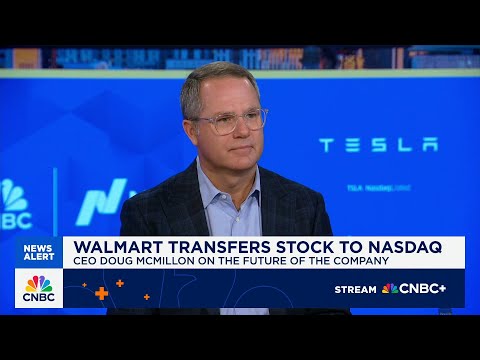
Walmart CEO Doug McMillon on tenure: You can't get growth without change
CNBC Television· 2025-12-09 13:01
>> ALL RIGHT, WELCOME BACK, EVERYBODY. WALMART RINGING THE OPENING BELL TODAY AT THE NASDAQ AS THE COMPANY TRANSITIONS ITS SHARES TO THIS EXCHANGE FROM THE NYSE. JOINING US RIGHT NOW AHEAD OF HIS DEPARTURE FROM HIS ROLE HEADING THE COMPANY IN JANUARY IS DOUG MCMILLON.HE IS WALMART'S CEO. AND DOUG, THANK YOU FOR JOINING US THIS MORNING. GOOD MORNING.WE HAVE SO MUCH TO TALK ABOUT. NOT A LOT OF TIME. SO LET'S JUMP IN RIGHT AWAY WITH WHY YOU'RE MAKING THIS MOVE TO THE NASDAQ.THAT'S A REALLY BIG DEAL. IT'S THE B ...