Uranium Mining

Search documents
金属:铀类公用事业板块重启-metal&ROCK-Uranium Utilities Re-engage
2026-01-13 02:11
Summary of Uranium Market Insights Industry Overview - The focus is on the uranium market, highlighting a resurgence in utility engagement and robust spot buying activity, with constrained supply expected to drive prices higher. The market is projected to reach $90/lb by Q3 2026 [1][15]. Key Points Utility Engagement - Utilities contracted 44 million lbs of uranium from January to September 2025, followed by an additional 38 million lbs from October to early December, indicating a significant increase in activity [2]. - Despite this uptick, the total contracted amount remains below the replacement rate of 150 million lbs/year and the 106 million lbs contracted in 2024, suggesting further increases in 2026 [2]. - The term price for uranium has risen to $86.50/lb, up from approximately $80/lb, with potential ceilings noted by Cameco at $140-150/lb [2]. Global Developments - Japan's Kansai Electric has signed an agreement with Kazatomprom as it resumes nuclear operations, marking a shift from being a net lender of uranium since 2011 [3]. - Globally, around 70 reactors are under construction, with 116 more planned, indicating a growing demand for uranium [3]. - China has demonstrated efficiency in reactor construction, completing units of the Zhangzhou nuclear power plant in just five years [3]. Spot Market Activity - Sprott purchased 8.6 million lbs of uranium in the spot market in 2025, nearing its annual cap of 9 million lbs, with expectations for further purchases in 2026 [4]. - Yellow Cake raised $175 million to acquire 1.3 million lbs from Kazatomprom, scheduled for delivery in the first half of 2026 [4]. Supply Constraints - Supply issues are exacerbated by Cameco's guidance downgrade and slow ramp-up of US brownfield restarts announced in late 2023/early 2024 [13]. - Kazatomprom has reduced its 2026 production guidance from 32,777 tons to 29,697 tons, with actual figures dependent on ongoing negotiations [13]. Regulatory Environment - The US Section 232 investigation into critical minerals, including uranium, is anticipated to conclude soon, which could influence utility purchasing behavior [14]. - The US is heavily reliant on uranium imports, with 70% of enriched uranium sourced from abroad, making import tariffs unlikely [14]. Market Outlook - The uranium market is expected to see continued price increases driven by rising contracting activity and supply challenges, with a forecast of $87/lb in Q2 2026 and $90/lb for the second half of the year [15]. Additional Insights - The report emphasizes the importance of strategic uranium reserves in the US, with the Department of Energy providing $2.7 billion for uranium enrichment projects, indicating a strong commitment to the sector [14]. - The overall sentiment in the uranium market is bullish, with expectations of increased demand and price support from both utility contracts and strategic government initiatives [36].

Snow Lake Completes Highly Successful Drill Program at the Pine Ridge Uranium Project in Wyoming
TMX Newsfile· 2026-01-12 12:30
Core Insights - Snow Lake Resources Ltd. has announced the completion of its 2025 drill program at the Pine Ridge Uranium Project, confirming widespread uranium mineralization and establishing continuity across multiple areas [1][2][4]. Drill Program Results - The drill program consisted of 114 holes totaling 38,000 meters (125,000 feet), with significant results including multiple zones of mineralization [6]. - Notable assay results include: - 2.6 meters at 0.101% (1,010 ppm) U3O8 from 257.6 meters in hole PR25-093, including 2.0 meters at 0.124% (1,240 ppm) U3O8 [6][8]. - Additional results include 1.2 meters at 0.040% (400 ppm) U3O8 from 173.7 meters in PR25-103 and 1.2 meters at 0.032% (320 ppm) U3O8 from 254.7 meters in PR25-105 [6][9]. Geological Insights - The mineralization is hosted in at least two major sandstone units within the Tertiary Ft. Union Formation, which are geologically and hydrologically isolated, indicating potential for future In-Situ Recovery (ISR) development [5][10]. - The southwest portion of the project shows mineralization in a lower sandstone package compared to the eastern area, suggesting additional exploration opportunities [7]. Project Overview - The Pine Ridge Uranium Project is located in the Powder River Basin of Wyoming, a key area for U.S. uranium production, and is in proximity to Cameco's Smith Ranch Mill, which has a licensed capacity of 5.5 million pounds of U3O8 per annum [10].



Stallion Uranium Refines Coyote Target with Highly Conductive Anomalies from Ground EM Survey, Mobilizes Stone Island VTEM Survey
Globenewswire· 2026-01-12 12:00
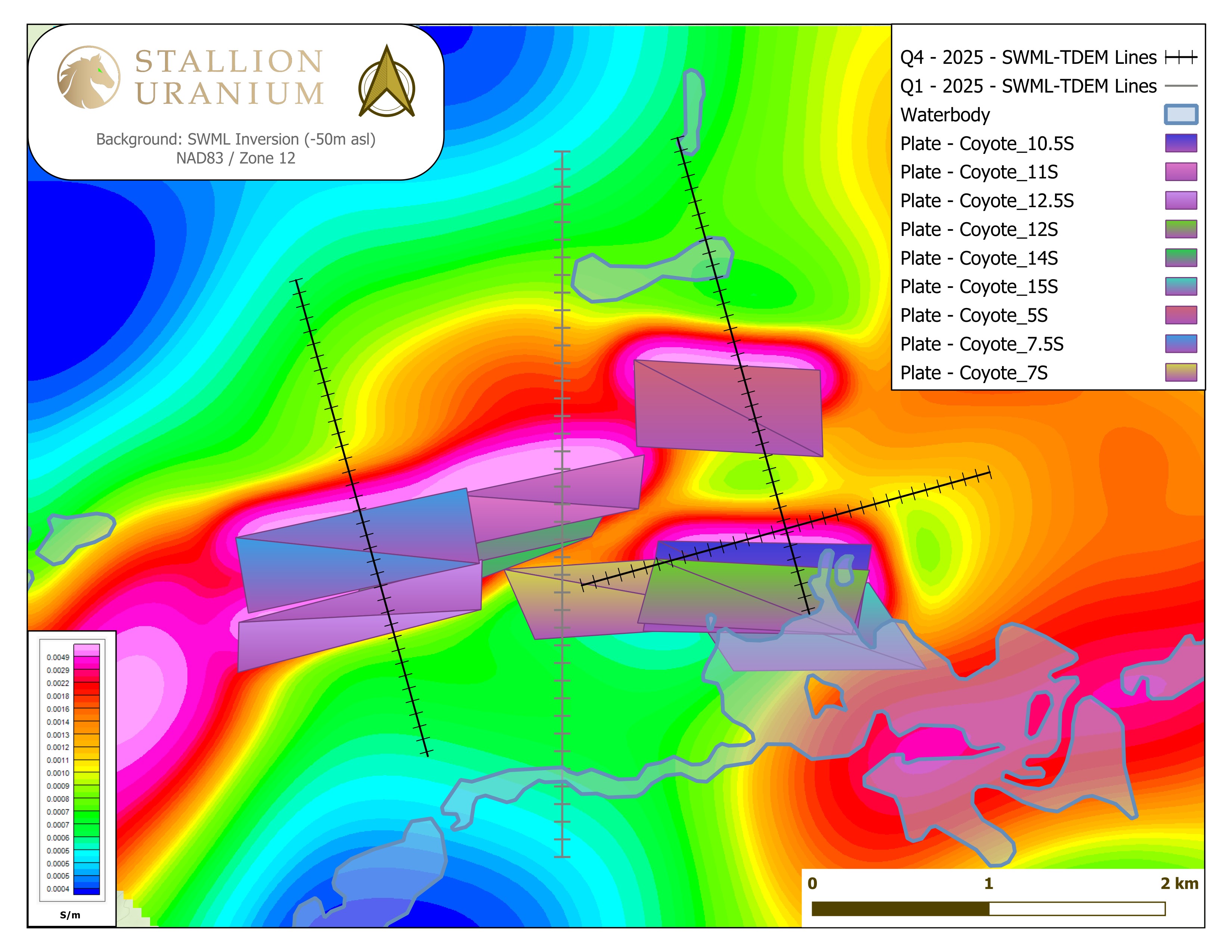
Core Viewpoint - Stallion Uranium Corp. has successfully completed a ground-based Step-Wise Moving Loop (SWML) Time-Domain Electromagnetic (TDEM) survey at the Coyote Target on its Moonlite Property, enhancing confidence in drill targeting for uranium exploration in the Athabasca Basin [1][2]. Survey Completion - The SWML TDEM survey was conducted by Abitibi Geophysics and has defined multiple high-quality conductors at the Coyote Target, with nine conductors identified, seven of which exhibit strong conductance levels [1][2][3]. - The survey significantly extends the existing electromagnetic grid, improving coverage and resolution across the Coyote Target area [3]. Conductor Identification - Nine discrete electromagnetic conductors were identified, including six strong conductors with conductance values exceeding 10 Siemens, which are significant for basement-hosted uranium exploration [5][6]. - The conductors are interpreted to be structurally controlled, with significant lateral and vertical offsets indicating faulting and structural disruption [3][5]. Structural Insights - The complexity of the conductor network occurs within a broader gravity-low anomaly, suggesting enhanced structural disruption favorable for uranium deposition [3][8]. - Electromagnetic modeling has provided improved constraints on conductor geometry, depth, and orientation, which will aid in precise drill collar placement [3][9]. Future Exploration Plans - Stallion Uranium has mobilized an airborne VTEM survey over its Stone Island Target, marking the first geophysical survey conducted on the Moonlite Project since the claims were staked [16][17]. - The VTEM survey aims to identify electromagnetic conductors and structural features beneath the Athabasca sandstone cover, which may be associated with uranium mineralization [17][18].
Nexus Uranium Announces Public Hearing Date for Chord Exploration Permit
TMX Newsfile· 2026-01-12 11:00
Core Viewpoint - Nexus Uranium Corp. has scheduled a public hearing for its Chord uranium exploration permit application, marking a significant milestone in the state permitting process [1][4]. Group 1: Company Progress - The public hearing before the Board of Minerals and Environment is set for March 18-20, 2026, representing the final step in obtaining the exploration drill permit for the Chord project [2]. - The permitting effort began in March 2024 with the submission of the Exploration Notice of Intent to the South Dakota Department of Agriculture & Natural Resources [2]. - The company has collaborated with various inter-governmental agencies, addressing all concerns and completing comprehensive environmental, wildlife, and archaeological studies [3]. Group 2: Company Statements - The CEO of Nexus Uranium expressed pride in the relationships built with state agencies and the high standards maintained throughout the permitting process [4]. - The company looks forward to presenting its application and advancing the Chord project towards a spring/summer drill program [4]. Group 3: Company Overview - Nexus Uranium is a Canadian exploration company focused on uranium projects in North America, holding projects in South Dakota and Wyoming, as well as in Saskatchewan, Canada [6].

Do You Own Energy Fuels Inc. Stock? Take a Look at This Stock Instead.
The Motley Fool· 2026-01-11 15:32
Industry Overview - Nuclear energy is experiencing a renaissance, with over 70 gigawatts of new capacity under construction globally, and the U.S. plans to triple its nuclear energy production by mid-century [1] - Energy Fuels Inc. is the largest uranium producer in the U.S., having produced two-thirds of the country's uranium since 2017 [2][3] Company Performance - Energy Fuels' shares increased by 183% last year, but its production was only 158,400 pounds of uranium in 2024, significantly lower than competitors [2][7] - The company reported $38.82 million in revenue for the first nine months of 2025, a 1.6% increase from the same period in 2024 [8] Comparison with Competitors - Cameco, the world's second-largest uranium producer, produced 27 million pounds of uranium in 2024 and reported $2.28 billion in revenue for the first nine months of 2025, a 17% increase year-over-year [4][8] - Over the past five years, Cameco has returned 600%, compared to Energy Fuels' 350%, indicating stronger long-term performance [6][7] Strategic Positioning - Cameco has a stronger balance sheet and is profitable, while Energy Fuels is not [8] - Cameco's side business is more focused, including a 49% stake in Westinghouse, which produces advanced nuclear reactors [8][9]


Jaguar Uranium(JAGU) - Prospectus(update)
2026-01-09 20:25
As filed with the Securities and Exchange Commission on January 9, 2026. Registration No. 333-292006 UNITED STATES SECURITIES AND EXCHANGE COMMISSION Washington, D.C. 20549 AMENDMENT NO. 1 TO FORM S-1 REGISTRATION STATEMENT UNDER THE SECURITIES ACT OF 1933 _____________________________________ JAGUAR URANIUM CORP. (Exact name of registrant as specified in its charter) _____________________________________ | British Columbia | 1000 | Not applicable | | --- | --- | --- | | (State or other jurisdiction of | (P ...
Canaccord Hikes Denison Mines (DNN) PT to C$5 on Phoenix Project Construction Readiness, Strategic Expansion
Yahoo Finance· 2026-01-08 14:12
Core Insights - Denison Mines Corp. is gaining attention from hedge funds, with Canaccord raising its price target to C$5 from C$4.40 while maintaining a Speculative Buy rating [1] Group 1: Strategic Partnerships and Transactions - Denison Mines successfully closed a transaction with Skyharbour Resources, forming four exploration joint ventures (JVs) using claims from Skyharbour's Russell Lake Uranium Project, adjacent to Denison's Wheeler River Project [2] - The partnership leverages the technical expertise of both companies, with Denison acting as the operator for Wheeler River Inliers (70% ownership) and Wheeler North (49% ownership) JVs, while Skyharbour leads operations for Getty East (30% Denison interest) and Russell Lake/RL (20% Denison interest) JVs [3] Group 2: Regulatory and Operational Milestones - Denison's expansion aligns with significant regulatory milestones, including the approval of the Environmental Assessment for the Phoenix deposit by the Province of Saskatchewan in July 2025, and the conclusion of public hearings by the Canadian Nuclear Safety Commission for federal approval and construction licenses in December 2025 [4] - Denison holds a 22.5% interest in the McClean Lake JV, which commenced mining at the McClean North deposit in July 2025 using the innovative SABRE mining method [4] Group 3: Investment Potential - Denison Mines focuses on acquiring, exploring, and developing uranium-bearing properties in Canada, although there are opinions suggesting that certain AI stocks may offer greater upside potential with less downside risk [5]

Skyharbour Announces Additional Uranium Property Staking Increasing Total Portfolio to Over 662,000 Hectares in the Athabasca Basin, Saskatchewan
Globenewswire· 2026-01-08 13:00
Core Insights - Skyharbour Resources Ltd. has acquired forty new uranium exploration claims in Northern Saskatchewan, increasing its total land package to 662,887 hectares across 43 projects, with a focus on the Athabasca Basin, known for high-grade uranium deposits [1][37] - The newly staked claims will be part of the Company's prospect generator business, aimed at attracting strategic partners to advance these assets [1] Summary of New Claims - The Carter North Project consists of ten mineral claims totaling 36,393 hectares, located adjacent to Cameco's North Williams Project and covering extensions of significant conductive corridors [3][6] - The Rover Project includes a single claim of approximately 793 hectares, situated near Cameco's McArthur River and Cigar Lake Mines, with historical exploration dating back to the late 1960s [9][11] - The East Dufferin Project comprises a single claim of 1,451 hectares, located south of the Athabasca Basin, with historical exploration identifying increased conductivity and magnetic activity [12][14] - The Brustad Project consists of one claim totaling 791 hectares, located near the southern margin of the Athabasca Basin, with historical exploration including various geophysical surveys [15][17] - The 914 and Elevator Projects now cover a total of 13,785 hectares, with extensive historical exploration indicating potential for uranium mineralization [18][20] - The Pendleton Project includes four claims totaling 5,338 hectares, located along the Needle Falls Shear Zone, with historical exploration suggesting potential for uranium deposits [21][22] - The Yurchison Project has been expanded to 35,029 hectares, consolidating previous properties and showing potential for uranium and other mineralization [24][27] - The Tarku Project consists of three claims totaling 8,262 hectares, adjacent to the South Dufferin Project, with historical exploration indicating strong potential for uranium mineralization [28][30] - The South Dufferin Project has been expanded to 39,398 hectares, with ongoing exploration efforts indicating readiness for further drilling [31][34]
Denison Announces Grid Power Available at Future Phoenix Uranium Mine Site Following Completion of SaskPower Transmission Line
Prnewswire· 2026-01-08 11:30
Core Viewpoint - Denison Mines Corp. has achieved a significant milestone with the installation of a new 138kV transmission line, providing grid power supply to the future Phoenix in-situ recovery uranium mine, which is crucial for the project's construction and operation [1][2][3] Group 1: Project Development - The availability of grid power at the Phoenix site is a major step in de-risking the project, as it supports the establishment of the freeze wall around the initial mining area [1][3] - The new transmission line is approximately 6 kilometers long and connects the Phoenix site to the existing grid, enhancing the project's infrastructure [2][4] - Denison has secured access to up to 8.8 MW of power from SaskPower under a power supply agreement, committing to purchase a minimum amount of power for five years [4] Group 2: Construction and Infrastructure - The electrification of the Phoenix site will now only require the installation of on-site electrical distribution infrastructure, which includes long-lead items that are on schedule for delivery [3] - The commencement of construction activities is contingent upon receiving final regulatory approvals and a final investment decision by Denison [5] Group 3: Company Background - Denison is a leading uranium mining, development, and exploration company with a 90% interest in the Wheeler River Project, which hosts high-grade uranium deposits [7] - The Wheeler River Project is the largest undeveloped uranium project in the eastern Athabasca Basin, with permitting efforts for the planned Phoenix ISR operation having started in 2019 [5][6] - Denison also holds interests in various uranium project joint ventures in Canada, enhancing its position in the uranium market [8]

Homeland Continues to Extend Near-Surface Anomalous Radioactivity at Coyote Basin Uranium Project
TMX Newsfile· 2026-01-08 09:00
Core Viewpoint - Homeland Uranium Corp. is advancing its Phase II exploration drilling program at the Coyote Basin Uranium Project, confirming the presence of elevated radioactivity over a significant area and indicating potential for further expansion [1][2]. Drilling Progress - Eight additional Reverse Circulation (RC) drillholes (CB-RC-0035 to CB-RC-0042) have been completed, with approximately 3,400 m (11,155 ft) of the planned 5,300 m (17,388 ft) drilled, representing about 64% completion of the Phase II program [2]. - The recent drillholes were strategically placed to evaluate the lateral extent of anomalous radioactivity, confirming continuity of elevated radioactivity in the area [3][5]. Geological Findings - Elevated radioactivity has been detected at shallow depths, typically between 50 and 100 m (164-328 ft) below the surface, associated with specific rock types such as shales, claystones, and fine-grained sandstones [4]. - The presence of an extensive anomalous horizon has been suggested by the results from the southernmost drillholes, indicating that the anomalous zone may extend further south [5]. Future Plans and Analysis - The company is focused on systematically expanding the footprint of the uranium mineralization while conducting geochemical analyses to better characterize the mineralization [6]. - Geochemical samples from the drillholes have been sent to SGS Laboratories for analysis, with results to be reported once compiled and reviewed [6][12]. Quality Control Measures - All drillholes are logged using a calibrated QL40 SGR Spectral Gamma Ray probe, ensuring accurate measurement of natural radioactivity [8]. - Discrepancies between spectral gamma readings and other testing methods have been noted, necessitating further geochemical and assay sampling to accurately determine uranium grades [11].