生物识别

Search documents
熵基科技(301330) - 301330熵基科技投资者关系管理信息20250828
2025-08-28 12:54
Financial Performance - In the first half of 2025, the company achieved a consolidated revenue of 9,323.56 million yuan, a year-on-year increase of 9.29% [2] - The net profit attributable to shareholders was 9,323.56 million yuan, up 18.56% year-on-year [2] - The net profit excluding non-recurring gains and losses was 8,443.09 million yuan, reflecting a growth of 25.69% [2] - Overseas business revenue reached 7.04 billion yuan, accounting for 75.73% of total revenue, with a growth of 12.58% compared to the same period in 2024 [2] - Domestic business revenue was 2.26 billion yuan, representing 24.27% of total revenue, with a decline of 18.88% year-on-year [2] Business Segments - The Smart Space segment generated approximately 6.86 billion yuan, making up 74.13% of total revenue [3] - The Smart Office segment earned about 1.70 billion yuan, accounting for 18.40% of total revenue, with a year-on-year growth of 30.80% [3] - The Digital Identity Authentication segment reported revenue of approximately 401.63 million yuan, representing 4.34% of total revenue, down 12.50% year-on-year [3] - The Smart Commercial segment generated around 289.41 million yuan, accounting for 3.13% of total revenue, with a growth of 17.10% [3] Cost and Profitability - Total operating expenses (excluding financial costs) for the first half of 2025 were 371 million yuan, a decrease of 0.74% year-on-year [4] - R&D expenses were 104 million yuan, down 1.50%, representing 11.20% of revenue [4] - The overall gross margin for the first half of 2025 was 51.13%, an increase of 1.64% year-on-year [4] - The gross margin for overseas sales was 57.51%, while domestic sales gross margin was 31.21%, down 1.18% year-on-year [4] Future Outlook - The company anticipates a stabilization of domestic business and continued growth in overseas markets [6] - New product launches in the second half of 2025 are expected to drive sales growth in the Smart Space segment [5] - The company is focusing on expanding its presence in key overseas markets, including North America, Europe, and Southeast Asia [7] Investor Engagement - The company addressed investor questions regarding cash flow, overseas business focus, and technological advancements in brain-computer interfaces [6][7][8] - The operating cash flow for the first half of 2025 improved significantly due to adjustments in payment structures [6] - The company is exploring the integration of brain-computer interface technology with robotics for applications in rehabilitation and elderly care [8]

熵基科技上半年实现营收9.29亿元,净利润同比增长18.56%
Ju Chao Zi Xun· 2025-08-27 03:09
Financial Performance - In the first half of 2025, the company's revenue reached 929,258,759.5 yuan, representing a year-on-year increase of 2.9% [2][3] - The net profit attributable to shareholders was 93,235,556.28 yuan, up 18.56% compared to the same period last year [2][3] - The net profit after deducting non-recurring gains and losses was 84,430,913.49 yuan, reflecting a growth of 25.69% year-on-year [2][3] - The net cash flow from operating activities was 169,183,153.56 yuan, a significant increase of 153.91% [3] - Basic earnings per share were 0.3999 yuan, an increase of 18.10% [3] - Total assets amounted to 4,212,927,418.94 yuan, up 4.94% year-on-year [3] Technological Advancements - The company holds multiple core technologies in the field of biometric recognition, covering various modalities such as fingerprint, palm, face, iris, and finger vein [2] - The company has developed a multi-modal fusion recognition technology that enhances accuracy and security by combining various biometric features [2] - Significant breakthroughs in liveness detection technology have been achieved, effectively preventing spoofing attacks using photos, videos, or masks [2] Product Development - The focus areas include palm and facial recognition technologies, enabling convenient identity verification across diverse mobile devices and platforms [4] - The company has introduced cross-platform interoperability for palm and facial recognition, supporting various operating systems including Harmony, Android, and iOS [4] - A standardized format and cross-platform protocol have been adopted to ensure secure transmission of feature templates, protecting user privacy [4] Strategic Positioning - The company has evolved from a single biometric technology pioneer to a leader in multi-modal BioCV and AI cognitive technologies [5] - By integrating computer vision with biometric recognition, the company aims to enhance user interaction and service provision [5] - The company is committed to exploring the value of human-scene interaction and empowerment through innovative practices [5]


熵基科技(301330) - 301330熵基科技投资者关系管理信息20250625
2025-06-25 11:16
Group 1: Company Overview and Business Strategy - The company aims to enhance market competitiveness through AI technology and brand influence, targeting revenue growth aligned with high equity incentive goals [2] - Focus on optimizing product and business structure, controlling costs, and improving operational efficiency to achieve performance growth [2] Group 2: Brain-Machine Interface (BMI) Technology - The company is exploring non-invasive BMI technology, particularly in the fields of elderly care, healthcare, and education [2][4] - Utilizes multi-modal data fusion technology ("EEG + EOG + EMG") to overcome precision limitations of traditional single-modal devices [2] Group 3: Applications in Education - Launching non-invasive brain-computer interface products aimed at enhancing focus among youth through interactive games and real-time EEG signal collection [3] Group 4: Partnerships and Collaborations - Established a long-term partnership with Workday to provide payroll calculation services for various sectors, enhancing operational efficiency for clients [5] Group 5: Mergers and Acquisitions - Ongoing audit of financial indicators related to the acquisition of "Longzhiyuan," with expectations of synergistic effects in product, technology, and market resources [6] Group 6: Ralvie AI Business Model - Ralvie AI focuses on work management and operational efficiency, quantifying employee work time and efficiency as a basis for performance evaluation [7] Group 7: Mars Wisdom Solutions - Mars Wisdom leverages advanced AI technologies to address semantic understanding, visual analysis, and data retrieval challenges, integrating with existing business platforms for enhanced service delivery [8] Group 8: Investor Relations Activity - The investor relations activity did not involve any undisclosed significant information [9]
研判2025!中国超声波指纹识别模组行业产业链、市场规模及重点企业分析:技术破局驱动市场下沉,产业链协同催生场景革命[图]
Chan Ye Xin Xi Wang· 2025-05-28 01:31
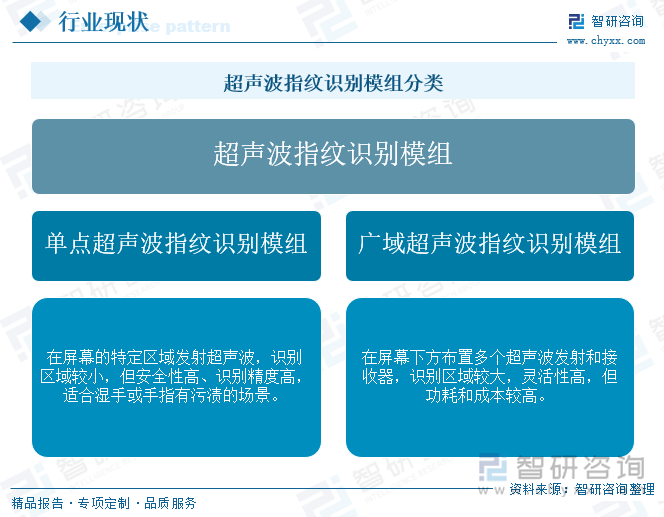
Core Insights - The domestic ultrasonic fingerprint recognition module industry has rapidly penetrated from high-end markets to mass consumer sectors due to core technological breakthroughs and significant reductions in manufacturing costs, with a projected market size of approximately 2.697 billion yuan in 2024 [1][13] - The industry has seen a collaborative innovation across the supply chain, with domestic manufacturers upgrading piezoelectric materials from traditional lead zirconate titanate (PZT) to environmentally friendly aluminum nitride (AlN), and innovating with CMOS Sensor architecture, reducing module thickness to 0.15mm and production costs from $20 in 2021 to $12, a decrease of over 40% [1][13] - The application scenarios for ultrasonic fingerprint recognition modules have expanded explosively due to the dual drivers of cost reduction and performance enhancement [1][13] Industry Overview - Ultrasonic fingerprint recognition modules utilize ultrasonic waves to penetrate materials and identify fingerprints based on reflected signals, forming a 3D image for high precision and security [2] - The modules can be categorized into single-point and wide-area ultrasonic fingerprint recognition modules based on the recognition area size [2] Industry Development History - The industry has undergone four main stages: the embryonic phase before 2015, initial application from 2016 to 2020, rapid expansion from 2021 to 2023, and diversification of applications from 2024 onwards [4][5][6] - The initial phase saw limited commercial application due to sensor size and cost constraints, while the introduction of Qualcomm's SenseID in 2015 marked a significant technological advancement [4] - From 2021 to 2023, the industry experienced rapid growth, with domestic ultrasonic fingerprint recognition module shipments exceeding 120 million units in 2023, a year-on-year increase of 150% and a market penetration rate of 25% [5] Industry Supply Chain - The upstream of the ultrasonic fingerprint recognition module industry includes raw materials and production equipment, while the midstream involves the manufacturing of the modules, and the downstream encompasses applications in consumer electronics, automotive electronics, smart home, industrial manufacturing, and healthcare [8] Market Size - The global development of ultrasonic under-display fingerprint recognition technology has progressed slowly, with Qualcomm being an early player in the field [12] - The domestic ultrasonic fingerprint recognition technology has made significant strides, with companies like Goodix breaking Qualcomm's technological monopoly [12] Key Companies' Performance - The market remains in a blue ocean stage, with Qualcomm and Goodix holding over 90% market share, with Goodix leveraging its advantages in optical under-display fingerprint recognition and cost-effective domestic products [15] - Goodix's revenue from fingerprint recognition chips reached 1.679 billion yuan in 2024, with a market share exceeding 40% [16] - O-film Technology, a leader in optical and biometric recognition, has also made significant contributions to the industry, with a revenue of 4.882 billion yuan in Q1 2025 [18] Industry Development Trends - The technology iteration is accelerating, with a focus on precision improvement and scene penetration, aiming for 100% screen area recognition by 2025 [20] - Leading companies are integrating the entire supply chain from chips to algorithms to modules, enhancing competitive advantages [21] - The domestic market is driven by policies and market demand, with expectations for smartphone shipments to reach 320 million units by 2025, and ultrasonic fingerprint penetration rates to exceed 35% [23]