
Trucking

Search documents
Should Investors Hold Old Dominion Stock Despite Its Higher Valuation?
ZACKS· 2025-12-12 16:40
Core Insights - Old Dominion Freight Line, Inc. (ODFL) is currently viewed as unattractive from a valuation perspective, with a forward 12-month price-to-sales ratio (P/S-F12M) of 5.62X compared to the industry average of 2.05X [1] Financial Performance - ODFL has a Value Score of D, indicating potential concerns regarding its investment attractiveness [3] - The company's operating ratio has deteriorated from 72% in 2023 to 73.4% in 2024, despite efforts to cut costs [4] - ODFL's stock has declined by 8.6% year-to-date, which is worse than the transportation-truck industry's decline of 4.9% [6] Industry Challenges - The trucking industry is facing a persistent driver shortage, complicating recruitment as older drivers retire [5] - Macroeconomic factors are contributing to a challenging freight environment, with reduced demand leading to low shipment volumes and rates [4] Shareholder Initiatives - ODFL maintains a solid balance sheet, ending Q3 2025 with cash and equivalents of $46.59 million against a current debt level of $20 million [12] - The company has been active in rewarding shareholders, paying dividends of $175.1 million and repurchasing shares worth $453.6 million in 2023, with further increases in 2024 and 2025 [16][17] Pricing Strategy - ODFL's disciplined pricing approach has allowed it to retain customers, with LTL revenue per hundredweight improving by 2.4% in 2024 and 3.4% year-over-year in the first nine months of 2025 [11] Investment Outlook - Despite current challenges, it is advised that investors hold onto ODFL stock due to its strong balance sheet and shareholder-friendly initiatives [19] - The recommendation is to wait for a better entry point for new investors, while existing shareholders are encouraged to stay invested [20]



Trucking capacity tightens as enforcement ramps up
CNBC Television· 2025-12-12 15:57
Driver Capacity & Regulations - The Department of Transportation (DOT) has taken 9,500 truck drivers, representing approximately 1% of US truckers, off the road due to failing English proficiency tests [1] - The DOT is investigating truck driving schools, having removed 3,000 schools from its training registry and put another 4,500 on notice for non-compliance [2] Market Impact & Rates - Bank of America suggests that reducing driver capacity by 1% to 2% could significantly impact rates [2] - The American Trucking Association believes capacity tightening with demand will be extraordinary for the industry [3] - Trucking rates show a 5% year-over-year increase, potentially signaling a recovery from a three-year freight recession [4] Industry Outlook - Industry anticipates that the Secretary's focus on cleaning up the industry will be a significant driver, making roads safer and the industry more competitive and profitable [3]

RXO’s Curve report projects lackluster Q4, improvement in 2026
Yahoo Finance· 2025-12-12 09:39
Group 1 - The article discusses the impact of shifting U.S. trade and tariff policies, non-domiciled CDL enforcement, and changes to English language proficiency enforcement on market pressure in the trucking industry [3] - Demand is highlighted as a critical factor, with American Trucking Associations Chief Economist Bob Costello suggesting that supply-side disruptions could lead to fundamental market changes, while Michigan State University Professor Jason Miller emphasizes the importance of demand [4] - Manufacturing output remains significantly weak compared to the 2007 peak, with a decline of nearly 7.8% in industrial production output and a 15.6% decline when excluding hi-tech goods [5] Group 2 - The Manufacturing Purchasing Manager's Index (PMI) showed fluctuations, with new orders contracting for three consecutive months as of November, although primary metals experienced growth [7] - The Federal Reserve's recent decision to reduce the federal funds rate by a quarter percentage point aims to support sluggish manufacturing, indicating moderate economic improvement but heightened uncertainty [8] - Truckload volumes are expected to remain muted in Q4, with a potential meaningful shift anticipated in 2026, despite October and November showing year-over-year performance improvements [9]
Jim Cramer names stocks to buy in the wake of the Fed's rate cut
CNBC· 2025-12-10 23:29
Economic Environment - The Federal Reserve cut the benchmark borrowing rate by 25 basis points, indicating a continued easing mode which is favorable for stock purchases [1] - The decision to cut rates was met with mixed opinions among Fed members, with concerns about inflation versus the need to support the job market [1] Market Performance - Major stock indices rose following the rate cut, with the Dow Jones Industrial Average increasing by 1.05%, the S&P 500 by 0.67%, and the Nasdaq Composite by 0.33% [2] Recommended Stocks - Homebuilders and related retailers are expected to benefit from lower rates, with Toll Brothers and Home Depot highlighted as solid buys [3] - Transportation companies such as J.B. Hunt and FedEx are recommended, particularly with the holiday season approaching [3] - Union Pacific and Norfolk Southern are noted for their potential merger benefits, while industrials like Caterpillar and Cummins are also expected to gain from lower rates [3] High-Value Stocks - Expensive stocks that are already performing well may continue to thrive, with Palantir mentioned due to a recent contract with the U.S. Navy [4] - The market is expected to remain bullish towards these companies as the year ends [4]

Laredo carrier Texas International Enterprises files for Chapter 11
Yahoo Finance· 2025-12-10 21:02
Laredo-based cross-border trucking company Texas International Enterprises Inc. filed for Chapter 11 bankruptcy protection on Saturday, reporting between $10 million and $50 million in both assets and liabilities. The carrier estimates it has more than 200 creditors, and classifies itself as a corporation engaged in interstate freight operations, according to the petition. The company said that “after any administrative expenses are paid, no funds will be available for distribution to unsecured creditors. ...
X @Bloomberg
Bloomberg· 2025-12-10 15:26
Dozens of trucks lined up next to Lithuania’s parliament building on Wednesday in a protest calling on the government to help companies recover thousands of vehicles being held by neighboring Belarus https://t.co/RVWuUQb7Wm ...
X @Bloomberg
Bloomberg· 2025-12-10 12:03
License limitations and English-language tests are upending a critical pillar of the US economy: the trucking industry https://t.co/2Wtq7VgOIy ...
Morgan Stanley sees supply-side ‘spark’ for trucking in 2026
Yahoo Finance· 2025-12-08 18:53
Core Viewpoint - Morgan Stanley indicates that the trucking industry's supply side is providing the necessary "spark" for a potential recovery in 2026, but emphasizes that improved demand is essential to sustain this recovery [1] Supply-Side Dynamics - The investment firm notes that previous trucking upcycles were initiated by supply-side catalysts, with examples including the polar vortex in 2014, electronic logging device mandates in 2018, and the impacts of Covid-19 in 2020 [1] - Heightened regulatory enforcement on the driver pool, including English-language proficiency requirements and restrictions on non-domiciled CDL, could eliminate over 5% of industry capacity, which may serve as a catalyst for the industry already facing capacity purges due to high operating costs and low rates [2] Demand Outlook - The 2026 outlook report suggests that while supply tightening from new driver regulations is sustainable, demand must also improve to support rate increases [3] - A proprietary survey indicates a potential restocking trend, with the percentage of shippers planning to increase inventories rising from 9% to 23%, although only 8% plan to build inventories for the full year of 2026 [4] Rate Projections - The base case for 2026 anticipates a mid-single-digit increase in truckload contract rates, with a more optimistic scenario projecting high-single- to low-double-digit increases if demand aligns favorably [6] - Carrier margins have been declining for three years due to operating costs outpacing rate increases, and while expense-reduction initiatives have been implemented, a real recovery in rates and margins may take additional time as demand remains uncertain [7]
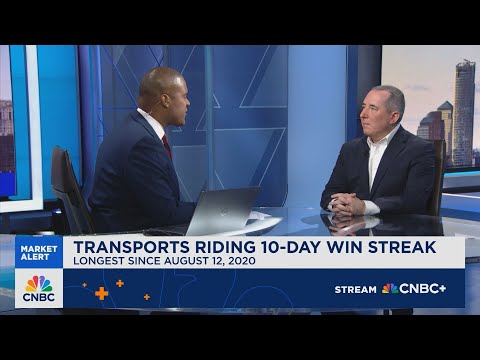
Hoexter: One to two percent fewer drivers can push spot pricing higher
CNBC Television· 2025-12-08 12:33
longest win streak since August of 2020. You all remember that was the pandemic. We were out, you know, toilet paper, everything was kind of flying around and transports really took off.What situation are we seeing right now that would lead to that same kind of a streak. So, it's not the demand side. The demand side hasn't kicked in yet.When we came out of CO, it was stuff. We all wanted stuff, more things. Right now, we're not seeing things move. We're actually seeing capacity start to come out.So, we're f ...
CRST reorganization leads to hundreds of job cuts
Yahoo Finance· 2025-12-08 10:45
Core Insights - CRST plans to redeploy a portion of its Capacity Solutions OTR fleet, resulting in job cuts and a reduction of its fleet by 200 trucks [1][2] - The decision aims to enhance customer service through solutions that provide value, reliability, and long-term stability [2] - The company will reduce its workforce by over 300 employees, primarily affecting drivers, with a 60-day notice provided to impacted workers [2][3] Fleet and Employment Changes - CRST will shift 100 trucks to other parts of its business, while approximately 200 trucks will be removed from its fleet of 4,300, which is less than 4% of its logistics portfolio [3] - The company is committed to assisting displaced drivers in finding other driving opportunities within the carrier [3] Financial Performance - Despite weak freight conditions, CRST reported its most successful quarter since 2022, indicating long-term stability and ongoing investment in personnel and customers [4] - The company emphasizes its 70-year commitment to evolving with customer needs and industry changes [4]