Livestock
Search documents
X @Bloomberg
Bloomberg· 2025-10-17 05:18
Somalia’s livestock exports are receiving a boost from fading Australian and Sudanese competition, which could help drive its shipments above $1 billion this year https://t.co/PnhhaBf0lr ...
X @Bloomberg
Bloomberg· 2025-10-13 11:54
New Zealand watered down its 2050 target for methane emissions from livestock and farming activities. Read more in today's Green Daily https://t.co/LXvxaD3LoB ...
'Who Gave A 20-Year-Old A $100,000 Cow Loan?' Dave Ramsey Is In Disbelief That A Lender Would Give Out That Much Money
Yahoo Finance· 2025-10-04 01:00
Core Insights - A 20-year-old secured a $100,000 loan to purchase cattle, raising concerns about the decision-making process behind such a loan [1][2] - The young borrower has experience in the cattle business, having worked alongside his father for 10 years, which adds context to the loan [2] - The loan was secured against a $100,000 certificate of deposit (CD), indicating a level of financial backing [3] Financial Analysis - The decision to borrow against the CD rather than using the funds directly for purchasing cattle was criticized, as loans typically carry higher interest rates than CDs [4] - The caller's confidence in the beef market's stability over the next two years was viewed as overly optimistic and compared to gambling, highlighting the unpredictability of commodity prices [4][5] - Ramsey emphasized the importance of understanding supply and demand dynamics in the cattle market, noting that an oversupply could lead to lower beef prices, while high demand with fewer cattle could increase prices [5]
Grain Market Update: Weighing the Impact of the US President's Social Media Post About Soybean Purchases
Yahoo Finance· 2025-10-02 20:47
Core Insights - The U.S. is not expected to become China's main supplier of soybeans, as China is currently seeking to fill its needs with U.S. soybeans until Brazil's next harvest [1] - The National Soybean Index reached its lowest monthly close at the end of September since August 2020, indicating ample supplies relative to demand [2] - The government shutdown has led to a lack of reporting from the USDA, creating uncertainty in the market and allowing China to potentially buy soybeans under the radar, similar to actions taken in 2018 [5][7] Market Trends - The agricultural markets are experiencing a quiet period, with livestock futures showing significant losses [4] - Basis is weak for both corn and soybeans due to increased supplies during harvest time, with producers selling soybeans while holding corn [8][12] - The cash cattle market is seeing pressure, with cutout values dropping significantly, indicating a potential shift in investor interest towards markets with a more bullish supply and demand outlook [16][18] External Factors - Gold prices are reaching record highs, driven by concerns over inflation and a growing lack of confidence in the U.S. economy, as central banks continue to buy gold as a safe haven [13][14] - The ongoing government shutdown is contributing to market uncertainty, impacting investor sentiment and trading behavior [15]
FAQ Friday
Yahoo Finance· 2025-09-26 12:26
Group 1: Boxed Beef Market - Boxed beef prices reported by USDA have been declining, with choice beef down nearly $40 and select beef off more than $30 since September 5, despite high retail prices [1] - The average cash price for cattle in the southern US has held near $240, recently slipping to $237, while the nearby October futures contract is priced at $232, indicating a bullish basis of $5 over [2] Group 2: Inflation and Trade Policy - Inflation remains a significant issue in the US, influenced by trade policy, regardless of government reassurances [4] - The soybean industry is not significantly affected by Argentina's export tax changes, as the demand for US soybeans remains stable despite claims of necessity from some industry members [6] Group 3: Federal Reserve and Market Reactions - Following a 25-basis point rate cut by the Federal Reserve, the US dollar index initially fell to 96.22 but closed higher, indicating market volatility in response to monetary policy [8] - Fed Chairman Powell's comments on inflation and job concerns were not surprising to the market, suggesting a cautious approach is expected [9] Group 4: Tyson Foods and Corn Market - Tyson Foods announced it would stop using high fructose corn syrup in its products, which is not expected to collapse demand for US corn, as indicated by the bullish May-July futures spread [10] - The May 2026 corn futures contract is priced near $4.5075, showing a similar market structure to the previous year when funds built a net-long position [11]
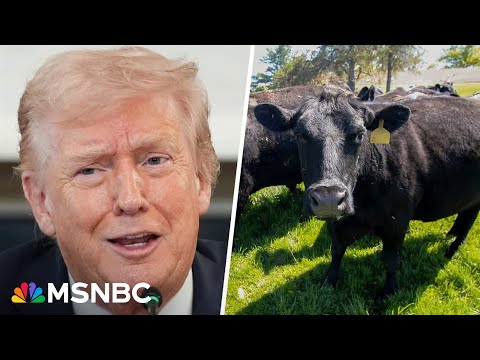
Three Reasons US Cattle Markets are a Conundrum
Yahoo Finance· 2025-09-23 16:16
Group 1: Boxed Beef Market Trends - The US boxed beef prices have been declining significantly since the president's announcement to lower beef prices, with choice prices dropping from a record high of $416.01 to $381.39 and select prices from $390.00 to $362.09 [1] - The USDA reported daily boxed beef prices, which some speculate may be intentionally reported lower despite actual market conditions [5] Group 2: Cattle Futures Market Dynamics - Cash feeder indexes have shown an increase, with back-month feeders closing $9.25 higher, leading to expanded daily limits for futures [2] - The Live Cattle Cash Index has seen a rise from $92.00 in July 2020 to a recent high of $242.00, although it has slipped to $240.00 recently [7] - The National Feeder Cattle Index increased from $114.23 to $367.03, but has recently decreased to $358.78 [7] Group 3: Supply and Demand Factors - The US cattle supply is not in an expansion phase, leading to a situation where demand continues to outpace available supplies, indicating a potential equilibrium price issue [8] - The investment industry has recognized changes in supply and demand, with noncommercial interests increasing their long futures positions from 67,700 contracts in June 2020 to 202,150 contracts by January [9] Group 4: Market Sentiment and Future Outlook - Recent reports indicate that funds have reduced their net-long futures position to 101,726 contracts, suggesting a potential loss of interest from long-term investors in the cattle market [10] - There is speculation that long-term investors may be considering reallocating funds to other markets, such as corn, based on favorable longer-term fundamentals [4][10]
全球大宗商品_是时候重新审视波动率套利策略了,最严重的关税和地缘政治冲击可能已过去Global Commodities_ Time to revisit volatility carry strategies with the worst tariff and geopolitical shocks possibly behind us
2025-09-23 02:34
Summary of Key Points from the Conference Call Industry Overview - The focus is on **Global Commodities**, particularly the volatility carry strategies in the commodities market, as the worst tariff and geopolitical shocks are believed to be behind us [1][2][22]. Core Insights and Arguments - **Volatility Carry Strategies**: There are opportunities in commodities volatility carry QIS (Quantitative Investment Strategies) as volatility premia are expected to recover. This is attributed to a structural imbalance between volatility buying and selling in commodities compared to other asset classes [2][10]. - **Market Conditions**: The current macro backdrop is seen as favorable for volatility carry strategies, with expectations of a shift into a "Goldilocks" regime, which historically has led to better performance for commodities volatility carry strategies [5][26]. - **Performance of Strategies**: Volatility carry strategies have faced challenges in 2025 due to negative volatility premia caused by tariff and geopolitical shocks, but there is optimism for recovery as these shocks subside [4][24]. - **Specific Commodity Considerations**: - **Oil**: Brent has historically higher volatility premia than WTI due to geopolitical risks and hedging activities [31]. - **Gold**: Weekly options have shown better performance than monthly options due to increased liquidity and demand for short-term optionality [41][36]. - **Copper**: The market is expected to stabilize following tariff clarity, which should benefit volatility carry strategies [44]. Additional Important Content - **Quantitative Research Findings**: The quant research team has confirmed the continuation of a "Normal" macro regime, with potential for a shift to "Goldilocks," which is favorable for commodities volatility carry strategies [5][26]. - **Geopolitical Risks**: Ongoing geopolitical tensions, particularly in the Middle East, and US sanctions on Russian oil are noted as risks that could impact crude oil volatility [23]. - **Seasonality in Curve Carry Strategies**: Curve carry strategies have been highlighted as top performers among major commodities QIS YTD, with expectations for continued positive returns into Q4 due to strong seasonal trends [7][48]. Data and Figures - **Volatility Dashboard**: The report includes a dashboard showing the current implied and realized volatility levels across various commodities, indicating a return to positive volatility premia for most major commodities [11][19]. - **Historical Performance**: Historical data suggests that volatility carry strategies tend to perform better under stable macro conditions, with significant underperformance during periods of heightened uncertainty, such as the GFC and COVID-19 pandemic [15][24]. This summary encapsulates the key insights and data points from the conference call, providing a comprehensive overview of the current state and outlook for the commodities market and volatility carry strategies.
X @Bloomberg
Bloomberg· 2025-09-11 04:42
Supply & Pricing - China's government has convened major pig breeders to discuss production cuts [1] - The aim is to address oversupply and support price increases in the pork market [1]
Federal Agricultural Mortgage (AGM) Update / Briefing Transcript
2025-09-03 16:02
Summary of Federal Agricultural Mortgage (AGM) Update / Briefing September 03, 2025 Industry Overview - The briefing focuses on the agricultural sector, specifically the USDA's farm income and wealth statistics for 2025, highlighting the financial health of farmers and the impact of government payments on farm income [80][81]. Key Points and Arguments 1. **USDA Data Release**: The USDA's revision for farm income is a significant event, with expectations of changes in net cash farm income and government payments [33][80]. 2. **Net Cash Farm Income Forecast**: The USDA forecasted net cash farm income for 2025 at $180.7 billion, representing a downward revision of approximately 5-7% from previous estimates [98][100]. 3. **Government Payments**: There is a notable decrease in government payments, with a drop of $3 billion, which may be attributed to timing issues and changes in program qualifications [116][119]. 4. **Crop and Livestock Performance**: - Livestock revenues are expected to increase significantly, particularly in beef and dairy sectors, while crop receipts remain largely unchanged from previous forecasts [113][115]. - The overall profitability across sectors shows livestock up slightly, while crops are down, reflecting market conditions [90]. 5. **Increased Costs**: - The USDA anticipates a $30 billion increase in cash expenses for farmers, driven by higher feed costs and interest expenses [122][128]. - Feed costs are projected to rise from $62 billion to over $68 billion, indicating increased financial pressure on farmers [125]. 6. **Debt Levels**: - Total debt is expected to rise by $30 billion in 2025, with real estate debt increasing significantly, reflecting higher borrowing needs among farmers [135][136]. - The debt-to-asset ratio may begin to rise, but remains below historical levels from the 1980s, indicating a relatively stable financial environment [146]. 7. **Market Sentiment**: Farmers are experiencing a shift in sentiment as they begin to see better-than-expected crop yields, leading to a more optimistic outlook despite lower prices [57][59]. Additional Important Insights 1. **Equity and Asset Values**: The USDA revised down the total value of real estate assets by $45 billion, despite an increase in farmland values, indicating a complex market dynamic [134]. 2. **Family Living Expenses**: Family living expenses are rising and may not decrease as quickly, contributing to overall financial strain on farmers [150][151]. 3. **Regional Variations**: There are regional differences in crop performance, with some areas, like the West Coast, seeing better prices for specific crops such as almonds [156]. This summary encapsulates the critical insights from the briefing, providing a comprehensive overview of the current state of the agricultural sector as reflected in the USDA's latest data.