
Oil

Search documents
IEA agrees to release 400 million barrels of oil to address Iran war supply disruption
CNBC Television· 2026-03-11 14:45
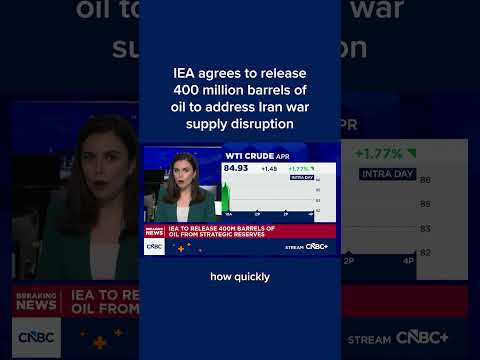
The IEA saying just now they have unanimously agreed to tap 400 million barrels of oil from their emergency reserves. This is the largest uh tapping of oil reserves in history by the 32 member uh countries. Now one important thing to note here is that we do have to see what the flow rate is going to be.The headline number here 400 million barrels the largest uh reserves tapping. But the question now turns to how quickly can those barrels get out of storage. It's not necessarily immediate.Also, we we're wait ...

X @CNN Breaking News
CNN Breaking News· 2026-03-11 14:42
IEA countries agree to the largest-ever release of oil reserves in an effort to curb rising prices caused by Middle East turmoil.https://t.co/QYqKXwC2SC ...
X @Mr hunter
GEM HUNTER 💎· 2026-03-11 14:35
RT Mr hunter (@TrueGemHunter)BIG NEWS FOR OIL 🛢️ 💥⚡ IEA MEMBERS AGREED TO RELEASE 400M BARRELS OF OIL.OIL didn't react bearish at all.This means only up for oil and this is BAD for the economy. https://t.co/qphhIEWild ...
Latest Inflation Data Is Encouraging, but Oil Clouds the Outlook
Barrons· 2026-03-11 14:33
Core Insights - February's inflation levels remained stable, with the consumer price index rising 2.4% year-over-year, matching January's pace and slightly below economists' expectations [1] - Excluding food and energy prices, inflation was measured at 2.5% year-over-year in February [1] - The ongoing war in Iran is expected to drive energy and other prices higher, overshadowing the positive inflation report [1] - Markets anticipate that the Federal Reserve will maintain steady interest rates during the upcoming March 17-18 meeting, but future monetary policy remains uncertain due to potential inflationary pressures from oil supply disruptions [1]
X @Mr hunter
GEM HUNTER 💎· 2026-03-11 14:09
BIG NEWS FOR OIL 🛢️ 💥⚡ IEA MEMBERS AGREED TO RELEASE 400M BARRELS OF OIL.OIL didn't react bearish at all.This means only up for oil and this is BAD for the economy. https://t.co/qphhIEWild ...
RockCreek Group CEO: Oil prices have been all over the place since the war started
CNBC Television· 2026-03-11 14:01
Afsaneh Mashayekhi Beschloss, Founder and CEO of RockCreek Group, says war driven energy shocks could raise inflation and volatility, warning disruptions in oil, LNG and fertilizer markets may ripple through the global economy. ...

Interior Secretary Burgum calls for IEA to release oil reserves to address supply shortage
CNBC· 2026-03-11 13:21
Core Viewpoint - The U.S. Interior Secretary Doug Burgum advocates for the International Energy Agency (IEA) to release oil stockpiles to mitigate the significant supply disruption caused by the Iran war [1][2]. Group 1: Oil Supply Disruption - The Iran war has resulted in the largest oil supply disruption in history, with tankers avoiding the critical Strait of Hormuz due to fears of attacks [3]. - Approximately 20% of global petroleum consumption passed through the Strait of Hormuz before the war, highlighting its importance for global oil exports [4]. Group 2: IEA Actions and Proposals - The IEA has proposed to release 400 million barrels of oil, marking the largest release in the organization's history [2]. - IEA member countries collectively hold about 1.2 billion barrels of oil in reserve, consisting of advanced economies in Europe, North America, and Northeast Asia [3]. Group 3: Temporary Transit Issues - Burgum emphasized that the current situation is not a global energy shortage but rather a temporary transit problem that can be resolved through military and diplomatic efforts [2]. - Releasing oil reserves at this time could alleviate pressure on global oil prices during this temporary disruption [2].
X @Bloomberg
Bloomberg· 2026-03-11 12:36
RT Bloomberg Opinion (@opinion)@JonathanJLevin @AllisonSchrager “Oil is not nearly as big a part of the US GDP as it was in the ‘70s and ‘80s, but [Iran] is still this big shock,” @foxjust says. “It’s going to create this new kind of pressure.”Watch LIVE here: https://t.co/dNJ1oR8R1L ...
CPI Inflation In Line As Rent Slows, Energy Heats Up; S&P 500 Falls
Investors· 2026-03-11 13:06
Group 1 - The consumer price index (CPI) for February rose by 0.3%, matching expectations, with the 12-month CPI inflation rate holding steady at 2.4% [1][1][1] - Shelter inflation has decreased, with primary rent rising only 0.1%, the lowest monthly gain since January 2021, and owner's equivalent rent increasing by 0.2% [1][1][1] - The core CPI, excluding food and energy prices, increased by 0.2%, maintaining a 12-month core inflation rate of 2.5%, tied for the lowest level since early 2021 [1][1][1] Group 2 - Markets are currently pricing in a minimal chance (0.7%) of a rate cut at the upcoming March 18 Federal Reserve meeting, with odds of a cut through April 29 at just 11% [1][1][1] - The S&P 500 futures fell by 0.1% early Wednesday, reflecting fluctuations in oil prices, and the index ended the previous session 2.8% below its record closing high from January 27 [1][1][1] - Economists forecast the overall CPI to rise by 0.3%, keeping the headline inflation rate at 2.4%, while core prices are expected to rise by 0.2% [1][1][1]
X @Mr hunter
GEM HUNTER 💎· 2026-03-11 12:10
Expect LARGE OIL volatility.IEA ANNOUNCEMENT IN 1HThis will decide the OIL market short term.Expecting LARGE swings.Mr hunter (@TrueGemHunter):Big day for OIL markets today, in 2 hoursIEA TO ANNOUNCE ON OIL RESERVE RELEASE AT 1PM GMTIf they release 400M barrels bearish short term, long-term if strait of Hormuz keeps being closed oil will be above $100 no matter what.No release= instant mega PUMP https://t.co/PnsvWeVPAw ...