Optics

Search documents
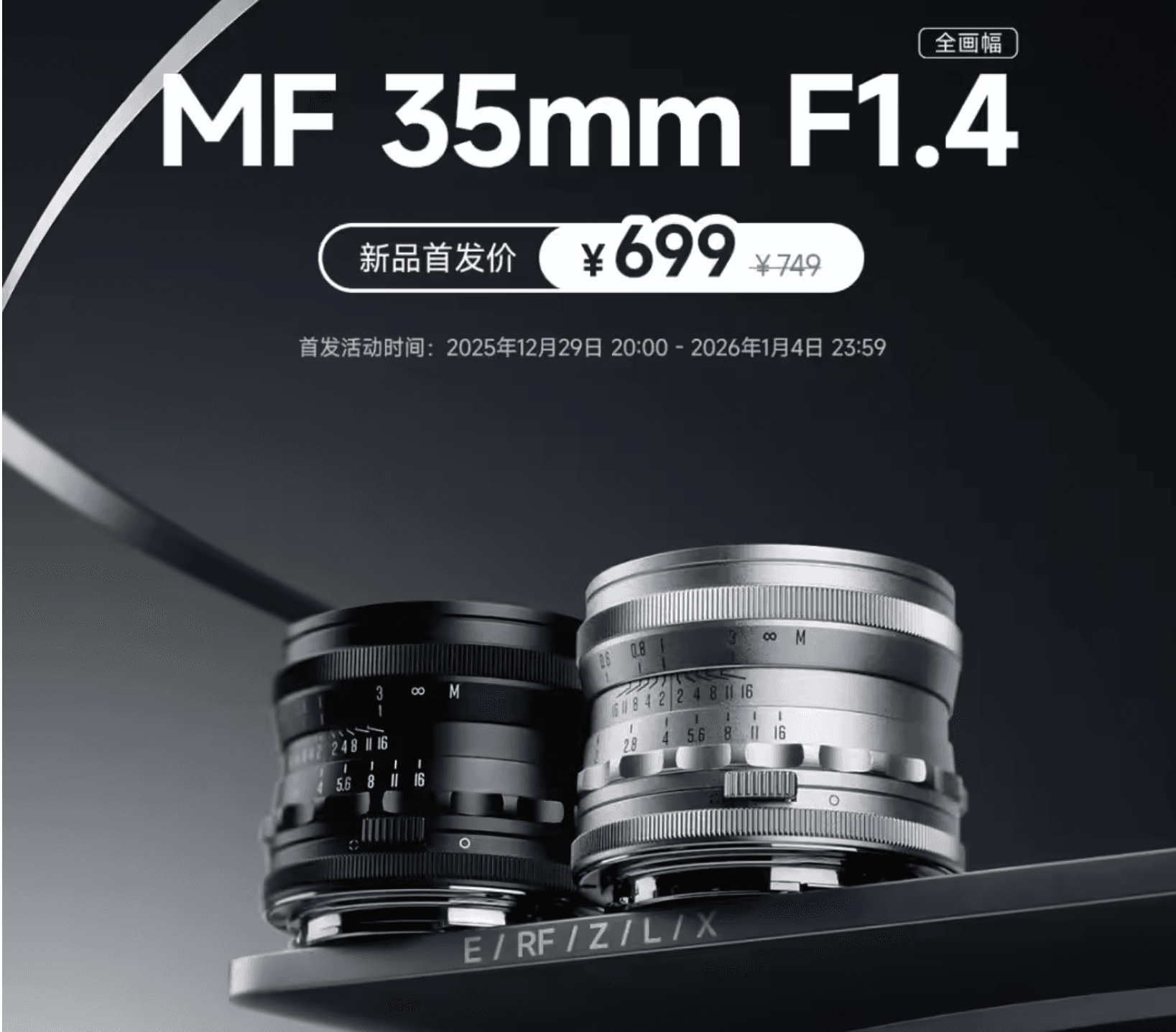
Brightinstar Launches MF 35mm F1.4 Full-Frame Manual Lens, Priced from USD 99.86
Pandaily· 2025-12-29 07:42
Core Viewpoint - Brightinstar has launched a new MF 35mm F1.4 full-frame manual focus lens, targeting photography enthusiasts with a competitive pricing strategy [1][4]. Product Features - The lens is priced at RMB 749 (approximately USD 107), with an introductory price of RMB 699 (approximately USD 99.86) [1]. - It features a full-metal body with a retro design, available in black and silver finishes, and weighs approximately 218 grams [2]. - The lens supports multiple mounts including Sony E, Nikon Z, Canon RF, Leica L, and Fujifilm X, with equivalent focal length conversion for Fujifilm APS-C cameras [2]. - It utilizes a 10-blade aperture and offers both clicked and de-clicked aperture modes, suitable for still photography and video shooting [3]. - As a fully manual lens, it lacks electronic contacts, meaning no EXIF data transmission; all adjustments are made via physical rings [3]. - The filter thread diameter is 49mm [3]. Market Positioning - By offering a large-aperture, full-frame 35mm lens at a relatively low price point, Brightinstar is positioning this product as a high-value option for photography enthusiasts seeking affordable manual lenses [4].


波长光电(301421) - 投资者关系活动记录表
2025-12-24 08:42
Group 1: Financial Performance - The semiconductor and related businesses achieved revenue of 55.4 million yuan in the first three quarters of 2025, representing an 85% year-on-year increase [2] - Revenue from semiconductor photolithography and testing services reached 17.7 million yuan, with a growth of over 110% [2] - PCB business revenue exceeded 30 million yuan, showing a growth of over 200% [2] Group 2: Business Growth Drivers - The growth in revenue is primarily driven by increased product delivery volumes from existing customers [3] - The company is focusing on high-precision optical processing and testing equipment to meet market demands in the semiconductor sector [3] - The company has initiated the installation of new high-precision equipment, with some expected to be operational by mid-2026 [3] Group 3: Future Business Prospects - The semiconductor and related businesses are strategic priorities, with plans for continued resource investment to maintain growth [4] - The laser business, while growing at a slower pace, is expected to remain stable and contribute to the company's overall performance [4] - The infrared optics business has shown recovery, driven by market demand for smaller, lighter products in various applications [5] Group 4: International Expansion - The company maintains a "domestic + international" dual-drive strategy, with a wholly-owned subsidiary in Singapore and plans for a new subsidiary in Malaysia [6] - The international business has faced revenue declines due to fluctuations in the global trade environment [6] - The Malaysian subsidiary is expected to enhance the company's international operations and create new growth opportunities [6]
宇瞳光学(300790.SZ):非球面玻璃镜片处于满产状态,应用于运动相机、车载ADAS镜头、AI眼镜等产品
Ge Long Hui· 2025-12-22 07:03
Group 1 - The company is operating at full capacity for its aspheric glass lenses, which are used in sports cameras, automotive ADAS lenses, and AI glasses [1] - The company is focusing on the AI glasses, autonomous driving, and new consumer markets, indicating a strategic direction towards emerging technologies [1] - The molded glass business is forming a new growth driver for the company, which is expected to become a new engine of growth [1] - The company plans to adjust its production capacity based on industry development and market demand [1]

弘景光电12月19日获融资买入1774.50万元,融资余额1.50亿元
Xin Lang Cai Jing· 2025-12-22 01:39
Group 1 - The core viewpoint of the news is that Hongjing Optoelectronics has shown significant trading activity and financial performance, with a notable increase in stock price and trading volume on December 19, 2023 [1] - On December 19, 2023, Hongjing Optoelectronics' stock price increased by 4.43%, with a trading volume of 159 million yuan. The net financing purchase was 3.2165 million yuan, with a total financing and securities balance of 150 million yuan [1] - The company specializes in the research, design, production, and sales of optical lenses and camera module products, with its main revenue sources being emerging consumer camera modules (56.87%), emerging consumer optical lenses (23.14%), and smart automotive optical lenses (18.16%) [1] Group 2 - As of September 30, 2023, Hongjing Optoelectronics reported a total revenue of 1.198 billion yuan, representing a year-on-year growth of 51.65%, and a net profit attributable to shareholders of 142 million yuan, with a year-on-year increase of 12.19% [2] - The number of shareholders decreased by 25.58% to 13,300, while the average circulating shares per person increased by 41.92% to 1,584 shares [2] - The company has distributed a total of 95.32 million yuan in dividends since its A-share listing [3]
元立光电完成北交所上市辅导 光学导光板龙头加速资本化进程
Ju Chao Zi Xun· 2025-12-21 02:13
Core Viewpoint - The successful completion of the listing guidance for Yuanli Optoelectronics indicates its readiness to submit a formal application for listing on the Beijing Stock Exchange, marking a significant step for the company in the optical materials sector [1] Group 1: Listing Guidance Completion - Yuanli Optoelectronics has completed the listing guidance process, preparing to submit its application to the Beijing Stock Exchange [1] - Dongguan Securities, as the guiding institution, confirmed that Yuanli Optoelectronics meets all necessary conditions to become a listed company, including a sound corporate governance structure and robust internal controls [1] - The company and its key stakeholders have a comprehensive understanding of the legal responsibilities related to public offerings and market operations, establishing a foundation of integrity and compliance [1] Group 2: Market Position and Client Base - Yuanli Optoelectronics specializes in the research, production, and sales of optical products, particularly light guide plates, and has become a leading player in the domestic market for large-sized light guide plates [2] - The company has a strong customer base, including major clients such as BOE, Guoxian Technology, and BYD, with its products widely used in consumer electronics and automotive sectors [2] - The company has demonstrated stable profitability, with audited net profits projected at 23.96 million yuan for 2023 and 29.01 million yuan for 2024, indicating a positive growth trend [2] Group 3: Future Growth Potential - The completion of the listing guidance is a critical milestone for Yuanli Optoelectronics, which aims to leverage capital market resources to expand production capacity, enhance R&D innovation, and broaden market applications [3] - The company is well-positioned to strengthen its leading position in the optical materials sector, contributing to high-end manufacturing and supply chain independence in China [3]
Viavi Solutions Inc. (VIAV): A Bull Case Theory
Yahoo Finance· 2025-12-18 18:13
Core Thesis - Viavi Solutions Inc. is positioned for substantial growth in the optics industry, with a current share price of $17.88 and a forward P/E ratio of 24.57, indicating potential upside for investors [1][4]. Company Overview - Viavi Solutions Inc. provides network test, monitoring, and assurance solutions across various sectors including telecommunications, cloud, and critical infrastructures globally [2]. - The company focuses on producing essential testing equipment for high-speed optics, solidifying its role in the optics supply chain [3]. Financial Performance - Revenue is projected to grow by 28% by FY26, with EBITDA expected to expand at a faster rate of 49%, highlighting operational efficiency [4]. - Viavi maintains a net income margin of 9.7%, indicating solid profitability in a specialized segment [4]. - The company trades at a forward-looking EV/Sales of 3.2x, EV/EBITDA of 15.3x, and a P/E of 27.0x, suggesting room for valuation upside [4]. Investment Appeal - The combination of strong projected financial growth, essential technology for the optics ecosystem, and a favorable risk/reward profile makes Viavi an attractive investment opportunity [5]. - Viavi benefits from the optics sector's growth while having a competitive advantage through its specialized testing equipment, positioning it for long-term value capture [5].

poLight ASA Collaborates with Image Quality Labs on M12-based Raspberry Pi TLens Studio for AI-driven Industrial Machine Vision Applications
Businesswire· 2025-12-17 13:00
"By collaborating with Image Quality Labs, we are delivering a key aspect that solves machine vision imaging barriers in a variety of applications,†said Dr. Øyvind Isaksen, CEO of poLight ASA. TØNSBERG, Norway--(BUSINESS WIRE)--poLight ASA (OSE: PLT) and Image Quality Labs (IQL) today announced the development of an M12-based Raspberry Pi TLens® Studio evaluation and development platform, utilizing the new line of TLens® off-the-shelf (OTS) focusing camera lens. This platform enables machine vision design e ...

金橙子并购萨米特 推动光学领域技术持续突破发展
Zhong Zheng Wang· 2025-12-15 12:39
Group 1 - The core point of the article is that Jin Chengzi plans to acquire a 55% stake in Changchun Samit Optoelectronics Technology Co., Ltd. for a total price of 188 million yuan, with cash and stock consideration both amounting to 94 million yuan [1] - Jin Chengzi intends to raise no more than 50 million yuan from up to 35 specific investors to support the acquisition [1] - Jin Chengzi's main products include laser control systems, integrated hardware, and laser processing equipment, which are applicable in various sectors such as consumer electronics, new energy, semiconductors, automotive, aerospace, and pharmaceuticals [1] Group 2 - The acquisition of Samit is expected to enhance Jin Chengzi's R&D capabilities and strengthen its competitive position in optical control and laser applications [2] - The collaboration with Samit, which specializes in precision optical control products, will allow Jin Chengzi to expand its customer resources in fields like aerospace detection and improve its core competitiveness [2] - Jin Chengzi aims to leverage Samit's products, such as fast mirrors and high-precision galvanometers, to enhance its offerings in industrial applications [2]

中润光学(688307.SH):戴斯光电研发生产的分束器及波片可以应用于量子通信领域
Ge Long Hui· 2025-12-11 08:37
Group 1 - The core viewpoint of the article highlights that Zhongrun Optical (688307.SH) has been deeply engaged in the optical and optoelectronic industry chain for many years through its subsidiary, Dais Optoelectronics [1] - Dais Optoelectronics produces a range of precision optical components, optical devices, optical modules, and systems [1] - The beam splitter and wave plate developed and manufactured by Dais Optoelectronics can be applied in the field of quantum communication [1]
Lumentum Holdings Inc. (LITE) Presents at Barclays 23rd Annual Global Technology Conference Transcript
Seeking Alpha· 2025-12-10 20:02
Core Insights - The company is experiencing unprecedented demand in AI, leading to capacity constraints across all product lines [1] - Demand is exceeding supply, with specific areas like indium phosphide and lasers facing significant tightness [1] - The backlog and customer commitments are projected to extend through 2027, indicating strong future demand [1] Product Line Analysis - All product lines are currently capacity constrained, with every segment facing tightness [1] - EML lasers are sold out until 2026 and largely booked through 2027, highlighting the strong demand in this category [1] - The trend of tightness in supply is expected to last for the next two years [1]