Oil

Search documents
X @Bloomberg
Bloomberg· 2026-03-02 21:22
Oil producers jumped on a chance to lock in prices for future sales as the crude market soared by the most since June, opening a window that had been scarce before the US and Israel launched strikes on OPEC member Iran https://t.co/udPnBbjIQR ...
Pampa Energía Announces Fiscal Year and Fourth Quarter 2025 Results
Accessnewswire· 2026-03-02 21:00
Core Insights - Pampa Energía S.A. has announced its financial results for the fiscal year and quarter ending December 31, 2025, highlighting its active role in the Argentine oil, gas, and electricity sectors [1] Financial Performance - The company reported significant financial metrics for the fiscal year, which are crucial for assessing its operational efficiency and market position [1] - Detailed revenue figures and profit margins were disclosed, indicating the company's performance trends over the year [1] Market Position - Pampa Energía S.A. continues to maintain a strong presence in the Argentine energy market, contributing to both oil and gas production as well as electricity generation [1] - The company's strategic initiatives and investments in infrastructure are aimed at enhancing its competitive edge in the industry [1]



Middle East Conflict Escalates: Iran Closes Strait of Hormuz as Oil Spikes and US Bases Face Attacks
Stock Market News· 2026-03-02 20:38
Geopolitical Crisis and Energy Market Shock - The Islamic Revolutionary Guard Corps (IRGC) has announced the effective closure of the Strait of Hormuz, threatening to target any ship attempting to pass through this critical maritime chokepoint [2] - Brent Crude futures surged by $4.87 to settle at $77.74 per barrel, while WTI Crude rose above $72, with analysts warning that a prolonged closure could push prices toward triple digits [3] Attacks on U.S. Bases and Diplomatic Evacuations - Iraqi armed groups have claimed responsibility for attacks on U.S. military bases in Kuwait, prompting the U.S. Embassy in Kuwait to issue a security alert [4] - The U.S. State Department has ordered the temporary departure of all embassy personnel from Jordan due to specific threats, amidst regional retaliations involving missiles and drones [5] Corporate Impact: Eli Lilly, Amazon, and Coinbase - Eli Lilly (LLY) announced that its oral weight-loss drug Orforglipron could reach the U.S. market as early as Q2 2026, pending FDA approval expected on April 10 [6] - Amazon (AMZN) has suspended e-commerce operations and closed fulfillment centers in Abu Dhabi due to disruptions caused by the regional conflict, impacting its logistics and cloud infrastructure [7] - Coinbase (COIN) has alerted users to potential latency and degraded performance when transacting via its onramp using Apple Pay, reflecting the broader operational disruptions in the market [8]


Kharg Island is a 'choke point' for Iran's oil exports, says VanEck Funds CEO
Youtube· 2026-03-02 20:31
Geopolitical Risks and Oil Exports - The discussion highlights the strategic importance of Carg Island, which is responsible for 90% of Iran's oil exports, indicating a potential choke point in geopolitical tensions [2][4] - The U.S. may leverage control over Iran's oil exports as a strategic objective, similar to past actions taken in Venezuela, which could significantly impact global oil supply and prices [3][5] - China's dependency on Iranian and Venezuelan oil, accounting for approximately 17% of its oil supplies, presents a complex dynamic in the geopolitical landscape [5] Market Implications - The upcoming meeting between China's leader and the U.S. President could provide an opportunity for negotiation, potentially affecting oil supply dynamics and market stability [6] - Speculation exists regarding the future leadership in Iran and its implications for oil exports, with scenarios ranging from increased exports to a more antagonistic regime [7][8] - The energy sector is currently performing well, with oil prices expected to tighten in the latter half of the year due to insufficient shale production growth to meet global demand [10][11]

Iran Attacks May Last Weeks as Traders Debate Impact | Open Interest 3/2/2026
Bloomberg Television· 2026-03-02 18:34
MATT: FUTURES ARE AT SESSION LOWS. 30 MINUTES UNTIL THE START OF THE CASH TRADE. I AM MATT MILLER. DANI: I AM DANI BURGER."BLOOMBERG OPEN INTEREST," STARTS RIGHT NOW. MATT: PRESIDENT TRUMP WARNS THE STRIKES ON IRAN MAY LAST WEEKS AND TELLS TEHRAN'S LEADERS TO STAND DOWN. DANI: OIL SURGES, THE MOST IN FOUR YEARS AS TANKER TRAFFIC IN THE STATE OF HORMUZ -- STRAIT OF HORMUZ STALLS.MATT: AS THE WAR WITH IRAN AS CLIFFS, INFLATION FEARS PILE PRESSURE ONTO MARKETS THAT WERE ALREADY ON EDGE. DANI: THE INDIVIDUAL EQ ...

Stock Market Today, Mar. 2: Stocks rebound as Iran conflict raises war worries
Yahoo Finance· 2026-03-02 18:26
Market Overview - U.S. equities showed a balanced performance with 48.6% of issues advancing and 48.0% declining, a significant turnaround from earlier when nearly 70% were in decline [2] - The Russell 2000 index rebounded from a nearly 3% decline to a 0.90% gain, while the Nasdaq and S&P 500 also posted gains [5] Oil Market Impact - The Strait of Hormuz has been shut down by Iran's Islamic Revolutionary Guard Corps, threatening oil supply routes and pushing Brent crude prices above $78 [3] - Oil prices saw significant increases, with Brent crude rising 8% to $78.70 and WTI crude up 6.76% to $71.55 following U.S. military actions in Iran [12] Sector Performance - Energy stocks led the market with Chevron reaching an all-time high, contributing to a nearly 20% year-to-date advance [4] - Defense contractors within the Industrials sector also gained due to the geopolitical tensions in the Middle East [4] Notable Stock Movements - Lumentum Holdings surged by 9.97% after securing a $2 billion investment from Nvidia, positively influencing related stocks like Applied Optoelectronics and nLIGHT [7] - AeroVironment experienced a significant decline of 17.86% following a downgrade related to Pentagon contracts [8] Economic Data - The ISM Manufacturing Prices index rose sharply from 59 to 70.5 in February, exceeding expectations and indicating potential inflationary pressures [15] - The U.S. Dollar Index increased by 0.82% to $98.41, reflecting a stronger dollar amidst market volatility [16] Geopolitical Context - President Trump's remarks on the ongoing military operation in Iran could further influence market reactions, with potential implications for oil prices and logistics in the region [18][22] - The conflict has led to significant disruptions, including the shutdown of key refineries in Saudi Arabia and halted LNG output in Qatar [22]
Stocks May Survive War — But What Happens To ETFs At $120 Oil?
Benzinga· 2026-03-02 17:41
Core Viewpoint - Wall Street believes that recent geopolitical tensions, particularly in Iran, are unlikely to significantly impact the U.S. stock market unless oil prices rise dramatically [1][2]. Group 1: Geopolitical Impact on Markets - Historical geopolitical shocks have not led to sustained volatility in U.S. stocks, according to Morgan Stanley [2]. - A significant increase in oil prices is necessary to alter the positive outlook for the stock market over the next six to twelve months [2]. - The reference point for oil prices is around $120 per barrel, which previously raised inflation concerns and led to increased equity volatility during the Russia-Ukraine War [4]. Group 2: Energy Prices and ETFs - Analysts at JPMorgan Chase have indicated that a severe energy supply disruption in the Middle East could push oil prices back to the $100 to $120 range, escalating geopolitical risks to macroeconomic risks [5]. - If crude prices remain high, energy ETFs may become a preferred hedge for investors [6]. - The current rally in energy prices raises questions about whether it is due to a structural supply shock or a temporary spike driven by headlines [6]. Group 3: Sector Focus and Defensive Strategies - The healthcare sector is emerging as a defensive play due to reasonable valuations, improving earnings trends, and easing policy headwinds [7]. - Despite underperforming compared to the AI-driven megatech sector, a sustained rise in oil prices could benefit the healthcare sector [8]. - Investors are cautioned against blindly following the "buy the dip" strategy, as historical patterns may not hold in the current geopolitical climate [8][9]. Group 4: Broader Market Influences - Markets are influenced by multiple factors beyond geopolitical issues, including oil prices, inflation, and earnings [10]. - For ETF investors, the focus should be on the stability of crude prices and their potential impact on market dynamics [10].

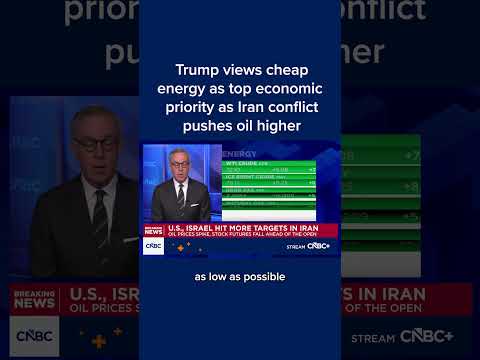
Trump views cheap energy as top economic priority as Iran conflict pushes oil higher
CNBC Television· 2026-03-02 16:15
Is anyone talking about the idea that if oil goes up big then perhaps there's inflation and if inflation comes back then we're not going to be able to cut rates. >> Yeah, it's an interesting question Jim. I mean, I can tell you that the president thinks about oil and energy as the the number one input to the economy and his entire sort of economic policy is focused on the idea of drill baby drill, getting oil prices as low as possible, lower even than some of the oil companies uh want it to go uh in order t ...
Sector ETFs to Benefit from U.S.-Iran Unrest
ZACKS· 2026-03-02 16:00
Core Insights - The United States and Israel conducted coordinated strikes on Iran aimed at dismantling its nuclear program and weakening its regime [1] - Iran's immediate retaliation and the potential for a broader regional conflict have significant implications for global oil markets [2] Military and Geopolitical Developments - Iran launched missiles targeting U.S. military assets across the Gulf, including Bahrain, the UAE, and Qatar, following failed nuclear negotiations [3] - The escalation of military actions raises concerns about increased defense spending and military readiness in the region [9] Oil Market Implications - Iran's oil production stands at approximately 3.4 million barrels per day, constituting about 4% of global oil supply, with exports primarily directed to China [4] - Oil prices are expected to rise significantly, with estimates suggesting a potential increase of $10–$20 per barrel if tensions persist [5] - The Strait of Hormuz, a critical chokepoint for global oil and LNG supplies, is under scrutiny, with risks of disruption potentially leading to higher shipping costs and energy prices [6] Investment Opportunities - Energy sector ETFs, such as the United States Brent Oil Fund LP (BNO), are positioned to benefit from rising oil prices due to geopolitical tensions [8] - Defense ETFs, like iShares US Aerospace & Defense ETF (ITA), are likely to see gains from increased military spending amid the conflict [9] - Artificial Intelligence ETFs, such as Global X Robotics & Artificial Intelligence ETF (BOTZ), may gain traction as AI becomes integral to military strategy [12] - Cybersecurity ETFs, like ETFMG Prime Cyber Security ETF (HACK), are expected to see heightened demand due to increased cyber threats during geopolitical tensions [13] - Shipping ETFs, such as Breakwave Tanker Shipping ETF (BWET), could benefit from rising freight rates due to disruptions in trade routes [14] - Gold Mining ETFs, like Themes Gold Miners ETF (AUMI), are anticipated to see increased demand as a safe-haven investment amid rising tensions [15]

Why Oil Markets Can't Shrug Off This Conflict
WSJ· 2026-03-02 15:54
Core Viewpoint - The current oil market lacks sufficient buffer to handle significant disruptions, indicating potential vulnerabilities in supply stability [1] Group 1: Industry Implications - The oil industry is facing challenges due to insufficient reserves to mitigate the impact of major supply disruptions [1] - Market dynamics suggest that any significant interruption in oil supply could lead to heightened volatility and price spikes [1] Group 2: Supply Chain Concerns - The existing supply chain infrastructure may not be equipped to absorb shocks from large-scale oil disruptions, raising concerns about overall energy security [1] - The lack of adequate cushion in the system could exacerbate the effects of geopolitical tensions or natural disasters on oil supply [1]