Chemicals

Search documents
3 Monster Dividend Stocks Yielding Up to 10.7%
Yahoo Finance· 2026-03-04 11:53
Core Viewpoint - The article discusses the risks associated with investing in ultra-high-yield dividend stocks, highlighting LyondellBasell's recent dividend cut and presenting alternative options for income investors. Group 1: LyondellBasell - LyondellBasell recently slashed its dividend in half, dropping its yield from 12.6%, which was the highest in the S&P 500, to a lower level [1][4] - The company had previously paid dividends well in excess of its earnings before the reduction, indicating a less sustainable dividend policy [5] Group 2: Conagra Brands - Conagra Brands now holds the highest dividend yield in the S&P 500 at 7.4% following LyondellBasell's cut [4] - The company expects its dividend payout ratio to be around 80% of its earnings this year, which is above its target range of 50% to 55% but more sustainable than LyondellBasell's previous practices [5] - Conagra is facing inflationary pressures that are impacting margins and demand, but it has seen positive momentum in its business and expects sales growth in the second half of its fiscal year [6] - The company has reduced its debt by over 10% in the past year, strengthening its financial position [6] Group 3: Delek Logistics Partners - Delek Logistics Partners is a master limited partnership (MLP) focused on energy midstream assets, currently offering an 8.9% distribution yield [7] - The MLP has a strong track record of paying distributions, recently extending its growth streak to 52 consecutive quarters [8] - Delek generates stable cash flows supported by long-term contracts, producing enough cash last year to cover its distribution by 1.2 times [8]
X @Bloomberg
Bloomberg· 2026-03-04 07:14
Saudi Arabia’s biggest chemical producer Sabic names Faisal Mohammed Al-Faqeer as new CEO https://t.co/moqlXqKrZV ...
Westlake: Capacity Capitulation Bottoming Out Market (Rating Downgrade)
Seeking Alpha· 2026-03-03 13:15
Group 1 - Westlake (WLK) is facing volume and pricing pressure in its performance and essential materials segment, including chlorovinyls, PVC resin, and polyethylene [2] - The company has undertaken significant supply shutdowns to improve EBITDA and respond to market conditions [2] Group 2 - The Value Lab focuses on long-only value investment ideas, targeting a portfolio yield of about 4% and has performed well over the last five years [1] - The Valkyrie Trading Society is a team of analysts that share high conviction investment ideas, aiming for non-correlated and outsized returns in the current economic environment [2]



美以伊冲突,霍尔木兹海峡告急!中国化工进口面临多少变数?
DT新材料· 2026-03-03 01:07
Core Viewpoint - The article discusses the potential impact of geopolitical tensions in the Middle East, particularly the situation in the Strait of Hormuz, on the global chemical market, highlighting the vulnerabilities of various chemical products that rely on imports from Iran and other Middle Eastern countries [3][4][5][6][7]. Group 1: Impact on Chemical Products - Methanol is highly sensitive to supply disruptions, with over 50% of its imports coming from Iran, which could lead to significant supply and price fluctuations in the domestic market [4]. - Liquefied Petroleum Gas (LPG) imports are also heavily reliant on the Middle East, with about 25% sourced from Iran, making the market vulnerable to rising costs and supply constraints if the Strait of Hormuz is affected [5]. - Ethylene Glycol faces dual pressures from rising production costs due to oil price increases and supply uncertainties from Iranian exports, leading to a moderate price elasticity [6]. - Polyethylene's direct dependency on Middle Eastern imports is relatively manageable, but prolonged disruptions could tighten supply and increase costs throughout the production chain [7]. Group 2: Historical Context and Logistics - Historical events, such as the attacks on shipping in the Red Sea, illustrate how geopolitical tensions can drastically increase logistics costs, potentially impacting the prices of chemicals more than the raw materials themselves [8]. - The article emphasizes the importance of understanding the specific vulnerabilities within the supply chain and preparing for potential disruptions, as the domestic chemical industry has been diversifying and increasing self-sufficiency [8].

TACK: Sensible Strategy Delivering Some Downside Protection, Yet Weaknesses Exist, A Hold
Seeking Alpha· 2026-03-01 04:00
Group 1 - The Fairlead Tactical Sector ETF (TACK) has outperformed the iShares Core S&P 500 ETF (IVV) this year amid capital rotation, indicating strong performance in the current market environment [1] - The focus of the analysis is on identifying underpriced equities with strong upside potential and overappreciated companies with inflated valuations, particularly in the energy sector, including oil & gas supermajors and exploration & production companies [1] - The importance of assessing Free Cash Flow and Return on Capital is emphasized to gain deeper insights into investment opportunities and avoid superficial conclusions [1] Group 2 - The analyst acknowledges that while underappreciated equities are favored, some growth stocks may justifiably hold premium valuations, necessitating a deeper investigation into market perceptions [1]

CLSE: Impressive Performance Amid Capital Rotation Reinforces Buy Rating
Seeking Alpha· 2026-02-28 03:12
Core Insights - The article emphasizes the importance of identifying underpriced equities with strong upside potential and overappreciated companies with inflated valuations in investment strategies [1] - It highlights the significance of analyzing Free Cash Flow and Return on Capital for deeper investment insights beyond simple profit and sales analysis [1] - The author acknowledges that while some growth stocks may deserve premium valuations, it is crucial for investors to investigate whether the market's current opinions are accurate [1] Industry Focus - The research primarily concentrates on the energy sector, including oil & gas supermajors, mid-cap, and small-cap exploration & production companies, as well as oilfield services firms [1] - Additionally, the analysis extends to various other industries such as mining, chemicals, and luxury goods [1]

52 Massive Vol/OI Spikes Expire March 20—Profit Plays on Top 3
Yahoo Finance· 2026-02-27 18:30
Options Activity - The put/call ratio was reported at 1.94, indicating extremely bearish sentiment with a net trade sentiment of -3,432,000, suggesting traders are either taking profits or expecting the share price to remain stable or increase slightly over the next 22 days [2] - Hewlett Packard Enterprise had the highest Vol/OI ratio at 291.16, with a trading volume of 120,075, nearly six times its 30-day average, and the March 20 $17.50 put accounted for 30% of its total options volume [3] - March 20 DTEs were popular in unusual options activity, with 52 of the top 100 Vol/OI ratios expiring in three weeks, ranging from 291.16 for Hewlett Packard Enterprise to 23.69 for Netflix [4] Company Performance - Netflix's shares increased by about 8% in pre-market trading following its decision to drop out of the race to acquire parts of Warner Bros. Discovery, which may lead to higher streaming prices for consumers [6] - Wells Fargo & Co. had a Vol/OI ratio of 56.50, with an options volume of 70,037, 1.4 times its 30-day average, and the March 20 $81 put accounted for 19% of its total options volume [7] - Wells Fargo's stock is down 12% in 2026 but has increased by 7% over the past year, with a dividend yield of 2.2%, which is significantly higher than the S&P 500's yield of 1.14% [9] Financial Metrics - Wells Fargo's efficiency ratio at the end of Q4 2025 was 64.5%, down from 68.2% a year ago, indicating improved cost management relative to revenue [11] - The bank's shares trade at a reasonable 12.5 times the Wall Street's 2026 earnings-per-share estimate of $6.92, suggesting it is a good long-term hold [11] - Over the past five years, including dividends, Wells Fargo has an annualized total return of 20.75%, with analysts rating it a Buy with a target price of $101.86, well above its current price [10]


ETF复盘资讯|“HALO交易”火爆出圈!电力ETF(159146)再涨2.64%连创上市新高!涨价题材大放异彩!有色ETF最高上探3.82%
Sou Hu Cai Jing· 2026-02-27 13:20
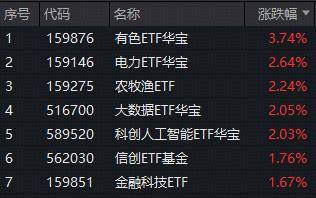
Core Viewpoint - The A-share market has shown active trading with significant focus on sectors like chemicals and non-ferrous metals, driven by price increases and strong performance in ETFs related to these sectors [1][2]. Group 1: Market Performance - The A-share market closed February with the Shanghai Composite Index achieving three consecutive monthly gains, with daily trading volumes exceeding 1 trillion yuan becoming a norm [1]. - On February 27, the total trading volume in the Shanghai, Shenzhen, and Beijing markets reached 2.51 trillion yuan, slightly down by 504 billion yuan from the previous day [1]. - Over 3,200 stocks in the market saw gains, with notable performances in small metals and rare earths, leading to a surge in stocks like Hunan Gold [1]. Group 2: Sector Highlights - The non-ferrous metals sector continued to perform strongly, with the non-ferrous ETF (159876) reaching a peak increase of 3.82% and closing up 3.74% on the day [4]. - The chemical sector benefited from rising prices, with the chemical ETF (516020) achieving four consecutive daily gains, marking its highest point since January 2022 [1][4]. - The AI sector is gaining traction, with domestic AI usage surpassing that of the US, benefiting the domestic AI industry chain, as reflected in the performance of the innovation-focused AI ETF (589520) [1]. Group 3: ETF Performance - The electric power ETF (159146) saw a significant increase of 2.64%, reaching a new high since its listing, driven by the rising demand for electricity due to AI development [2][10]. - The largest medical ETF (512170) in the market rose by 1.14%, recovering its annual line, with a net inflow of over 1.9 billion yuan in the previous three days [14][16]. - The electric power sector is viewed as a defensive investment amid the AI boom, with the electric power ETF focusing on various energy sources including thermal, hydro, wind, nuclear, and solar power [12]. Group 4: Future Outlook - Analysts suggest that the non-ferrous metals sector still has upward momentum, supported by supply disruptions and high demand, with a focus on precious, industrial, battery, and strategic metals [7]. - The medical sector is expected to recover, with growth opportunities arising from performance recovery, overseas expansion, brain-computer interfaces, and AI in healthcare [16][18].
BASF announces job cuts amid cost-saving strategy and new India hub
BusinessLine· 2026-02-27 09:19
Core Viewpoint - BASF SE is implementing significant job cuts and cost-saving measures in response to ongoing challenges in the chemicals market, with a focus on its internal IT division and overall profitability [1][2]. Group 1: Job Cuts and Cost-Saving Measures - The company is targeting significant workforce reductions in its internal IT division, which employs approximately 8,500 people [1]. - BASF has increased its annual cost savings target to €2.3 billion ($2.7 billion) by the end of this year, up from a previous target of €2.1 billion [3]. Group 2: Financial Performance and Market Conditions - BASF expects adjusted operating earnings between €6.2 billion ($7.3 billion) and €7 billion ($8.2 billion) for the year, compared to €6.6 billion ($7.8 billion) last year [1]. - The CEO indicated that 2026 will be a transitional year with significant headwinds, although a market recovery may begin in the latter part of that year [2]. Group 3: Strategic Business Adjustments - The company is streamlining its portfolio to focus on more profitable business units, having already divested its coatings division and planning to list its Agricultural Solutions business in Frankfurt by 2027 [5]. - BASF is selling 4,400 apartments it owns to concentrate on its core business and strengthen its balance sheet, a move criticized by local unions [5]. Group 4: Market Reaction - BASF shares fell by as much as 5.4% in Frankfurt, reflecting investor concerns despite previous optimism regarding economic recovery [4].

NewMarket Corporation Announces Quarterly Dividend
Businesswire· 2026-02-27 00:14
Core Viewpoint - NewMarket Corporation has declared a quarterly dividend of $3.00 per share, payable on April 1, 2026, to shareholders of record as of March 16, 2026, reflecting the company's ongoing commitment to returning value to its shareholders [1]. Company Overview - NewMarket Corporation operates through subsidiaries including Afton Chemical Corporation, Ethyl Corporation, American Pacific Corporation, and Calca Solutions, LLC, focusing on chemical additives, specialty materials for aerospace and defense, and high-purity hydrazine production [1]. - The company emphasizes a long-term commitment to safety, innovation, and improving the world [1]. Financial Performance - For the fourth quarter of 2025, NewMarket reported an income before income tax expense of $113.2 million, down from $134.2 million in the same quarter of the previous year [2]. - The full year 2025 income before income tax expense was $560.6 million, compared to $584.1 million in 2024 [2]. - Net income for the third quarter of 2025 was $100.3 million, or $10.67 per share, compared to $132.3 million, or $13.79 per share, for the same period last year [2].